

Every Family's Situation Is Different
There isn't a single solution that's right for every family. Some families benefit from keeping the home and using a financing option. Others discover that selling the home provides the financial flexibility they need to move forward. Our role is to help families understand their options so they can choose the strategy that best supports their loved one's care—not to push one solution over another.When a parent suddenly needs assisted living or memory care, families are often faced with an unexpected question: Should we borrow against the home, or should we sell it? The answer depends on your timeline, the condition of the home, and your family's overall goals. Understanding the pros and cons of a HECM, a HELOC, and a home sale can help you make the right decision with confidence.
Two things families need to know right now:
-
Speed to cash: An as-is sale can close in weeks. A HELOC draw is fast only if the borrower stays in the home and qualifies on credit and income. A HECM typically takes weeks to months just to get through HUD counseling and FHA underwriting.
-
Risk of lender action: HELOCs can be frozen or reduced by the lender at any time. A HECM line cannot be frozen once established, but it takes longer to set up and requires the senior to remain the primary resident.
Pro Tip: If placement is happening in the next 30 days, skip the loan research for now and call a placement specialist and a home-sale coordinator first. The loan decision can follow once you know the care timeline.
Table of Contents
-
How do HECM and HELOC actually compare for urgent care funding?
-
What HECMs and HELOCs really cost, and the risks families miss
-
How Divinetransitionsforseniors coordinates a fast as-is sale
-
Divinetransitionsforseniors helps Washington families move forward
How do HECM and HELOC actually compare for urgent care funding?
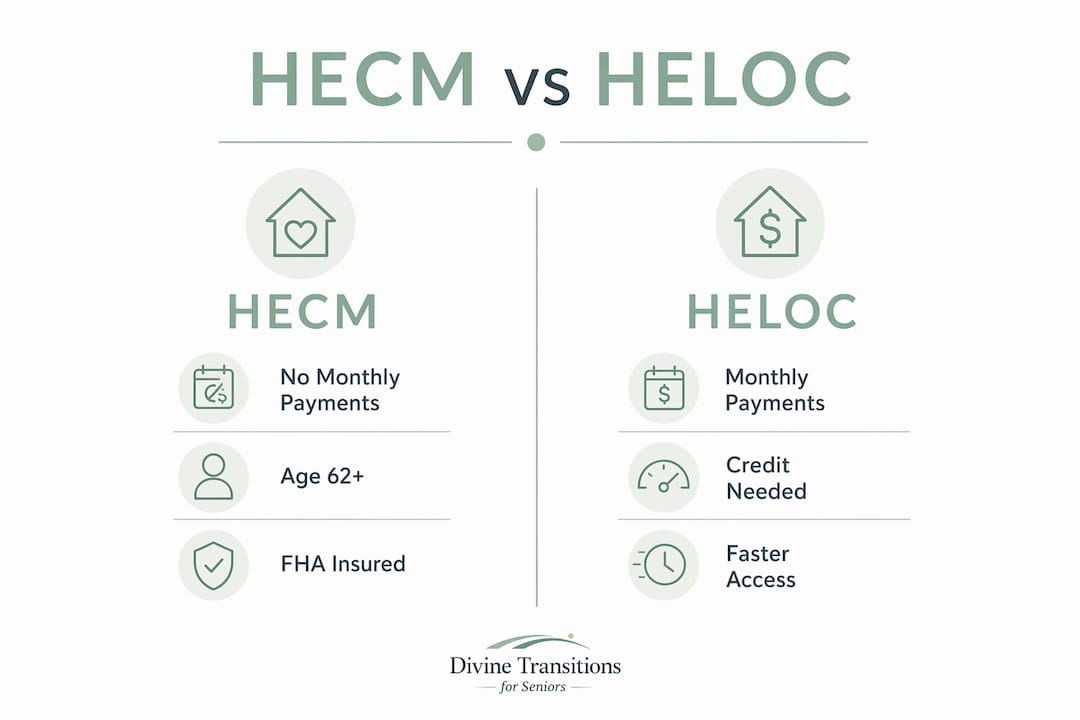
The table below maps the differences that matter most when a family is racing against a care placement deadline.
| Dimension | HECM (FHA Reverse Mortgage) | HELOC |
|---|---|---|
| Best for / timeline | Aging in place, long-term need | Short-term borrowing, borrower stays in home |
| Monthly payment required? | No required mortgage payments | Yes, interest or principal+interest |
| When loan is repaid | Sale, death, or permanent move-out | During draw/repayment period; lender can accelerate |
| Stability of access | Line cannot be frozen once established | Lender can freeze or reduce at any time |
| Upfront vs ongoing costs | Higher upfront (origination, FHA mortgage insurance, appraisal) | Lower upfront; variable rate adds ongoing cost |
| Impact on heirs/estate | Loan balance grows; heirs repay from sale proceeds (non-recourse) | Reduces equity; heirs responsible for balance |
| Eligibility requirements | Age 62+, sufficient equity, HUD counseling | Credit score 620+, verifiable income, DTI ratio |
| Time to usable funds | Weeks to months (counseling, appraisal, underwriting) | Days to weeks if already approved and home is primary residence |
Jeff Taylor, Mphasis Digital Risk (via CBS News): “HELOCs’ apparent short-term affordability masks long-term risks for seniors, including line freezes when home values drop or income changes. Seniors who depend on that line for care costs can find themselves without access precisely when they need it most.”
The HECM’s non-recourse protection is real: FHA-insured HECMs guarantee that neither the borrower nor heirs owe more than the home’s value at sale. That protection matters for estate planning, but it does not help a family that needs a placement deposit next week.
Pro Tip: HECM’s higher upfront costs look painful, but if a senior plans to stay home for years, the no-payment structure often saves more than the fees cost. The math flips completely when a permanent care move is already decided.

Which option fits your timeline?
Match your situation to the timeline bucket that fits, then follow the one-line recommendation.
-
Days to weeks (emergency placement): If care is needed quickly, it may be worth evaluating whether selling the home provides faster access to equity than financing options. For many families, an as-is sale is one option that can shorten the timeline, but the best approach depends on the home's condition, the family's goals, and the urgency of the move.
-
One to three months: A HELOC may work if the senior still lives in the home, qualifies on credit and income, and the family can carry monthly payments alongside facility fees. A bridge loan is another option. Start the HECM process only if you expect a long-term need and can wait.
-
Three or more months / long-term aging in place: A HECM becomes worth evaluating seriously. No monthly mortgage payments, a line that cannot be frozen, and FHA insurance make it a strong fit when the senior will remain home for the foreseeable future.
Who should consider each path:
-
Sell now: Parent is moving to memory care or assisted living permanently; home needs repairs; family cannot carry dual monthly costs.
-
Consider a HELOC: Parent needs short-term bridge funding, remains in the home, has steady income, and credit qualifies.
-
Consider a HECM: Parent is aging in place long-term, is 62 or older, and the family wants to eliminate monthly mortgage payments.
What HECMs and HELOCs really cost, and the risks families miss
HECM upfront costs typically include an origination fee, FHA mortgage insurance premium, appraisal, title, and closing costs. The loan balance grows over time as interest and insurance accumulate, reducing the equity available to heirs. The mandatory HUD counseling and FHA appraisal add weeks to the process, making a HECM a poor fit for emergency placements.
HELOC costs are lower upfront but carry a variable interest rate that can rise unpredictably. Monthly payments are required throughout the draw period, and the repayment phase adds principal on top of interest.
The hidden risk most families miss:
-
Monthly HELOC payments plus assisted-living fees often create unsustainable cash outflow for retirees on fixed incomes.
-
HELOCs can be frozen or reduced by the lender based on market conditions or a drop in home value, a pattern documented during the 2008 housing crisis.
-
Most HELOCs include occupancy clauses. If the homeowner moves into assisted living for more than roughly 12 consecutive months, the lender can deem the property no longer owner-occupied and freeze the line or demand full repayment.
Occupancy risk in plain terms: A family draws on a HELOC to pay for care, the senior moves to a facility, and 13 months later the lender freezes the line or calls the loan. The family now owes the full balance while still paying facility fees. This is not a rare edge case.
Before committing to a HELOC, run a full monthly outflow model: total monthly costs including the HELOC payment, facility fees, property taxes, insurance, and any home maintenance. If the number is unsustainable, the HELOC is not the right tool. Consult an elder-law attorney if Medicaid eligibility is a concern, since using home equity can affect qualification depending on how and when funds are spent.
Steps to get cash quickly and safely
First 72 hours:
-
Contact a senior placement specialist to confirm the care timeline and deposit requirements.
-
Gather the home’s title or deed, most recent mortgage statement, and property insurance documents.
-
Walk the home and note deferred maintenance, belongings that need sorting, and any major repair needs.
-
Contact Divinetransitionsforseniors for a coordinated as-is sale plan. Families pay nothing directly.
-
Get a cash or as-is offer so you have a real number to work with before evaluating loans.
First 30 days:
-
If the as-is sale timeline fits the placement deadline, proceed with the sale and use proceeds to fund care.
-
If a short bridge is needed while the sale closes, evaluate a short-term bridge loan with a lender familiar with senior transitions.
-
If the senior will remain in the home and qualifies, a HELOC draw can supplement costs during the bridge period.
-
Start HECM paperwork only if the senior is staying home long-term and the family can absorb the 4–8 week timeline.
Pro Tip: If you start a HECM and then the senior’s health changes and a permanent move becomes necessary, the HECM becomes due. Starting the process speculatively can cost thousands in fees with no benefit. Confirm the long-term plan before applying.
Questions to ask before you sign anything
For HELOC lenders:
-
What is your policy on freezing or reducing the credit line, and under what conditions has that happened?
-
Does this HELOC include an occupancy clause, and what triggers it?
-
What is the estimated time from application to first draw?
-
How will monthly payments change if the prime rate rises by two percentage points?
For HECM counselors and lenders:
-
What is the realistic timeline from HUD counseling to funded disbursement?
-
What are the total upfront costs, including FHA mortgage insurance and origination?
-
What disbursement options are available: lump sum, line of credit, monthly installments?
-
What happens to the loan if the borrower moves to a care facility within 12 months?
For as-is sale coordinators and Divinetransitionsforseniors:
-
What is the realistic net sale timeline for a home in this condition?
-
Are repairs required, or will you coordinate an as-is offer?
-
How do you coordinate the sale timeline with the placement specialist’s deposit deadline?
-
What closing costs should the family expect, and what is the estimated net to the family?
How Divine Transitions Helps Families Create a Strategy for the Family Home
When a parent needs care now and the home is the primary asset, Divine Transitions for Seniors handles the pieces families rarely have time to manage alone.
-
As-is sale coordination: Works with local real estate professionals to get cash or as-is offers quickly, without requiring repairs or staging. Many homes served have deferred maintenance or decades of belongings.
-
Belongings and downsizing support: Coordinates sorting, donation, and removal of personal property so the home is ready for sale without the family having to manage it.
-
Placement specialist liaison: Works alongside senior placement specialists so the sale timeline aligns with the care placement deadline, not against it.
-
No direct cost to families: Divine Transitions for Seniors earns referral fees from real estate and placement partners. Families pay nothing directly.
A typical coordinated as-is sale in Oregon or Washington moves from first call to a funded offer in roughly 2–6 weeks, depending on the home’s condition and local market. That timeline is faster than a HECM and comparable to a HELOC draw, without the occupancy risk or monthly payment burden. For families navigating senior home sales, having one point of contact through this process reduces both delays and mistakes.
Key Takeaways
For families facing an urgent care placement, comparing the timeline, costs, and risks of a HECM, a HELOC, and selling the home can help determine which approach best supports the move to care.
| Point | Details |
|---|---|
| Sell as-is for speed | An as-is sale typically closes in 2–6 weeks, faster than any loan option for urgent placements. |
| HELOC freeze risk is real | Lenders can freeze or reduce a HELOC at any time; occupancy clauses can trigger repayment if the senior moves out for more than roughly 12 months. |
| HECM takes weeks to months | HUD counseling, FHA appraisal, and underwriting make a HECM a poor fit for emergency funding needs. |
| Dual costs can be unsustainable | Combining HELOC monthly payments with assisted-living fees often creates cash flow families cannot sustain on fixed incomes. |
| Divinetransitionsforseniors | Coordinates as-is home sales and care placement timelines in Oregon and Washington at no direct cost to families. |
What families often get wrong about these decisions
Most families spend the first week researching HECM vs HELOC when the real question is whether a loan is the right tool at all. Both products were designed for aging in place, not for funding a permanent move to care. A HELOC assumes the borrower stays in the home, keeps making payments, and maintains a qualifying credit profile. A HECM assumes the senior will live there for years, making the upfront costs worthwhile. When neither assumption holds, both products create problems the family did not anticipate.
The families I see in the most difficult positions are the ones who drew on a HELOC to buy time, then discovered the occupancy clause six months later when the lender reviewed the account. By then, the senior is settled in a facility, the home is sitting empty, and the family owes monthly payments on a line that may be frozen anyway. Selling the home first, even quickly and as-is, eliminates that entire category of risk. It also gives the family a clean number to work with for care planning, rather than a revolving credit line that can shrink without warning.
The HECM is a genuinely good product for the right situation. But “the right situation” is a senior who wants to stay home, has enough equity, is 62 or older, and has time to complete the HUD process. That description fits a lot of seniors. It rarely fits the family who called a placement specialist last Tuesday.
Helping Oregon and Washington Families Move Forward
When the home is the biggest obstacle between your parent and the care they need, Divine Transitions for Seniors offers a practical path forward. Rather than taking on new debt with uncertain timelines, families in Oregon and Washington can request a no-cost consultation to get a realistic picture of what an as-is sale would produce and how quickly.

If you're trying to decide whether borrowing against the home or selling it is the better path, we're here to help you understand your options. Every family's timeline is different, and sometimes a simple conversation can provide the clarity needed to move forward with confidence. If you decide to work with us, we'll help coordinate the home transition, connect you with trusted professionals, and support you every step of the way.
Useful sources
Families and advisors can verify the rules, timelines, and expert commentary cited in this article through the following primary sources:
| Source | What it covers |
|---|---|
| HUD / FHA HECM program | Official HECM eligibility, counseling requirements, and FHA insurance rules |
| CBS News / Jeff Taylor | Expert commentary on HELOC freeze risk and rate outlook for seniors |
| CNBC Select | HECM timeline and as-is sale alternatives |
| Finance of America | Eligibility comparison: HECM vs HELOC |
| Brevy | HELOC occupancy clauses and care-move triggers |
| Savvy Reverse | Monthly payment and cash-flow comparison |
Who to call for personalized guidance:
-
A HUD-approved HECM counselor (required before any HECM application, and a useful free resource even if you decide not to proceed).
-
An elder-law attorney if Medicaid eligibility is a concern. Using home equity can affect qualification depending on timing and how funds are spent.
This article is general information, not legal, financial, or tax advice. Confirm current rules with HUD, a licensed lender, or a qualified elder-law attorney for your specific situation.
FAQ
Can a HELOC be used to pay for assisted living?
Yes, but only while the senior remains the primary resident of the home. If the senior moves to a facility for more than roughly 12 consecutive months, most HELOC occupancy clauses allow the lender to freeze the line or demand repayment.
How long does a HECM take to fund?
A HECM typically takes several weeks to months from application to disbursement, due to mandatory HUD counseling, an FHA appraisal, and underwriting. It is not a viable option for families who need funds within days or a few weeks.
What is the main eligibility difference between a HECM and a HELOC?
A HECM requires the borrower to be at least 62 years old and have sufficient home equity, with no income or credit score requirement. A HELOC requires a credit score of 620 or higher, verifiable income, and a qualifying debt-to-income ratio, which many retired seniors cannot meet.
Is selling the home faster than a HECM or HELOC for funding care?
For most families facing an urgent placement, yes. An as-is sale coordinated by a specialist like Divinetransitionsforseniors can close in roughly 2–6 weeks in Oregon and Washington, without the occupancy risks or monthly payment obligations that come with either loan product.
Does using a HELOC or HECM affect Medicaid eligibility?
It can. Medicaid rules vary by state, and how home equity is accessed and spent may affect qualification. Consult an elder-law attorney before drawing on either product if Medicaid is a current or future consideration.