
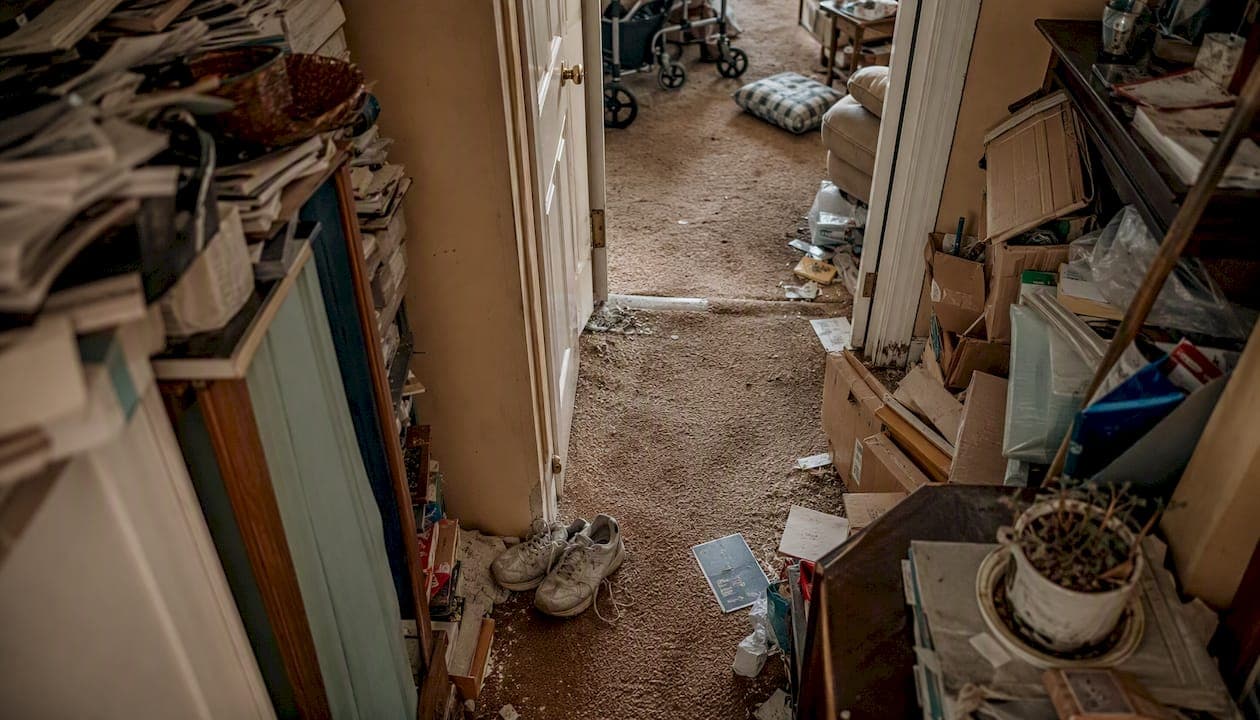
Your first move is a safety triage, not a conversation about clutter. Walk through the home, clear the exits, check for fire hazards, and decide within the hour whether you need emergency services or a planned, compassionate approach.
TL;DR:
- Clear blocked exits and remove immediate fire hazards today.
- Schedule a calm, dignity-first conversation using the scripts below.
- Match the severity to the right help: family effort, a professional organizer through NAPO, Adult Protective Services (APS), or Divinetransitionsforseniors for coordinated cleanup and home-sale support.
The International OCD Foundation and APS are your two most important outside contacts. Divinetransitionsforseniors coordinates the full picture when cleanup connects to a home sale or care placement.
Table of Contents
- What are the immediate safety hazards in a senior hoarding situation?
- How do you start a compassionate conversation about hoarding with your parent?
- What cleanup options are available for senior hoarding situations?
- How do you vet a hoarding cleanup service for a senior parent?
- How does cleanup timing connect to selling the home or funding care?
- What does long-term support look like after a cleanup?
- What is your 30/90-day action plan for a hoarding-affected home?
- How do you protect your parent's privacy and dignity during cleanup?
- Key Takeaways
- What adult children often underestimate about hoarding cleanup
- Useful resources for hoarding support and senior assistance
- FAQ
What are the immediate safety hazards in a senior hoarding situation?
Run this checklist before anything else. Speed matters here.
- Medications: Confirm your parent can reach and identify their prescriptions. Buried or expired medications are a common hazard for older adults with hoarding behavior.
When to call immediately: Dial 911 if there is an active fire risk or your parent is injured. Call APS (Oregon: 1-855-503-7233) if the home is uninhabitable and your parent cannot or will not act. Contact their primary care physician if you suspect medication mismanagement or cognitive decline.
Pro Tip: Take time-stamped photos of every hazard before touching anything. This documentation protects you legally, helps APS assess the situation accurately, and gives any professional cleanup crew a baseline to work from.
How do you start a compassionate conversation about hoarding with your parent?
The opener that works best: "I'm worried about your safety in the house, and I'd like to help you make it more comfortable." Safety concern first, help offered second. Never lead with the word "hoarding."
Two scripts to adapt
Calm check-in (no immediate crisis): "Mom, I noticed a few things when I visited that had me a little worried. I'm not here to judge anything — I just want to make sure you're safe and comfortable. Can we walk through the house together?"
Urgent safety prompt: "Dad, the path to the front door is blocked, and that scares me. If there were ever a fire, you'd need to get out fast. Can we move a few things today, just the ones near the door?"
Dos and don'ts
| Do | Don't |
|---|---|
| Express concern for their safety | Say "this place is a mess" |
| Ask permission before touching anything | Throw things away without consent |
| Listen without interrupting | Issue ultimatums on the first visit |
| Offer to help sort, not decide | Call it "hoarding" to their face |
| Acknowledge sentimental value | Rush or set aggressive timelines |
Pro Tip: Frame the work as a "safety upgrade" or "home refresh." That language reduces the perceived threat and protects your parent's dignity. Abrupt clean-outs, even well-intentioned ones, can cause lasting emotional harm.
What cleanup options are available for senior hoarding situations?
Four categories of help exist, and they are not interchangeable.
Family-led: Works for mild clutter with a cooperative parent. Slow, emotionally charged, and often stalls. Best paired with a therapist from the start.
Professional organizers (NAPO): Trained to sort, categorize, and coach without judging. NAPO's directory lists vetted members, many with senior experience. Good for moderate situations where the parent is willing. They work by the hour and do not haul debris.
Hoarding-specialty cleanup crews: Handle biohazard-level conditions, bulk removal, and disposal. Fast, but the speed can be traumatic without mental-health support running alongside. Always ask about their staged-removal policy before hiring.
Coordinated transition services: Handle cleanup, estate sorting, and home-sale timing as a single workflow. The right choice when the home needs to be sold to fund care. Divinetransitionsforseniors operates this way in Oregon and Washington.
| Approach | Senior/dementia sensitivity | Mental-health collaboration | Timeline | Estate coordination |
|---|---|---|---|---|
| Family-led | Variable | Optional | Months | No |
| NAPO organizer | High | Referral-based | Weeks–months | No |
| Specialty cleanup crew | Variable | Rarely included | Days–weeks | No |
| Coordinated transition service | High | Referral-based | Flexible | Yes |
Pro Tip: Never schedule a full clean-out without a therapist or peer counselor involved. Research on staged support programs shows that abrupt disposals frequently trigger grief responses that set back long-term progress.
How do you vet a hoarding cleanup service for a senior parent?
Ask these questions on the first call:
- Do you have written trauma-informed training protocols?
- What is your experience with seniors or clients with dementia?
- Are you licensed, bonded, and insured for biohazard work if needed?
- How do you handle sentimental items — do you sort with the client or without them?
- What is your staged-removal policy, and can we slow down if needed?
- Do you work with therapists or social workers?
- What are your disposal policies, and do you provide an itemized list?
Red flags: No written policies, pressure to sign same-day, no proof of insurance, refusal to discuss a staged timeline, or vague answers about what happens to belongings.
On payment: most families cover cleanup costs from personal funds or estate assets. Some Area Agencies on Aging offer limited grants for hazard remediation. When cleanup connects to a home sale, Divinetransitionsforseniors can help align those costs with sale proceeds so families are not paying out of pocket upfront.
How does cleanup timing connect to selling the home or funding care?
The three timelines families face most often:
| Scenario | Timeline | Cost shape |
|---|---|---|
| Immediate hazard fix only | Days | Hourly labor + disposal fees |
| Staged clean + organizer | 4–12 weeks | Organizer hourly + junk removal |
| Therapy-supported full declutter | 3–6 months | Therapy + organizer + crew |
When the goal is selling the home to fund assisted living or memory care, timing matters as much as cost. A traditional MLS listing requires repairs, staging, and showings — none of which work well in a hoarding-affected home. An as-is sale, coordinated with cleanup and estate sorting, can move faster and reduce the emotional burden on the family. See Selling Your Parents' Home to Fund Senior Care in Oregon for a detailed breakdown of that path.
Pro Tip: Before any items leave the home, photograph and label anything with potential estate value: jewelry, art, collectibles, tools, and furniture. A single overlooked item can represent thousands of dollars. This step also speeds the sale closing.
What does long-term support look like after a cleanup?
Cleanup without follow-through almost always reverses. The evidence-based approach combines three elements.
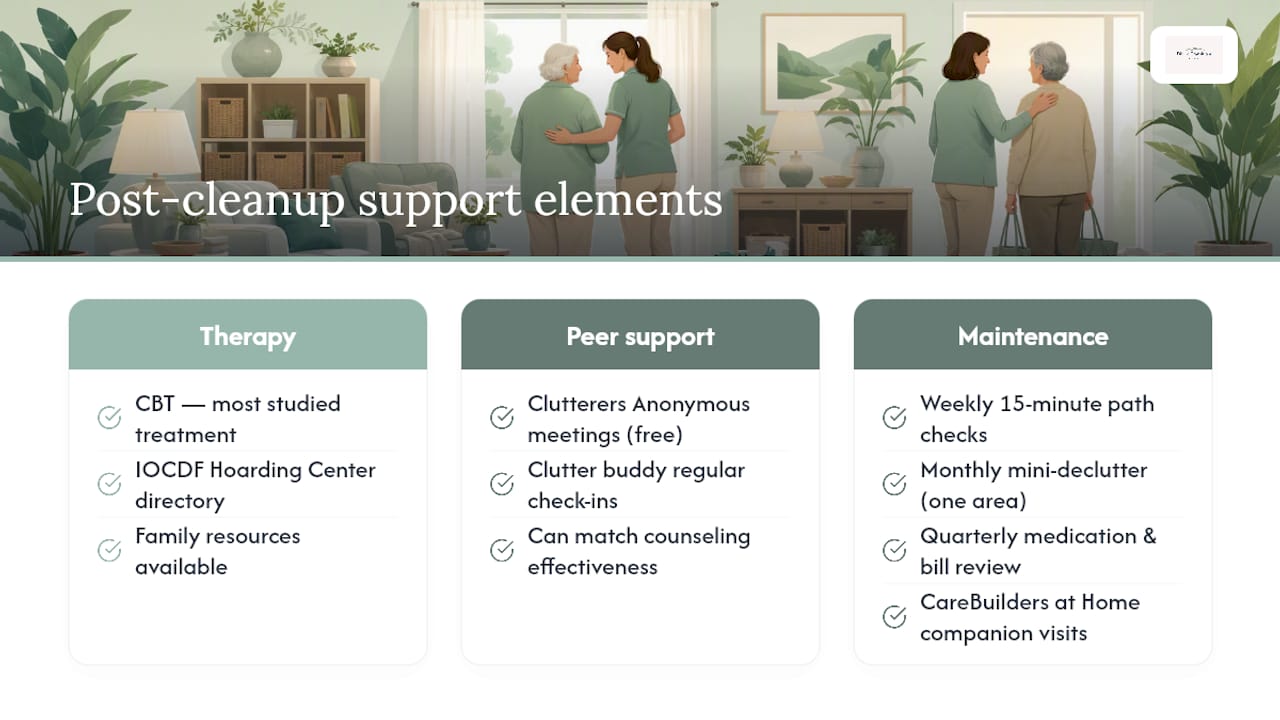
Cognitive-behavioral therapy (CBT) is the most studied treatment for hoarding disorder. The International OCD Foundation's Hoarding Center maintains a therapist directory and family resources. Clutterers Anonymous offers free peer support meetings, and "clutter buddy" relationships, where two people check in regularly, can be as effective as clinical counseling for maintaining progress over time.
A simple maintenance plan: weekly 15-minute path checks, a monthly mini-declutter of one area, and a quarterly medication and bill review. In-home companion services can support these routines. CareBuilders at Home offers senior companion and care services that can include light organizational support as part of regular visits.
APS case managers can stay involved after a crisis is resolved, connecting your parent to community programs and monitoring housing stability. That ongoing relationship is often what keeps a senior housed long-term.
Pro Tip: Schedule the first post-cleanup check-in before you leave the house on cleanup day. A date on the calendar is the single most effective relapse-prevention tool.
What is your 30/90-day action plan for a hoarding-affected home?
Days 1–30
- Complete the safety triage checklist (exits, fire, medications, pests).
- Document hazards with photos and share with APS or a professional if needed.
- Have the first compassionate conversation using the scripts above.
- Call a NAPO organizer or APS based on severity level.
- Photograph and label high-value items before any removal begins.
- Schedule a therapy intake appointment or Clutterers Anonymous meeting.
Days 31–90
- Begin staged clean-outs with the organizer or cleanup crew.
- Confirm therapy or peer support is active and scheduled regularly.
- Make the home-sale decision: traditional listing, as-is sale, or hold.
- If selling, contact Divinetransitionsforseniors to coordinate cleanup, estate sorting, and sale timing as a single process.
- Connect with a senior placement specialist if assisted living is the next step.
When you call Divinetransitionsforseniors, have these ready: the address, a rough description of the home's condition, the care decision timeline, and any known estate or legal complications.
How do you protect your parent's privacy and dignity during cleanup?
Dignity is not a soft concern. It is a practical one. A senior who feels humiliated or violated during cleanup will resist future help, sometimes permanently.
Concrete steps that protect both:
- Work with the senior present whenever possible, even if progress is slower.
- Never share photos of the home's condition on social media or with extended family without explicit permission.
- Use a shredder on-site for personal documents rather than bagging them for later.
- Ask before discarding anything, even items that appear worthless.
- Brief every person entering the home (crew members, family, organizers) on respectful language and behavior before they walk in.
Privacy also has a legal dimension. If APS is involved, your parent retains rights to refuse services unless a court has determined they lack capacity. Understanding that boundary prevents confrontations that damage trust.
Key Takeaways
Hoarding cleanup for seniors requires a safety-first triage, a compassionate conversation, and a severity-matched response that pairs cleanup with mental-health support and, when needed, home-sale coordination.
| Point | Details |
|---|---|
| Safety triage comes first | Clear exits and remove fire hazards before any conversation about cleanup begins. |
| Match help to severity | Mild situations need an organizer; moderate needs therapy too; severe requires APS and a professional crew. |
| Staged support prevents relapse | Programs combining peer counseling, CBT, and staged clean-outs kept most participants housed in documented pilots. |
| Dignity protects progress | Abrupt clean-outs without consent cause emotional harm and often reverse gains; always work with the senior present. |
| Divinetransitionsforseniors coordinates the full picture | For Oregon families needing cleanup, estate sorting, and a home sale aligned to fund care, Divinetransitionsforseniors handles all three. |
What adult children often underestimate about hoarding cleanup
Most families walk into this expecting a logistics problem. It is not. The clutter is a symptom, and the cleanup is only sustainable when the underlying behavior gets addressed at the same time. I have seen families spend weeks clearing a home, only to watch it return to the same state within a year because no one addressed the emotional drivers.
The other thing families underestimate is how much the home sale decision affects the cleanup timeline. When there is no urgency around the property, cleanup can stretch indefinitely. When the family knows the home needs to sell to fund care, that deadline creates structure. It is not a comfortable kind of pressure, but it is often the thing that finally moves a situation forward. The families who do best are the ones who treat cleanup, care placement, and the home sale as a single coordinated decision, not three separate problems.
Useful resources for hoarding support and senior assistance
| Resource | What it helps with | Contact |
|---|---|---|
| International OCD Foundation | Therapist directory, CBT resources, family guides for hoarding disorder | iocdf.org |
| NAPO (via Fairfax County resource) | Vetted professional organizers searchable by location | napo.net |
| Adult Protective Services (Oregon) | Crisis intervention, welfare checks, consent-based clean-outs | 1-855-503-7233 |
| Clutterers Anonymous | Free peer support meetings and clutter buddy matching | clutterersanonymous.net |
| Legal Assistance to the Elderly | Eviction defense, reasonable accommodation filings, guardianship advice | Contact Oregon Legal Aid |
| Benjamin Rose Institute | Caregiver safety guides and hazard inspection checklists | benrose.org |
Save this page and call the resource that matches your severity level today.
FAQ
What is the first step in hoarding cleanup for a senior parent?
Clear blocked exits and remove immediate fire hazards first, then document what you find with photos. Safety triage comes before any conversation about long-term cleanup.
When should I call Adult Protective Services for a hoarding situation?
Call APS when the home is uninhabitable, your parent cannot or will not address dangerous conditions, or you believe they lack the cognitive capacity to make safe decisions. In Oregon, APS can be reached at 1-855-503-7233.
How long does senior hoarding cleanup typically take?
Immediate hazard fixes take days; a staged clean-out with an organizer typically runs 4–12 weeks; therapy-supported full decluttering can take 3–6 months, depending on severity and the senior's willingness to participate.
Can the home be sold as-is after a hoarding cleanup?
Yes. An as-is sale, coordinated with cleanup and estate sorting, is often the fastest path to accessing home equity for care costs. Divinetransitionsforseniors specializes in aligning those timelines for Oregon families.
Does homeowner's insurance cover hoarding cleanup costs?
Standard policies generally do not cover cleanup as a standalone service. Coverage may apply if a specific insured event, such as fire or water damage, caused or worsened the conditions. Check with your insurer before assuming either way.