

One of the most common questions families ask is whether a parent has to sell their home before moving into assisted living or memory care. The answer is: not always. Depending on your timeline, financial situation, and the condition of the home, there may be several options available. Understanding those options can help you make the best decision without delaying the care your loved one needs.
When a contingency can work:
-
The home you’re buying has been sitting on the market with few competing offers
-
Your parent’s home is already listed or under contract before you make the offer
-
The seller is not in a hurry and agrees to a kick-out clause as a compromise
When it usually fails:
-
You’re in a seller’s market with multiple competing offers
-
Your parent’s home needs repairs, is full of belongings, or hasn’t been maintained
-
The care placement can’t wait 30–60 days for a contingency window to run
Right now, do two things: Call a senior transition coordinator and a real estate attorney before you sign anything. Gather the mortgage statement, title documents, and any power of attorney paperwork.
Pro Tip: If a care facility has offered a placement and you need to commit within days, skip the contingency entirely and explore bridge financing or an as-is cash sale instead.
Table of Contents
-
How Divinetransitionsforseniors coordinates sales and placement when families can’t wait
-
Financing options specific to assisted living and memory care
-
How to negotiate a contingency effectively in a seller’s market
-
Divinetransitionsforseniors is ready to help Oregon and Washington families
What is a home sale contingency and how does it work?
A home sale contingency is a clause in a purchase agreement that makes the buyer’s purchase conditional on selling their current home first. If the sale doesn’t happen within the agreed window, the buyer can walk away and get their earnest money back.

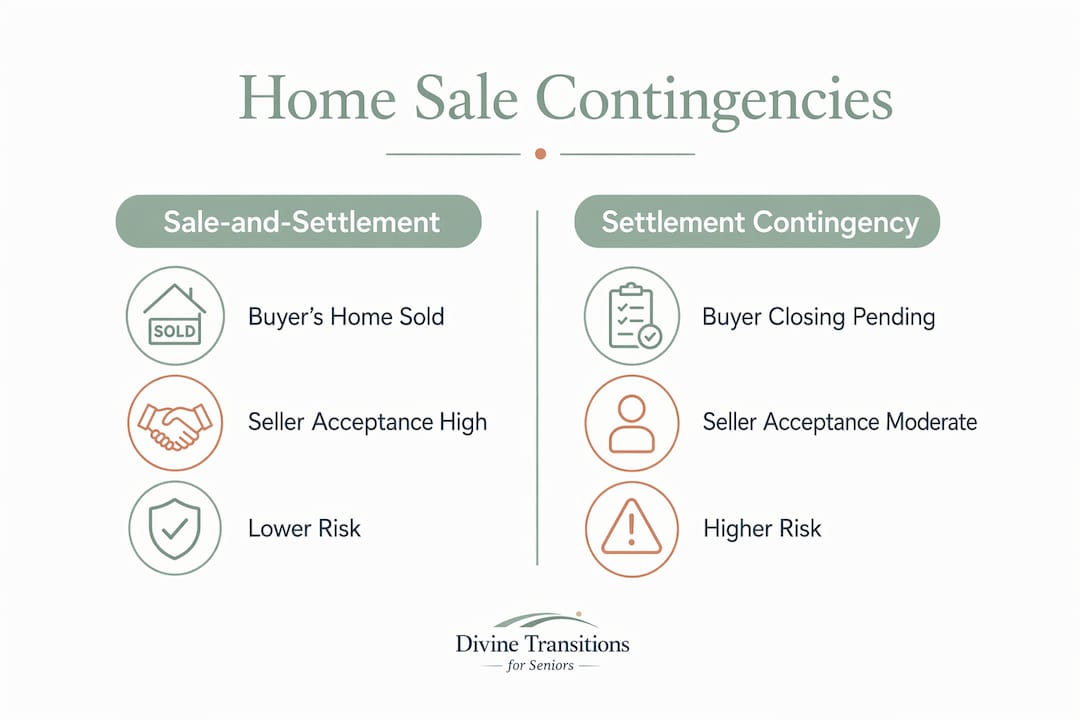
Two versions exist in practice:
The difference matters enormously for timing. A settlement contingency is far less risky for the seller and far more likely to be accepted.
| Contingency Type | Buyer’s home status | Typical seller acceptance | Risk level |
|---|---|---|---|
| Sale-and-settlement | Not yet listed | Low in competitive markets | High |
| Settlement | Already under contract | Moderate | Lower |
Deadlines in these contracts are calendar-based — or should be. Vague language like “within 45 days” invites disputes. A well-drafted clause specifies an exact date and time, such as “by 5:00 PM on a specific calendar date,” along with a clear notice procedure if a kick-out clause is triggered.
How a contingency changes your offer in a seller’s market
Sellers treat contingent offers as second-tier. That’s not an opinion — it’s how most listing agents advise their clients. Contingent offers are often seen as weaker because they introduce timing uncertainty and the possibility the deal collapses entirely.
Pros for the buyer:
-
No risk of carrying two mortgages simultaneously
-
Earnest money is protected if the contingency isn’t met
-
Buys time to sell without interim financing costs
Cons for the buyer:
-
Offer is less competitive against non-contingent bids
-
Seller may add a kick-out clause that forces a fast decision
-
Closing timeline is unpredictable, which is a serious problem when a care placement is waiting
Common seller responses:
-
Accept with a kick-out clause, allowing them to keep showing the home and requiring you to remove the contingency within 24–72 hours if a better offer arrives
-
Counter with a shorter contingency window (21–30 days instead of 60)
-
Request a higher earnest money deposit to offset their risk
-
Reject the offer outright and wait for a cleaner bid
In a hot market, scenario four is the most common outcome. Washington’s real estate market has remained competitive in many areas, and sellers in desirable neighborhoods rarely need to accept contingent terms.
Legal and timing risks families must know
Contingencies are legally binding contract clauses, and small errors in wording or timing can cost a family their earnest money or force a rushed, undervalued sale.
The specific risks to watch:
-
Ambiguous timeframes: Phrases like “within 45 days” without a calendar date create disputes about when the clock started
-
Kick-out windows: A 24–72 hour notice period is standard, but families in crisis may not be monitoring their email or phone closely enough to respond in time
-
Lender deadlines: Financing contingencies typically align with 30–45 day closing windows; if your parent’s home sale slips, your financing approval may expire
-
Earnest money language: Without explicit language stating the deposit is refundable if the contingency isn’t met, the seller may have grounds to keep it
Questions to ask a real estate attorney before signing:
-
Does the contract specify an exact calendar date and time for the contingency deadline?
-
What is the exact notice procedure if the seller triggers the kick-out clause?
-
Is the earnest money explicitly stated as refundable?
-
Does the contract auto-extend, or does it void automatically at expiration?
A recent survey found that 23% of buyers included a home sale contingency in their offer. That’s a significant share of transactions, and the legal exposure is real for every one of them.
Pro Tip: Use a caregiver tracking tool like Care Chronicle to log contract dates, notice deadlines, and kick-out windows alongside medical appointments and care decisions. One missed date can cost thousands.
Faster, safer alternatives to a home sale contingency
For most families funding assisted living or memory care, the goal is speed and certainty, not contingency protection. These alternatives de-link the purchase from the sale and give families more control.
-
Bridge loan: Short-term financing that covers the gap between buying and selling. Rates typically run 7%–12%, and funds can be available within days of approval. Best for families who need to move a parent quickly and can absorb short-term interest costs.
-
HELOC: A home equity line of credit against the parent’s existing home. Slower to set up (2–6 weeks typically), but lower cost than a bridge loan. Works well when the move isn’t immediate and the home has significant equity.
-
As-is cash sale: Selling the parent’s home directly to a cash buyer or through a senior-focused real estate coordinator. Fastest path to liquid funds, though the sale price will reflect the as-is condition. Often the right call when the home needs repairs or is full of belongings.
-
Sell first, then rent short-term: The parent’s home sells on the open market at full value; the family rents a short-term apartment or uses respite care while the new placement is finalized. Maximizes proceeds but requires a temporary housing plan.
-
Reverse mortgage: Available only to homeowners 62 and older who still live in the home. Not useful once a parent has moved to memory care, and the loan becomes due when the home is vacated.
| Option | Typical time to funds | Primary cost | Best for |
|---|---|---|---|
| Bridge loan | Days to 2 weeks | 7%–12% interest | Urgent placements |
| HELOC | 2–6 weeks | Lower interest, setup fees | Non-emergency moves |
| As-is cash sale | 1–3 weeks | Price concession vs. market | Homes needing repairs |
| Sell first, rent | 30–60 days | Temporary housing cost | Maximizing sale price |
Step-by-step checklist for families who need funds quickly
The fastest safe path combines an as-is sale or bridge financing with concurrent placement steps, so the home sale and care move happen in parallel rather than sequentially.
Days 1–7:
-
Confirm power of attorney is in place and current
-
Gather mortgage statement, title documents, and homeowner’s insurance
-
Contact a senior transition coordinator and a real estate attorney
-
Get a preliminary home valuation (as-is and repaired estimates)
Days 8–14:
-
Consult with a lender about bridge loan or HELOC eligibility
-
Begin sorting belongings with a downsizing coordinator
-
Confirm care placement timeline with the assisted living or memory care facility
Days 15–30:
-
List the home or accept a cash offer, depending on timeline pressure
-
Coordinate closing date with care move-in date
-
Confirm earnest money protections are explicit in any purchase contract
| Milestone | Target date | Expected outcome |
|---|---|---|
| Documents gathered | Day 7 | Ready for attorney and lender review |
| Financing option confirmed | Day 14 | Bridge loan or HELOC in process |
| Home listed or offer accepted | Day 21 | Sale timeline established |
| Closing and move-in aligned | Day 30 | Funds available for care placement |
How Divine Transitions Helps Families Coordinate the Home Transition
Divine Transitions for Seniors provides one trusted point of contact for Oregon and Washington families who need to sell a home and place a loved one in care at the same time, at no direct cost to the family.
What the coordination covers:
-
Connecting families with experienced local real estate agents who specialize in senior home sales and as-is transactions
-
Coordinating belongings sorting, downsizing, and estate management so the home is ready to sell without months of preparation
-
Aligning the home sale closing date with the care facility move-in date to avoid gaps in funding
-
Connecting families with senior placement specialists for assisted living and memory care options
Families who reach out early — even before a crisis — have the most options. Those who call after a placement deadline has already been set are working against the clock, but Divinetransitionsforseniors has experience in both situations.
Financing options specific to assisted living and memory care
Assisted living costs in Washington vary by facility and level of care, and memory care typically runs higher than standard assisted living. The financing approach should match the urgency and the home’s condition.
Bridge loans work well when placement is immediate and the home has equity. The loan covers the first months of care while the home sells. The cost is real — interest rates in the 7%–12% range add up quickly — but the alternative of losing a placement spot or delaying care is often worse.
HELOCs are better suited to planned transitions. If a family has a few weeks before placement is required, a HELOC against the parent’s home can fund the deposit and first month’s fees at a lower cost than a bridge loan. The risk: if the parent’s health declines faster than expected, the HELOC setup timeline may not be fast enough.
As-is cash sales are the most common path for homes that need significant repairs or have years of accumulated belongings. The sale price will be below market value, but the speed and certainty often outweigh the concession. Families should get at least two offers and have a real estate attorney review the terms.
Veterans benefits (Aid and Attendance) and Medicaid are longer-term options that require advance planning and eligibility review. They are not fast sources of funds for an immediate placement but can reduce ongoing care costs once established.
How to negotiate a contingency effectively in a seller’s market
If a contingency is genuinely the right tool for your situation, how you present it matters as much as the terms themselves.
Start with your home already listed. Sellers are far more likely to accept a contingent offer when the buyer’s home is already on the market or under contract. Listing first demonstrates commitment and reduces the seller’s perceived risk.
Offer a shorter window. A 30-day contingency is more attractive than 60 days. If your parent’s home is priced right and in a reasonable condition, 30 days is achievable in most Washington markets.
Agree to a kick-out clause upfront. Proposing the kick-out clause yourself signals good faith and removes one of the seller’s main objections. Make sure the notice period is written as a specific number of hours (48 or 72), not “a reasonable time.”
Increase the earnest money deposit. A larger deposit signals financial strength and reduces the seller’s concern that you’ll walk away. Confirm with your attorney that the refund language is explicit before you increase the amount.
Communicate through agents, not around them. In a competitive market, your agent’s relationship with the listing agent can influence how a contingent offer is received. A well-presented offer with a clear explanation of your timeline and financial position is more persuasive than a bare contract.
Key Takeaways
A home sale contingency rarely works as a reliable funding mechanism for families facing urgent senior care placements — faster alternatives like bridge loans and as-is sales give families more control with less legal risk.
| Point | Details |
|---|---|
| Contingency limitations | A 30–60 day window and kick-out clauses make contingencies unreliable for urgent care timelines. |
| Top alternative | An as-is cash sale or bridge loan delivers funds in days to weeks without contingency risk. |
| Legal review is required | Calendar-based deadlines and explicit earnest money language must be confirmed by an attorney before signing. |
| Start both processes at once | Coordinating the home sale and care placement in parallel prevents funding gaps and lost placement spots. |
| Divinetransitionsforseniors | Coordinates as-is sales, downsizing, and placement for Oregon and Washington families at no direct cost. |
A senior transition advisor’s perspective
The families I see struggle most are the ones who believed the contingency would protect them, only to find themselves scrambling when a kick-out notice arrived and their parent’s home wasn’t ready to sell. The contingency clause is a legal tool, not a care funding strategy.
What actually works is treating the home sale and the care placement as one coordinated project from day one. That means calling a transition coordinator and a real estate attorney before you call the care facility back. It means knowing your financing options before you need them. The emotional weight of these decisions is real, and having one person who can hold the whole picture together makes a measurable difference in outcomes.
Divinetransitionsforseniors is ready to help Oregon and Washington families
When a parent needs care and the home needs to sell, most families are managing both for the first time, under pressure, with no roadmap. Divine Transitions for Seniors coordinates the entire process for Oregon and Washington families at no direct charge, connecting you with experienced local real estate professionals, senior placement specialists, and downsizing support so nothing falls through the cracks.

Before your first call, have these ready: the property address, a rough sense of the home’s condition, any existing mortgage balance, and the care facility’s placement timeline. That’s enough to get started.
Reach out to Divinetransitionsforseniors today to begin coordinating the sale and placement timeline.
Useful resources for U.S. families
-
What Are Real Estate Contingencies? — Zillow: Clear overview of all contingency types, including home sale and kick-out clauses, with plain-language explanations.
-
Consumer Guide: Real Estate Contract Contingencies — NAR: The National Association of Realtors’ consumer-facing guide to contingency clauses and attorney review recommendations.
-
Home Sale Contingency: How It Works — LegalClarity: Detailed legal analysis of contingency language, calendar-based deadlines, and kick-out clause timing.
-
Understanding Contingencies — Freddie Mac: Explains how contingencies interact with lender timelines and financing approval windows.
-
How to Buy a House Contingent on Selling Yours — Zillow: Covers bridge loans, HELOCs, and selling-first strategies with practical cost comparisons.
-
Senior Transition resources — Divinetransitionsforseniors: Checklists and process guides for families coordinating home sales and care placements in Oregon and Washington.
-
Memory Care funding guidance — Divinetransitionsforseniors: Articles on memory care placement timelines and how home sale proceeds fund ongoing care costs.
This article is general information, not legal or financial advice. Consult a licensed real estate attorney and a qualified financial advisor for guidance specific to your situation and Washington state contract law.
FAQ
What is a home sale contingency in simple terms?
A home sale contingency is a clause in a purchase contract that lets the buyer cancel the deal and recover their earnest money if their current home doesn’t sell within a set timeframe, usually 30 to 60 days.
Can a seller reject a contingent offer?
Yes. Sellers can reject, counter, or accept a contingent offer, and in competitive markets most sellers prefer non-contingent bids. Sellers who do accept often add a kick-out clause requiring the buyer to remove the contingency within 24–72 hours if a better offer arrives.
What happens to earnest money if the contingency isn’t met?
If the contract explicitly states the earnest money is refundable when the contingency isn’t satisfied, the buyer gets it back. Without that language, the seller may have grounds to keep the deposit, which is why attorney review of contract terms is strongly recommended.
What is the fastest way to fund assisted living without a contingency?
A bridge loan or an as-is cash sale are typically the fastest options, with funds available in days to a few weeks. Divinetransitionsforseniors coordinates as-is sales and connects Oregon and Washington families with senior placement specialists to align the sale and care timelines.
How can Divinetransitionsforseniors help when time is short?
Divinetransitionsforseniors coordinates the home sale, belongings management, and care placement as one process for Oregon and Washington families, at no direct cost. Families can reach out with just the property address, a sense of the home’s condition, and the care facility’s timeline to get started.