

When a parent suddenly needs assisted living or memory care, one of the first questions families ask is, "How are we going to pay for this?" For many families, the answer isn't found in a savings account—it's in the family home. The challenge isn't simply selling the home. It's determining the right strategy to access that equity in a way that fits your family's timeline, financial goals, and the condition of the property.
One of the biggest misconceptions is that every family should sell the home immediately—or that every home should be listed on the traditional market.
The truth is, every family's situation is different.
Questions like these matter:
-
How quickly is care needed?
-
What condition is the home in?
-
Is there time to make repairs?
-
Does the family want to maximize price or minimize time?
-
Are there other funding sources available?
The right strategy is the one that best supports your loved one's care while aligning with your family's goals.
Table of Contents
-
Home-equity tools that let you access cash without selling right away
-
When time is short: rapid home-sale strategies that actually work
-
Divinetransitionsforseniors: coordinated help when the home is the bottleneck
How most families actually pay for assisted living
Most families use a mix of private pay and targeted public benefits, and the house is usually the single largest source of funds. No single bucket covers everything, which is why treating assets as a portfolio — layering sources strategically — is what financial planners and elder-care advisors consistently recommend.
Private-pay sources
-
Savings and checking accounts: Fastest to access, no eligibility hurdles. Deplete quickly at typical facility rates.
-
Retirement accounts (IRA, 401k): Accessible but withdrawals are taxable income; early withdrawals before age 59½ carry a 10% penalty on top of ordinary income tax.
-
Social Security and pensions: Reliable monthly income that can offset a portion of the monthly fee immediately.
-
Retirement income streams (annuities, investment dividends): Useful for ongoing costs but rarely large enough to cover the full monthly rate alone.
Insurance and policy-based sources
-
Long-term care insurance: Pays a daily or monthly benefit once the insured meets the policy’s benefit triggers, typically needing help with two or more activities of daily living (ADLs). Most policies have an elimination period (commonly 30–90 days) before benefits begin, so plan for a gap.
-
Life insurance conversions: Some policies allow an accelerated death benefit or can be sold via a life settlement for a lump sum. Worth checking before assuming a policy has no living value.
Public programs
-
Medicare: Does not cover assisted living room and board or ongoing custodial care. Its role is narrow — limited medically necessary services.
-
Medicaid: Covers care-related services through Home and Community-Based Services (HCBS) waivers in many states, but generally not room and board in assisted living. Means-tested; eligibility and covered services vary significantly by state.
-
VA Aid & Attendance: An unrestricted monthly cash benefit available to wartime veterans and surviving spouses who meet service and medical criteria. Often overlooked, and it can stack with other benefits.
Pro Tip: Before assuming a parent doesn’t qualify for VA Aid & Attendance, check the VA’s basic eligibility criteria at va.gov. Many families discover eligibility only after months of paying out of pocket.
Selling vs. keeping the home: what to expect and when
Selling usually produces the largest immediate cash, but timing and home condition determine whether a traditional listing or an as-is sale makes more sense. An as-is coordinated sale compresses the timeline at a somewhat lower net price; a traditional MLS sale takes longer but often yields more net proceeds when the home is in reasonable condition.

| Route | Time to Cash | Relative Net Proceeds | Upfront Costs | Best Fit |
|---|---|---|---|---|
| Traditional MLS listing | 2–4+ months | Highest | Repairs, staging, agent commissions | Move-in ready or light-prep homes |
| Coordinated as-is sale | 2–6 weeks | Moderate | Minimal | Needs repairs, full of belongings, urgent timeline |
| Rent the home | Ongoing monthly | Lower (spread over time) | Landlord prep, property management | Family wants to preserve asset; no immediate lump-sum need |
| Estate sale / auction | 4 weeks | Variable | Auction fees | Primarily for personal property; rarely the primary funding source |
Selling options — pros and cons
-
Traditional MLS: Higher net proceeds, but repairs, staging, and market time eat into the timeline. If the home needs significant work, carrying costs (mortgage, taxes, utilities, insurance) accumulate while the family is also paying facility fees.
-
As-is coordinated sale: Lower net price, but cash arrives faster and the family avoids repair costs and months of carrying costs. For homes full of decades of belongings or deferred maintenance, this is often the practical choice.
-
Renting: Preserves the asset but adds landlord complexity and does not produce a lump sum. Rental income is taxable, and property management fees reduce the net benefit.
Tax note: When a parent sells a primary residence, the IRS allows a capital gains exclusion of up to $250,000 for a single filer (or $500,000 for a married couple) on the gain, provided the home was the primary residence for at least two of the five years before the sale. Consult a tax professional for your specific situation — this is general guidance, not tax advice.
Pro Tip: A coordinated as-is sale paired with a professional declutter can shave four to eight weeks off the timeline compared to a traditional listing, and it eliminates the carrying costs that quietly drain proceeds during a long market period. For homes with decades of belongings, that time savings often matters more than the price difference.
Home-equity tools that let you access cash without selling right away
These tools can unlock cash faster than a full sale, but they carry long-term costs and eligibility effects that matter for Medicaid planning and estate outcomes.

Reverse mortgage (HECM)
A Home Equity Conversion Mortgage lets homeowners 62 and older borrow against home equity with no monthly payments required. The loan becomes due when the homeowner permanently leaves the home — including a permanent move to assisted living. Interest and fees accumulate over time, and the growing loan balance reduces what heirs ultimately receive. Speed to funds: typically four to eight weeks for origination.
Warning: If the parent moves permanently to assisted living, the HECM lender can call the loan due within 12 months. That often forces a sale under time pressure — the opposite of what families intend when they choose this route.
HELOC (Home Equity Line of Credit)
A revolving credit line secured by the home. Requires a credit check, income verification, and an appraisal. Underwriting typically takes four to eight weeks. Monthly interest payments are required during the draw period. If the parent has limited income or credit history, approval can be difficult. Proceeds are generally countable assets for Medicaid purposes until spent on care.
Bridge loan
A short-term loan (typically three to twelve months) designed to cover immediate costs until a home sale closes. Faster to fund than a HELOC, but interest rates are higher. Best used when a sale is already in motion and the family needs to cover the first one to three months of facility costs before proceeds arrive.
Short-term personal loan or family loan
A personal loan from a bank or credit union, or an informal loan from a family member, can cover the gap in days. Family loans should be documented in writing to avoid Medicaid gifting issues. High-cost lenders (payday-style or predatory bridge products) should be avoided entirely.
How each option affects Medicaid and estate recovery
-
Loan proceeds are typically countable assets until spent on care or legitimate expenses.
-
Spending loan proceeds on care costs reduces countable assets, which can help with Medicaid spend-down.
-
Estate recovery programs in most states can claim against the estate for Medicaid costs paid; a lien on the home may exist even after a sale.
-
Consult an elder law attorney before taking out any loan if Medicaid eligibility is a near-term goal.
What Medicaid, Medicare, and VA benefits actually cover
The short answer: Medicare does not cover assisted living room and board or ongoing custodial care. Medicaid often covers care-related services through HCBS waivers but usually not room and board. VA Aid & Attendance provides unrestricted monthly cash that can offset costs significantly.
Medicaid
Medicaid is the nation’s primary payer for long-term care services, but its role in assisted living is more limited than most families expect. Coverage and eligibility vary widely by state. Key concepts:
-
Means-tested: Income and asset limits apply; rules differ by state.
-
HCBS waivers: Many states offer Home and Community-Based Services waivers that pay for personal care, medication management, and other services in assisted living settings — but not room and board.
-
5-year look-back: Medicaid reviews asset transfers made in the five years before application. Gifts or transfers during that window can trigger penalty periods that delay eligibility.
-
Spend-down: In most states, a person must spend down assets to the state’s resource limit before qualifying. An elder law attorney can help structure this legally and efficiently.
-
Estate recovery: States are required to seek reimbursement from the estate for Medicaid costs paid after age 55. This can affect what heirs receive from a home sale.
Medicaid’s HCBS waiver programs vary so significantly from state to state that what covers care in one state may not exist in another. Oregon and Washington each have their own waiver structures, waitlists, and eligibility rules. Get state-specific guidance before counting on Medicaid as a near-term funding source.
Medicare
Medicare covers hospital stays, skilled nursing facility care (short-term, post-hospitalization), some home health care, and hospice. It does not cover assisted living room and board or long-term custodial care. Families sometimes assume a hospital stay will trigger Medicare coverage for assisted living — it does not.
VA Aid & Attendance
VA Aid & Attendance provides a monthly cash pension supplement for wartime veterans and surviving spouses who need help with daily activities. It does not directly pay the facility, but the unrestricted cash can be applied to room and board. Basic eligibility requires wartime service, a medical need for assistance, and income/asset limits. It can stack with Medicaid in some states. Apply through the VA or a VA-accredited claims agent.
Pro Tip: State Health Insurance Assistance Programs (SHIP) offer free, unbiased counseling on Medicare, Medicaid, and VA benefits. Find your state’s SHIP through eldercare.acl.gov — it costs nothing and can clarify eligibility faster than most online searches.
A practical funding timeline: matching cash to costs
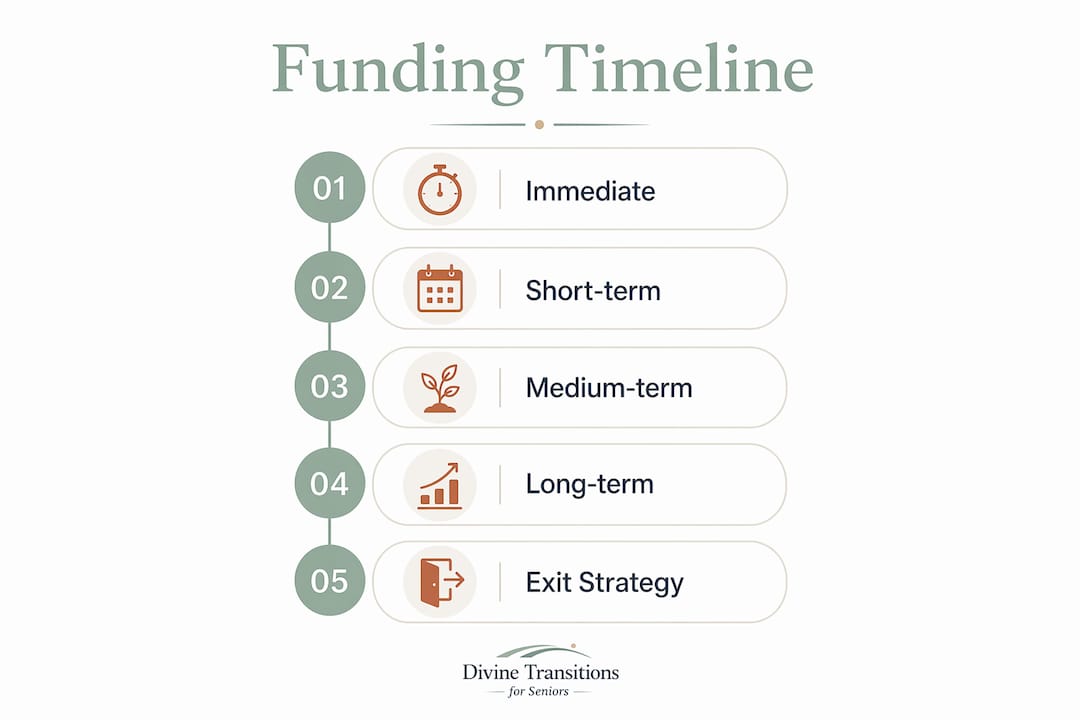
Assemble a short-term liquidity plan for immediate move-in first, then build a parallel medium-term plan to convert home equity or transition to public benefits as needed.
Simple budgeting worksheet
| Item | Monthly Amount |
|---|---|
| Facility monthly rate | $_______ |
| Community / move-in fee (one-time) | $_______ |
| Social Security income | $_______ |
| Pension income | $_______ |
| LTC insurance benefit (if active) | $_______ |
| VA Aid & Attendance (if eligible) | $_______ |
| Monthly gap to cover | $_______ |
The gap is what home equity, savings, or other sources must fill each month.
Step-by-step timeline
-
Days 0–7: Confirm the facility’s monthly rate, deposit, and community fee. Identify all liquid cash (savings, checking, money market). Determine if LTC insurance is in force and whether the elimination period has started.
-
Week 1–4: Triage the home — get a same-day value estimate, assess repair needs and belongings volume, and decide between a traditional listing and an as-is sale. File a VA Aid & Attendance claim if eligible (processing takes several months, so start early). Notify the LTC insurer to begin the claims process.
-
Month 1–3: Close the home sale or complete HELOC/bridge loan funding. Apply sale proceeds to the monthly gap. Begin Medicaid eligibility assessment with an elder law attorney if assets are depleting.
-
Month 3–6: Transition to Medicaid if applicable, once assets reach the state’s resource limit and the spend-down is complete. Confirm estate recovery implications with the attorney.
Emergency short-term options for timing gaps
-
Family bridge loan (document it in writing).
-
Personal loan from a bank or credit union.
-
Credit line draw on an existing HELOC.
-
Advance on a life insurance policy’s cash value.
Avoid high-cost lenders, payday-style products, or any lender charging triple-digit APRs. The cost of a bad short-term loan can exceed months of facility fees.
When time is short: rapid home-sale strategies that actually work
Coordinated as-is sale and move management, when paired with senior-placement coordination, often produce the fastest usable cash — even when net proceeds are somewhat lower than an MLS sale. The biggest operational barrier is timing: a house full of decades of belongings or deferred maintenance can add weeks or months to a sale if no one is coordinating the pieces.
Rapid home-sale checklist
-
Identify and remove any safety hazards that could kill a sale (broken steps, water damage, HVAC failure).
-
Sort belongings into four categories: keep, family distribution, donate/sell, and dispose. Start with the main living areas and kitchen.
-
Get a same-day cash offer alongside a traditional market appraisal so you have both data points before deciding.
-
Confirm title is clear: check for liens, unpaid property taxes, or any unresolved estate issues before listing.
-
Gather all paperwork: deed, mortgage payoff statement, property tax records, HOA documents if applicable.
-
Align the closing date with the facility move-in date to minimize the period when the family is paying both carrying costs and facility fees.
Illustrative compressed timeline (anonymized example — for illustration only)
A family in the Portland area faced a parent’s sudden dementia diagnosis. The home had not been maintained in several years and contained 40-plus years of belongings. A coordinated approach — professional declutter, as-is pricing, and simultaneous placement coordination — produced a signed purchase agreement in three weeks and a closing in five. A traditional MLS listing with repairs and staging would have taken an estimated three to four months. The difference was roughly eight to ten weeks of carrying costs avoided, plus the family’s time and stress.
The home is almost never “ready to sell.” Waiting until it is costs families weeks of carrying costs and delays care placement. The faster move is usually to price it honestly for its current condition and let a coordinated team handle the rest.
Pro Tip: Ask the buyer to allow a 30-day rent-back period after closing. This gives the family time to complete the move-out without rushing, and it aligns the cash receipt with the facility’s billing cycle. Many as-is buyers will agree, especially in a motivated seller situation.
Divinetransitionsforseniors coordinates senior transitions in Oregon and Washington — handling the home triage, as-is sale coordination, downsizing, and connection to senior placement specialists so families have one point of contact instead of five.
How to choose a funding path: key questions and red flags
Pick the path that meets your immediate cash deadline, preserves enough net proceeds for ongoing monthly costs, and minimizes long-term risk to the care plan.
Decision questions to ask before committing
-
How many days or weeks until the facility deposit is due?
-
Is the home marketable as-is, or does it need significant repairs to attract any buyer?
-
Are there existing liens, unpaid taxes, or a mortgage balance that will reduce net proceeds?
-
Does the parent want the home to stay in the family? If so, a sale may not be the right first move.
-
Is there an LTC insurance policy in force, or documented VA service that could trigger Aid & Attendance eligibility?
-
Will Medicaid be needed within five years? If yes, every asset transfer needs elder law review first.
Red flags — stop and get professional advice before proceeding
-
Any gift or asset transfer made within the past five years (Medicaid look-back risk).
-
Missing or unclear title documentation.
-
Mortgage, tax, or judgment liens on the property.
-
Repair estimates that seem inflated or contractors pushing for immediate decisions.
-
Lenders offering bridge loans with unusually high fees or prepayment penalties.
-
Anyone suggesting you transfer the home to a family member for $1 to “protect it” from Medicaid — this is a common misconception that can trigger a lengthy Medicaid penalty period.
When you see a red flag, pause. Consult an elder law attorney or a trusted transition coordinator before signing anything or moving assets.
Key Takeaways
One of the biggest misconceptions is that every family should sell the home immediately—or that every home should be listed on the traditional market.
The truth is, every family's situation is different.
Questions like these matter:
-
How quickly is care needed?
-
What condition is the home in?
-
Is there time to make repairs?
-
Does the family want to maximize price or minimize time?
-
Are there other funding sources available?
The right strategy is the one that best supports your loved one's care while aligning with your family's goals.
The part most guides skip
Most articles about paying for assisted living treat the home as a simple line item: “sell the house, use the proceeds.” What they skip is the operational reality of what it actually takes to get a family home sold quickly when a parent has just had a fall or received a dementia diagnosis.
The house is rarely ready. There are often decades of belongings, deferred repairs, and no clear plan for who handles what. Meanwhile, the facility clock is ticking and the family is managing a health crisis at the same time. The financial options are real — as-is sales, bridge loans, VA benefits, Medicaid spend-down — but none of them work well if the home-sale process is stalled because no one is coordinating the pieces.
What I’ve seen consistently is that families who move fastest are the ones who stop trying to do everything themselves and bring in a coordinated team early. That means a senior placement specialist, an elder law attorney, and someone who can manage the home transition simultaneously. The funding strategy matters, but execution is what actually gets the parent into care on time.
This article is general information, not legal, financial, or tax advice. Confirm current rules and your specific situation with a qualified elder law attorney, financial advisor, or tax professional.
Divinetransitionsforseniors: coordinated help when the home is the bottleneck
When a parent needs assisted living now and the family home is the primary asset, the gap between “we need to act” and “we have the funds” is almost always a coordination problem, not just a financial one.

Every family's situation is unique, and there is rarely a one-size-fits-all solution. If you're trying to determine the best strategy for helping fund assisted living or memory care, Divine Transitions can help you evaluate your options, coordinate the home transition, and move forward with confidence.
If you’re facing an urgent care decision and the home is the bottleneck, reach out to Divinetransitionsforseniors to talk through your timeline and options. There’s no obligation, and the conversation often clarifies the fastest realistic path forward.
Useful sources and where to get help
-
Paying for Long-Term Care — National Institute on Aging: authoritative federal overview of private pay, Medicare, Medicaid, and private insurance options.
-
VA Aid & Attendance and Housebound Benefits — VA.gov: official eligibility criteria and application guidance for veterans and surviving spouses.
-
Eldercare Locator — ACL/HHS: find local SHIP counselors, elder law referrals, and community resources by ZIP code.
-
Long-Term Care Information — ACL.gov: federal resource hub for long-term care planning, including state Medicaid agency contacts.
-
State Medicaid agency: Search “[your state] Medicaid HCBS waiver assisted living” for state-specific eligibility rules, waiver availability, and waitlist status.
-
Elder law attorney: The National Academy of Elder Law Attorneys (NAELA) at naela.org maintains a directory of accredited attorneys by state.
-
Divinetransitionsforseniors — Oregon and Washington families: coordinated home sale, downsizing, and senior placement at no charge to the family.
| Resource | Best For |
|---|---|
| National Institute on Aging | Understanding all long-term care payment options |
| VA.gov Aid & Attendance | Veterans and surviving spouse benefit eligibility |
| Eldercare Locator (ACL) | Finding local SHIP counselors and elder law referrals |
| State Medicaid agency | State-specific waiver rules and spend-down guidance |
| Elder law attorney (NAELA) | Medicaid look-back, spend-down, and asset transfer planning |
| Divinetransitionsforseniors | Coordinated home sale and senior placement in Oregon and Washington |
FAQ
What do families do when they can’t afford assisted living?
Most families start with whatever private funds are available — savings, Social Security, pensions — and simultaneously work to convert home equity through a sale or home-equity loan. Public programs like Medicaid HCBS waivers and VA Aid & Attendance can offset costs for those who qualify, and an elder law attorney can help structure a legal spend-down plan.
Can you sell a home to a family member for $1 before moving to assisted living?
No — not safely. Medicaid’s 5-year look-back rule treats below-market transfers as disqualifying gifts, which can trigger a penalty period that delays Medicaid eligibility for months or years. Any transfer of the home for less than fair market value within five years of a Medicaid application requires review by an elder law attorney before it happens.
How do you avoid spending everything on a nursing home or assisted living?
Early planning is the most effective protection. A blended funding strategy — LTC insurance, VA benefits, a structured Medicaid spend-down, and a timed home sale — can stretch assets significantly further than paying privately without a plan. An elder law attorney can identify legal strategies like spousal protections and exempt asset rules that many families don’t know exist.
How is most assisted living care actually paid for?
Most families begin with private pay — personal savings, retirement income, and home equity proceeds — and transition to public programs like Medicaid as assets deplete. Very few families rely on a single source; the typical pattern is a stack of two or three funding sources that shifts over time as circumstances change.