

When a parent is discharged from the hospital and can’t safely go home, you have roughly 24–72 hours to find a safe placement and secure the funds to pay for it. Every family's situation is different, but there are a few important first steps that can help you move from crisis to a clear plan. Start by working with the hospital discharge team, exploring care options, and understanding how you'll fund care so these pieces can move forward together. Everything else follows from those three calls.
Here’s what to do right now:
-
Call the hospital discharge planner or social worker. They can initiate a clinical handoff to an assisted living community or short-term rehab facility and often have existing relationships with facilities that accept rapid admissions.
-
Contact a senior placement specialist or expedited admissions line. Ask specifically about beds available for same-day or next-day move-in. Calling 3–5 facilities at once is standard practice in urgent placements.
-
Reach out to Divinetransitionsforseniors. They coordinate placement alongside a fast home-sale strategy, so you’re not managing two crises at once.
-
Contact an elder law attorney or whoever holds power of attorney (POA). You’ll need legal authority to sign admission agreements and financial documents.
-
Begin evaluating the best strategy for the family home. Depending on your timeline, financial goals, and the condition of the property, that may include a traditional sale, an as-is sale, or another approach.
The goal in the first 72 hours is safety, not perfection. A bridge placement now, with a better permanent plan to follow, is almost always the right call.
Table of Contents
-
How do you secure an immediate assisted living placement in a crisis?
-
What are your fastest funding options when you need to move now?
-
What documents and logistics do you need ready for a rapid admission?
-
How Divinetransitionsforseniors helps when you need assisted living now
How do you secure an immediate assisted living placement in a crisis?
Four realistic pathways can move in 24–72 hours. Each has different requirements, and knowing which one fits your parent’s situation saves hours of wasted calls.

| Pathway | Typical Timeline | Medical Requirements | Medicare/Medicaid | Key Documents Needed |
|---|---|---|---|---|
| Hospital discharge to assisted living | 24–48 hours | Clinical assessment, stable condition | Generally not covered | Discharge summary, physician orders, POA, proof of funds |
| Short-term rehab (SNF) | 24–72 hours | Qualifying hospital stay (3+ nights) | Medicare covers limited days | Hospital records, Medicare card, physician referral |
| Expedited assisted living move-in | 24–72 hours | Facility intake assessment | Varies by state waiver | Photo ID, medication list, financial documentation |
| Temporary skilled nursing (SNF) | 24–48 hours | Higher acuity needs | Medicare Part A may apply | Full medical records, insurance cards, POA |
The hospital-to-assisted-living pathway is the most direct when your parent is medically stable. Some communities keep suites ready specifically for rapid admissions and can complete intake paperwork during the same visit where you tour. Short-term rehab through a skilled nursing facility (SNF) buys time when the clinical picture is more complex, and Medicare Part A may cover a limited stay following a qualifying three-night hospitalization.
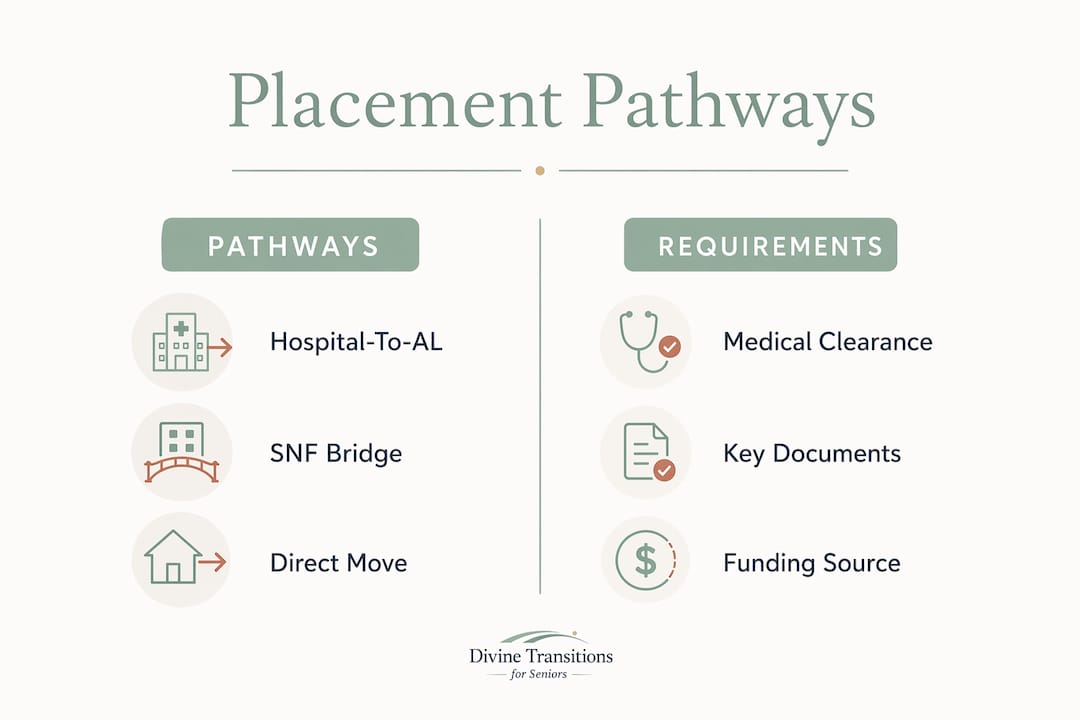
One thing worth knowing: accepting a bridge placement at a SNF while you search for the right long-term assisted living community is not a failure. It’s often the safest move. You get your parent out of the hospital, into supervised care, and you buy yourself a week or two to make a considered permanent decision rather than a panicked one.
The call sequence that works: discharge planner → Divine Transitions for Seniors (for coordinated placement and home-sale logistics) → elder law attorney or POA contact. Don’t wait until one call is finished before starting the next. Run them in parallel.
What are your fastest funding options when you need to move now?
Funding is where most families stall. Here’s the realistic picture, ranked by how quickly you can access the money.
With typical monthly costs for assisted living around $6,200, a six-month stay will cost nearly $37,000 before any additional care fees. Most families need a funding plan within days, not weeks.
| Funding Source | Typical Time to Access | Documentation Required | Practical Notes |
|---|---|---|---|
| Private pay (existing savings/accounts) | Hours to 1 day | Bank statements, proof of funds letter | Fastest option; required by most facilities upfront |
| VA benefits (Aid & Attendance) | Weeks to months | — | Retroactive once approved; apply immediately |
| Bridge loan / short-term loan | 3 days | Credit check, asset verification | Higher cost; buys time while home sells |
| Reverse mortgage | 4 weeks | Counseling certificate, appraisal | Only if parent owns home and is still living there |
| Home sale (traditional MLS) | — | Title, repairs, staging | Too slow for most urgent placements |
| As-is home sale | 2–4 weeks (often faster) | Title, basic disclosure | Best option when home needs work or is full of belongings |
| Medicaid (spend-down) | Months | Financial history, asset documentation | Last resort; requires spending down to eligibility threshold |
Medicare covers limited skilled nursing after a qualifying hospitalization but generally does not pay for assisted living room and board. Medicaid waiver programs vary significantly by state and often exclude housing costs, meaning families typically pay out of pocket for months before Medicaid steps in.
VA Aid and Attendance is underused and worth pursuing immediately if your parent is a veteran or the surviving spouse of one. The application takes time, but benefits can be paid retroactively to the application date, so filing on day one matters.
Pro Tip: When the family home hasn’t been maintained, needs significant repairs, or is full of decades of belongings, a traditional MLS listing is often the slowest possible choice. When a home needs significant repairs or contains decades of belongings, families may benefit from exploring alternatives to a traditional listing. Depending on the situation, that could include an as-is sale or another strategy that better matches the family's timeline.
The rapid home-sale approach works precisely because it removes the prep-and-repair bottleneck. Families don’t have time to paint walls and stage furniture when a parent needs care now.
What documents and logistics do you need ready for a rapid admission?
Getting these together before your first facility tour prevents the most common delay: showing up without paperwork and losing the bed to the next family.
Documents to bring on day one
-
Photo ID for your parent (driver’s license or passport)
-
Power of attorney and healthcare proxy documents (original or certified copies)
-
Proof of funds — a recent bank statement or letter from a financial advisor
-
Current medication list with dosages, prescribing physicians, and pharmacy contact
-
Recent discharge summary or physician note (within the last 30 days if possible)
-
Insurance cards — Medicare, Medicaid if applicable, and any supplemental coverage
-
VA paperwork if your parent is a veteran
-
Vaccination records if the facility requires them (many do for flu and COVID)
Packing for day one (the rest can follow in 1–2 weeks)
-
Nightclothes, slippers, and a one-week wardrobe (labeled with name)
-
Toiletries: toothbrush, shampoo, soap, razor, and any personal care items
-
Hearing aids, glasses, and dentures with their cases
-
A phone charger and any personal device
-
Two or three framed photos or a small comfort item from home
Leave the furniture, collections, and most personal belongings for later. The goal on move-in day is a safe bed and familiar faces, not a fully decorated room. Divine Transitions for Seniors handles the belongings coordination and downsizing after your parent is settled, so you don’t have to manage that during the most stressful 48 hours.

What should you ask facilities when time is short?
Speed creates pressure to skip due diligence. Don’t. A bad placement in a crisis leads to a second traumatic move, which is harder on everyone. These questions take five minutes by phone and tell you most of what you need to know.
Ask by phone before you visit:
-
Do you have a bed available for move-in within 24–48 hours?
-
What are your staffing ratios during the day shift and overnight?
-
Are you licensed for memory care, or is this a standard assisted living license?
-
When was your last state inspection, and were there any deficiencies cited?
-
Can you accept a direct hospital discharge?
-
How do you manage medications — is there a licensed nurse on site around the clock?
-
What is your escalation process if a resident becomes agitated or has a behavioral incident?
Quick verification steps after the call:
Check the facility’s state license and inspection records through your state’s health department website. Most states post survey results and complaint histories online. You can also ask the admissions coordinator to email the most recent survey report — a good facility will send it without hesitation.
Red flags to watch for:
-
Evasive or vague answers about staffing numbers
-
No clear description of dementia protocols when you ask directly
-
Heavy reliance on agency or temporary staff as the norm
-
Unclear or shifting answers about what extra services cost beyond the base rate
Rushing a placement without asking about dementia behavior management is one of the most common mistakes families make under pressure. A community that can’t describe its protocols clearly probably doesn’t have strong ones.
Despite $12 billion in federal spending tied to assisted living services, federal oversight remains limited. State licensing and inspection records are your best available tool for rapid due diligence.
What happens if assisted living won’t accept them?
Facilities can and do decline admissions when a person’s medical or behavioral needs exceed what they’re licensed to manage. It’s not a dead end. Here’s how to escalate quickly.
Alternatives when assisted living says no:
-
Short-term skilled nursing (SNF): Handles higher-acuity needs, accepts hospital discharges, and Medicare Part A may cover a limited stay after a qualifying hospitalization.
-
Home health with private-duty care: A viable option when the home is safe and the family can arrange 24/7 coverage, though costs add up quickly.
-
Memory care units: Accept higher behavioral acuity than standard assisted living; ask specifically about locked units and behavior-management staffing.
-
Inpatient hospice or palliative care: Appropriate when the clinical picture has shifted to end-of-life needs.
The escalation sequence when a facility declines:
-
Ask for the denial in writing, including the clinical reason. This documentation helps the next facility understand what level of care is needed.
-
Request an immediate clinical reassessment from the hospital or attending physician to clarify the care level required.
-
Contact the hospital discharge planner and Divine Transitions fors Seniors to identify alternate placements that match the updated clinical profile.
-
Arrange interim skilled nursing care to maintain safety while the permanent placement search continues.
Medicare covers SNF stays at 100% for the first 20 days following a qualifying hospitalization, then with a daily copay for days 21–100. After 100 days, coverage ends entirely. That window is your runway to find the right long-term placement without financial panic.
When assisted living isn’t the right fit, the goal is still the same: get your parent into a safe, supervised setting as fast as possible, then work the permanent plan from there.
How Divine Ttansitions for Seniors helps when you need assisted living now
When a parent needs care immediately and the family home is sitting empty, full of belongings, and possibly years behind on maintenance, two urgent problems land on your plate at once: finding a placement and funding it. Most families try to manage both alone, under enormous stress, and without a coordinator to keep the moving parts aligned.

Divine Transitions for Seniors is built for exactly this situation. The service coordinates placement guidance alongside a fast home-sale strategy, so both timelines move in parallel rather than one stalling the other. For Oregon and Washington families, this means one point of contact who works alongside hospital discharge planners, senior placement specialists, elder law attorneys, and real estate partners, all at no direct cost to the family.
The home-sale piece matters more than most families expect. A house that needs repairs, hasn’t been staged, or is full of decades of belongings can sit on the MLS for months. An as-is sale, coordinated through Divine Transitions For Seniors, removes that bottleneck. Proceeds become available weeks sooner, which directly affects how long private-pay care can be sustained while VA benefits or Medicaid processes.
Before your first call, have these ready: the address of the home, a rough sense of your parent’s care needs, and any POA or financial documents you can locate. From there, Divine Transitions for Seniors handles the coordination. If your family is facing an urgent transition, start with a conversation. We'll help you understand your options, coordinate the next steps, and determine the strategy that best supports your loved one's care and your family's goals. Visit divinetransitionsforseniors.com to start the conversation.
Key Takeaways
When assisted living can’t wait, the 24–72 hour window requires simultaneous action on placement, funding, and paperwork — not a sequential checklist.
| Point | Details |
|---|---|
| Safety first, then permanence | Accept a bridge placement at a SNF or respite setting to get your parent safe; plan the permanent move after. |
| Call in parallel, not sequence | Discharge planner, placement specialist, and Divinetransitionsforseniors should all be contacted within the first few hours. |
| Funding needs a plan on day one | At a median $6,200 per month, private pay runs out fast; identify proof of funds, VA eligibility, or a home-sale path immediately. |
| Documents determine speed | Missing POA, medication list, or proof of funds is the most common reason a rapid admission stalls at the facility. |
| Divinetransitionsforseniors coordinates both | For Oregon and Washington families, Divinetransitionsforseniors aligns placement and as-is home-sale timelines at no direct cost to the family. |
What I’ve seen families get wrong in the first 72 hours
One of the biggest surprises for families is realizing that choosing a care community is only one part of the transition. At the same time, they're often trying to determine what to do with a home that's been lived in for decades.
A parent who falls or receives a sudden dementia diagnosis has usually been living in that home for 20, 30, sometimes 40 years. The house hasn’t been touched in a decade. There are belongings in every room. The roof may need work. And now, while you’re sitting in a hospital discharge meeting trying to absorb a care plan, someone is also telling you that care costs about $6,200 a month and you need to show proof of funds by Friday.
The families who move through this fastest are the ones who stop trying to solve both problems alone. They accept a bridge placement to get their parent safe, and they hand the home-sale coordination to someone who does this every day. The families who struggle are the ones who delay placement because they’re not sure how to pay for it, or delay the home sale because they can’t face the house yet. Both delays are understandable. Neither is safe.
If you’re reading this in the middle of a crisis, the most useful thing you can do right now is make one call. The rest follows from there.
Useful resources and who to call right now
-
Your state health department’s facility search tool: Look up any assisted living community’s license status and most recent inspection report. Search “[your state] assisted living license lookup” to find the right page.
-
Medicaid.gov: Find your state’s Medicaid waiver programs and eligibility requirements at medicaid.gov. Ask specifically about Home and Community-Based Services (HCBS) waivers, which may cover some assisted living services.
-
VA Benefits (Aid & Attendance): Apply at va.gov/pension/aid-attendance-housebound if your parent is a veteran or surviving spouse. File the application the same day you begin placement calls — benefits are retroactive to the application date.
-
Administration for Community Living / Long-Term Care Ombudsman: Find your local ombudsman at acl.gov — they can help resolve disputes with facilities and provide unbiased guidance on care options.
-
Divinetransitionsforseniors blog: Practical guides on senior care transitions and home-sale strategies for Oregon and Washington families.
When you call a facility, ask: “What was the date of your last state survey, and were any deficiencies cited?” A facility that answers clearly and offers to send the report is one worth visiting.
This article is general information, not legal, financial, or medical advice. Confirm current rules, eligibility requirements, and care options with a qualified professional or the relevant state and federal agencies for your specific situation.
FAQ
How quickly can someone move into assisted living in an emergency?
Some facilities can complete admission within 24–48 hours when a bed is available and clinical documentation is in hand. Calling 3–5 communities simultaneously and having discharge paperwork, a medication list, and proof of funds ready speed the process significantly.
Where do seniors go if they can’t afford assisted living?
Medicaid waiver programs in most states cover some assisted living services for eligible individuals, though they often exclude room and board and require a spend-down of assets first. Short-term skilled nursing through Medicare Part A, home health services, or adult foster care are lower-cost alternatives while longer-term funding is arranged.
What happens when assisted living is no longer enough?
When a resident’s needs exceed what an assisted living community is licensed to provide, the typical next steps are transfer to a skilled nursing facility, a locked memory care unit, or inpatient hospice. The facility is required to provide written notice and assist with transition planning.
How long does the average person stay in assisted living?
Average length of stay in assisted living varies widely by individual health trajectory, but most residents stay between one and three years. Some move to higher levels of care as needs increase; others remain for much longer when health is stable.
Do people decline faster in assisted living?
Research does not support the idea that assisted living itself accelerates decline. Delayed placement, on the other hand, carries real risks: falls, medication errors, caregiver burnout, and social isolation at home often worsen outcomes more than a timely move to supervised care.