

Yes, you can usually arrange an urgent assisted living move in Washington within a few days. The key is knowing who to call first and what to have ready before you pick up the phone.
Your first 24–72 hour checklist:
- Call the hospital case manager (if your loved one is being discharged) — they can initiate a CARE Assessment and flag urgent placement needs same day.
- Contact your loved one's primary care physician for a current medication list and any care-level documentation the facility will need.
- Reach Divinetransitionsforseniors for same-day placement coordination, home-sale guidance, and a single point of contact through the whole process.
- Call your local Area Agency on Aging (find yours at Eldercare) for local resource referrals and Medicaid navigation.
- Contact Washington DSHS if Medicaid or COPES funding may be needed — the DSHS long-term care residential options page explains eligibility and intake steps.
Documents to gather now: photo ID, Medicare and insurance cards, current medication list, advance directive or power of attorney, and any recent hospital discharge paperwork.
On Medicare vs. Medicaid: Medicare does not pay for assisted living. Washington's Apple Health (Medicaid) may cover care services through COPES or Community First Choice, but room and board typically remain the resident's responsibility. Start the Medicaid application early — eligibility takes time even when care starts immediately.
Pro Tip: Pack a single folder with every document listed above before your first facility call. Facilities that can move fast will ask for all of it within the first hour.
Key Takeaways
An urgent assisted living move in Washington is achievable within 24–72 hours when you call the right people first and have documents ready before the first facility conversation.
| Point | Details |
|---|---|
| Start with one call | Contact a hospital case manager or Divinetransitionsforseniors first — both can initiate placement coordination same day. |
| Medicare does not cover assisted living | Use Apple Health/COPES, VA Aid & Attendance, or a fast home sale to fund care instead. |
| Legal authority must be confirmed | Bring POA documents to every facility; if none exist and capacity is lost, contact a Washington elder law attorney immediately. |
| Match care needs before signing | Confirm the facility can handle your loved one's mobility, medication, and supervision needs — and can increase care without a second move. |
| Divinetransitionsforseniors coordinates the full transition | Placement, home sale, and belongings management run in parallel at no direct cost to Washington families. |
Table of Contents
- How to keep your family steady when everything feels urgent
- Legal questions you need to answer before move-in
- Speed matters, but so does the right fit
- Divinetransitionsforseniors coordinates your entire urgent move
- Sources
- FAQ
How to keep your family steady when everything feels urgent
An urgent senior care transition puts every family member under pressure at once. Siblings who live in different cities suddenly have opinions. The person being moved may be frightened or resistant. And you, the one holding the phone, are expected to make decisions in hours that most families take months to consider.
A few things that genuinely help: Designate one family spokesperson for facility calls. Too many voices slow the process and create conflicting information. Brief everyone else by group text or a shared document, not by phone tag.
Be honest with your loved one about what is happening. Framing the move as "temporary" to reduce resistance often backfires when the person realizes it is not. A calm, direct conversation — "We need you somewhere safe while we figure out the next steps" — tends to land better than a cover story.
Give each family member a specific task. One person handles documents, one researches facilities, one manages the home. Divided responsibility reduces the sense that one person is carrying everything.
Finally, grief is normal here. Moving a parent into assisted living quickly, without the time to process it, is genuinely hard. Acknowledge that to each other. The logistics can be managed; the feelings need space too.
Legal questions you need to answer before move-in
The most common legal obstacle in an emergency relocation is consent. A facility cannot admit a resident who lacks capacity without a legally authorized decision-maker in place.
Power of attorney (POA): If your loved one already signed a durable power of attorney for healthcare and finances, bring those documents to every facility conversation. Facilities will ask for copies before admission.

No POA in place: If your loved one has not signed a POA and now lacks the capacity to do so, you may need emergency guardianship through Washington Superior Court. This process can move quickly in genuine emergencies, but it requires an attorney. Contact a Washington elder law attorney immediately — the Washington State Bar Association's referral service can connect you same day.
Consent for a competent adult: If your loved one is cognitively intact, they must consent to the move. You cannot legally place a competent adult in a facility against their will, even with POA. A care manager or social worker can sometimes help facilitate a difficult conversation.
Advance directives: Bring the POLST (Physician Orders for Life-Sustaining Treatment) form and any living will to the facility. Washington facilities are required to honor these documents.
Speed matters, but so does the right fit
Families in crisis almost always ask me the same question: "How fast can we get them in somewhere?" That urgency is completely understandable. But the families who end up making a second move within 90 days are usually the ones who chose a bed over a match.
Speed must win when there is a genuine safety risk: a hospital discharge with no safe home to return to, a caregiver who has collapsed, or a cognitive crisis that cannot be managed at home. In those cases, a safe licensed setting today beats a perfect setting in three weeks.
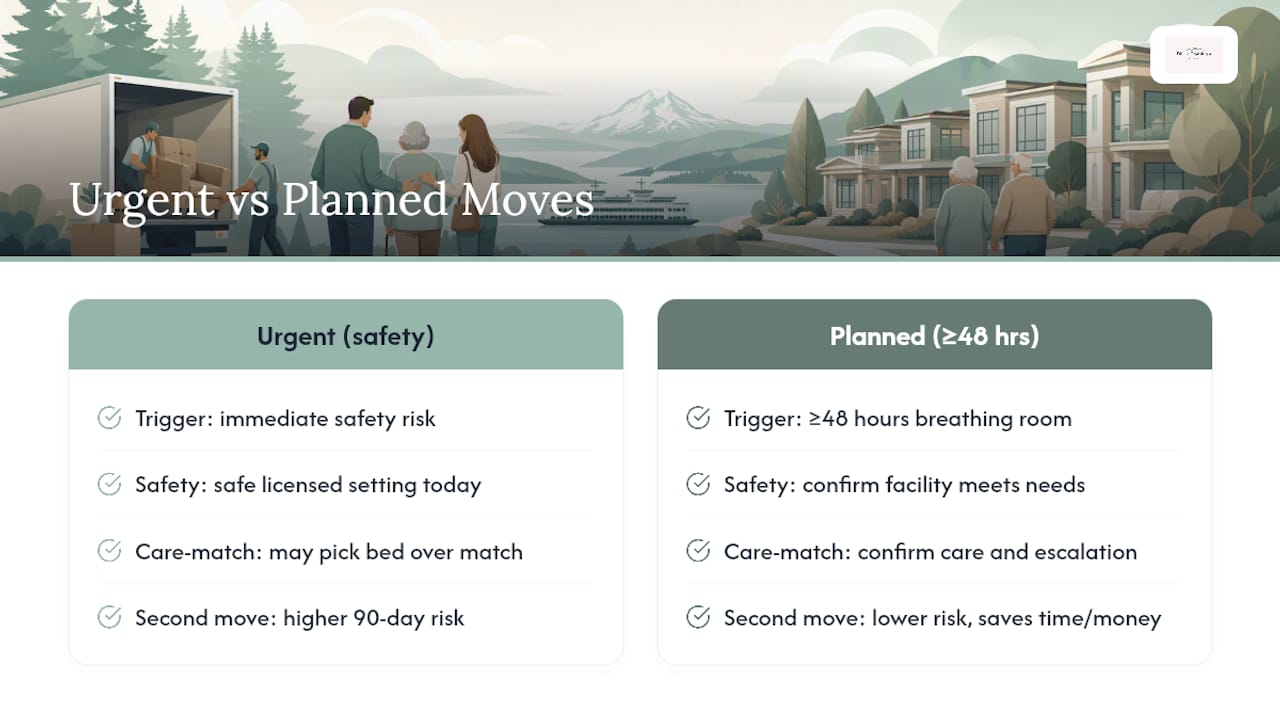
When there is even 48 hours of breathing room, use it to confirm two things: that the facility can actually provide the level of care your loved one needs now, and that it can increase care without forcing a second move later. Assisted living facilities vary widely in what they can handle — mobility support, wound care, oxygen, memory care. A placement that fails on care-match costs far more time and money than a slightly slower first decision.
The good news: competent help is available the same day you call. You do not have to figure this out alone.
Divinetransitionsforseniors coordinates your entire urgent move
When a family is facing a last-minute elderly move, the hardest part is rarely finding a facility. It is managing everything at once: placement, the home, decades of belongings, and funding — while also caring for a person in crisis.

Divinetransitionsforseniors handles the full picture for Washington families at no direct cost to you. A same-day consult gets placement coordination started within hours. From there, the team works in parallel: coordinating with placement specialists to identify licensed facilities that match your loved one's care needs, and connecting you with local real estate partners for a fast or as-is home sale when home equity is the primary funding source. Many families discover the home has not been maintained for years or is full of belongings — a traditional MLS listing is simply too slow. Divinetransitionsforseniors coordinates furniture pickup, estate sorting, and sale timelines alongside placement so nothing stalls waiting on something else.
For funding, the team can connect you with partners for bridge loans, HECM options, or home-equity strategies — and refers directly to the Area Agency on Aging, DSHS, and VA when public benefits apply.
To get started: call or visit Divinetransitionsforseniors to request a same-day consult. Have your loved one's medication list, POA documents, insurance cards, and a recent discharge summary ready. Divinetransitionsforseniors coordinates placements across Washington State.
Sources
Key agencies and what each one handles:
- Does Medicare Pay for Assisted Living in Washington State? - LegalClarity
- Long-Term Care Residential Options — Washington State Department of Social and Health Services
Senior placement specialists and geriatric care managers in Washington offer same-day phone consultations for emergency situations. They screen facilities for care-level fit, negotiate admission exceptions, and can cut the typical 7–14 day intake timeline significantly — emergency placement coordination routinely brings that window down to 24–72 hours when logistics are handled in parallel.
After move-in, tracking your loved one's mobility and therapy progress matters. A senior fitness progress checklist can help families monitor PT/OT follow-through and flag concerns early.
This article provides general information, not legal, medical, or financial advice. Confirm current eligibility rules and legal requirements with Washington DSHS, a licensed elder law attorney, or a qualified financial advisor.
This article is general information, not a substitute for advice from a qualified doctor. Consult a qualified healthcare professional about your own circumstances before acting on anything here.
FAQ
How quickly can someone move into assisted living?
In many cases, move-in can happen within 24–72 hours when a placement specialist confirms bed availability and care-level fit, and logistics like medication transfer and paperwork are handled in parallel.
Does Medicare pay for assisted living in Washington State?
No. Medicare excludes long-term custodial care, including assisted living. Washington families should explore Apple Health/COPES, VA Aid & Attendance, or a home sale to fund placement.
Can you go to assisted living if you can't walk?
Yes. Many assisted living facilities accommodate residents with significant mobility limitations, including wheelchair users, provided they offer 24/7 staffing, accessible bathrooms, wide hallways, and onsite or rapid PT/OT access. Confirm these specifics before signing.
What if you need assisted living and can't afford it?
Washington's COPES waiver through DSHS can cover care services for eligible residents, though room and board typically remain private-pay. Assisted living in Washington is primarily private-pay, but adult family homes often cost less, and VA Aid & Attendance is available for qualifying veterans.