

Your parent's house may be worth far more than they paid for it decades ago. If you're inheriting or buying it, the first question you're probably asking is: "Will I owe a huge tax bill?" In most inheritance cases, the answer is no — or at least, far less than you'd expect. When you inherit a home, federal law typically resets the property's cost basis to its fair market value on the date of death. That reset is called a stepped-up basis, and it means capital gains on a parent's house are usually calculated only on appreciation that happened after the owner died, not over the entire time they owned it.
Here's what to do right away:
- Order a date-of-death appraisal. A qualified appraiser establishes the fair market value that becomes your stepped-up basis. Get this done quickly — it protects you if the IRS ever questions your numbers.
- Confirm how ownership transfers. Did your parent have a will (probate), a revocable living trust, or a joint tenancy? The path determines when you can legally sell.
- Decide whether to sell quickly or move in. Selling shortly after inheriting often produces little or no federal capital gain. Moving in and meeting the two-year residency rule can unlock the IRC §121 exclusion on future appreciation.
- Check Washington State's capital gains rules. Washington's capital gains tax has its own thresholds and exemptions that interact with your federal calculation.
- Call a CPA and an estate attorney before listing the home if the estate is complex, multiple heirs are involved, or the gain is large.
Pro Tip: If your family needs cash quickly to fund assisted living or memory care, an as-is cash sale shortly after inheriting is often the most tax-efficient move. Because the sale price usually approximates the stepped-up basis, federal capital gains can be close to zero — and you skip months of carrying costs.
Table of Contents
- How the stepped-up basis works when you inherit a house
- Why gifting a house during life is different from inheriting it at death
- How the federal primary-residence exclusion (IRC §121) applies after inheriting
- What Washington State's capital gains tax means for heirs and buyers
- How probate, trusts, and timelines affect your ability to sell the house
- Step-by-step: how to calculate capital gain on an inherited house
- Practical strategies to reduce tax: sell now, convert, hold, or plan ahead
- Forms, records, and your immediate next steps after inheriting
- Key Takeaways
- What families facing urgent care decisions actually need to hear
- How Divinetransitionsforseniors helps Washington families sell a parent's home for care
- Useful sources and next reads
- FAQ
How the stepped-up basis works when you inherit a house
When someone inherits a home,
on the date the original owner died. That reset is the stepped-up basis. Your taxable gain is the difference between what you sell the house for and that stepped-up value — not the price your parent paid 30 years ago.
Why does this matter so much? Say your parent bought their Seattle-area home for $80,000 in 1985. By the time they passed, it was worth $620,000. If you inherited it and sold it the following month for $625,000, your taxable gain is $5,000, not $545,000. The IRS taxes you on what happened on your watch, not your parent's.
A few things to keep in mind:
- Documentation is non-negotiable — A qualified appraisal or a comparative market analysis from a licensed appraiser, dated close to the date of death, is the evidence that supports your stepped-up basis. Without it, the IRS can challenge your numbers.
- Inheriting doesn't trigger income tax. Heirs generally owe no tax simply for receiving property — the tax clock starts only when you sell and realize a gain.
Why gifting a house during life is different from inheriting it at death
Parents sometimes try to transfer a home to their children while still alive — often to avoid probate or simplify the estate. The tax consequences of that choice are dramatically different from what happens at death.
When a parent gifts a home, the child takes the parent's original cost basis — called a carryover basis. If your parent paid $80,000 for the house and gifts it to you when it's worth $620,000, your basis is still $80,000. Sell it for $625,000, and you owe capital gains on $545,000. Contrast that with inheriting the same house: your basis is $620,000, and the gain is $5,000.
Gifting a home to avoid probate can create a severe basis-carryover trap where the recipient ends up owing far more in capital gains than probate would have cost in the first place.
| Scenario | Your Basis | Taxable Gain (if sold at $625,000) | Probate Required? |
|---|---|---|---|
| Inherit at death | $620,000 (stepped-up) | ~$5,000 | Depends on estate plan |
| Receive as lifetime gift | $80,000 (carryover) | ~$545,000 | No |
| Buy from parent at FMV | $625,000 (purchase price) | $0 at sale | No |
Common family scenario: a parent adds a child to the deed to "make things easier later." That partial gift triggers a partial carryover basis on the gifted share. The child ends up with a blended basis that's complicated to calculate and often unfavorable.
Pro Tip: Before accepting a gift of a house, ask your parent what they originally paid, whether they have cost-basis documentation, and whether they still plan to live there. If they do, a gift now could cost you far more in taxes later than simply inheriting the property at death.
How the federal primary-residence exclusion (IRC §121) applies after inheriting
Even after a stepped-up basis, some inherited homes appreciate significantly before the heir sells. That's where IRC §121 becomes relevant.
Under IRC §121, single filers can exclude a substantial amount of capital gain from the sale of a primary residence. Married couples filing jointly can exclude up to double that amount. To qualify, you must have owned and used the home as your main residence for a significant portion of the five-year period ending on the date of sale.
Here's how this plays out for an heir who converts an inherited home into their primary residence:
- You inherit the home and receive a stepped-up basis at the date-of-death fair market value.
- You move in and establish it as your primary residence.
- You live there for at least two years.
- When you sell, the §121 exclusion applies to gain measured from the stepped-up basis — not from your parent's original purchase price.
So if the home's stepped-up basis was $620,000, you lived there for two years, and you sell for $900,000, your gain is $280,000. A single filer could exclude $250,000 of that, leaving only $30,000 taxable. A married couple filing jointly could exclude up to $500,000 of gain, meaning the full $280,000 would be excluded in this scenario.
A few limitations worth knowing:
- The exclusion can only be used once every two years.
- Partial exclusions are available if you had to sell before meeting the full two-year test due to a job change, health issue, or unforeseen circumstance.
- Converting a rental property to a primary residence before selling adds complexity — depreciation recapture applies to any deductions taken during the rental period.
- IRS Publication 523 contains worksheets for calculating your exclusion and confirming eligibility.
What Washington State's capital gains tax means for heirs and buyers
Washington passed a capital gains tax that applies to certain long-term capital gains realized by Washington residents. The Washington Department of Revenue (WA DOR) administers this tax, and families selling inherited property need to understand when it applies and when it doesn't.

The WA capital gains tax is assessed on long-term capital gains above the standard deduction threshold. Washington law provides a standard deduction, and gains below that threshold are not subject to the tax. Real estate sold directly by individuals has historically been treated differently from other capital assets under Washington's framework — but the rules can change, and the interaction between federal and state treatment is not always straightforward.
Key points for Washington heirs:
- Residency matters. The WA capital gains tax applies to Washington residents. If you live in Washington and sell an inherited home, confirm whether the gain triggers state-level reporting.
- The stepped-up basis still reduces your WA taxable gain. Washington's calculation starts from the federally recognized gain, so a low federal gain generally means a low (or zero) state gain.
- Check WA DOR directly. Exemption amounts, filing thresholds, and asset classifications are updated by the legislature and WA DOR. The WA DOR capital gains tax page is the authoritative source for current rates and filing requirements.
- Withholding may apply. Depending on the transaction, there may be state-level withholding or reporting obligations at closing. A Washington CPA can confirm whether your sale triggers these requirements.
- Consult a CPA for WA-specific filing. Federal and state rules interact in ways that vary by individual circumstances — residency, gain size, asset type, and filing status all affect the outcome.
How probate, trusts, and timelines affect your ability to sell the house
One of the most common surprises families face: you can't list or transfer the home until someone has legal authority to act. Until an executor is appointed by the court (in a probate case) or a trustee confirms their authority (in a trust case), no deed transfer or listing agreement is valid.
| Transfer Method | Typical Timeline | Approximate Cost Range | Key Advantage |
|---|---|---|---|
| Probate (with will) | 6 months | Legal fees, court costs, executor fees (often 2–4% of estate value) | Court oversight; clear title |
| Probate (no will) | — | Higher legal fees; administrator fees | Legally required path |
| Revocable living trust | 4–12 weeks | Trust setup costs already paid; minimal court involvement | Fastest path to sale authority |
| Joint tenancy / right of survivorship | Days to weeks | Recording fees only | Simplest transfer; no probate |
Once authority is confirmed, the operational checklist looks like this:
- Notify the mortgage lender of the owner's death and ask about a due-on-sale clause.
- Order a date-of-death appraisal immediately — this establishes the stepped-up basis and is time-sensitive.
- Locate the deed, will or trust documents, and any existing title insurance policies.
- Secure property insurance in the estate's or trustee's name; standard homeowner policies often lapse at death.
- Contact a real estate attorney if title is unclear, multiple heirs are involved, or the property has liens.
When a parent needs care funding urgently, the timeline from inheritance to sale matters enormously. A trust-held property can often be listed within weeks. A probate estate may take the better part of a year before a deed can transfer. Families facing that gap sometimes use bridge financing or explore whether the parent can move into assisted living before the house sells.
Step-by-step: how to calculate capital gain on an inherited house
Here's a worked example that shows the math from start to finish.
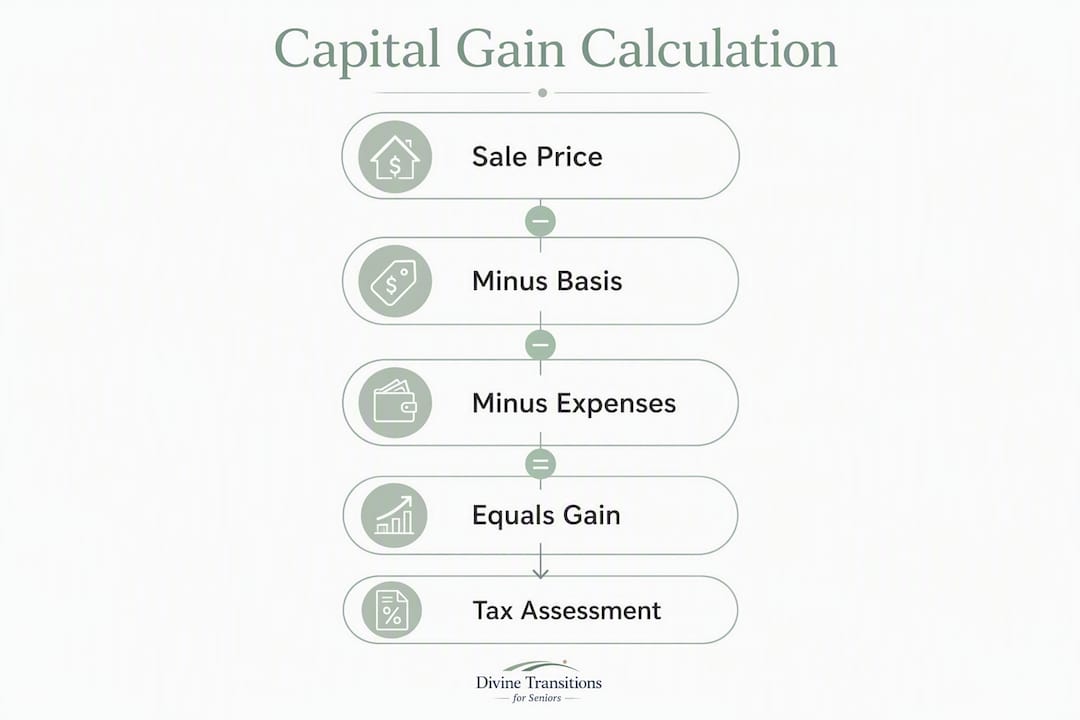
The scenario: Your parent bought their Tacoma home in 1990 for $95,000. They passed away, and a qualified appraisal established the fair market value at $580,000 on the date of death. You inherited the home and sold it 14 months later for $610,000. Selling costs (agent commission, closing costs, transfer taxes) totaled $36,000.
The calculation:
- Stepped-up basis: $580,000 (fair market value at date of death)
- Sale price: $610,000
- Selling expenses: $36,000
- Adjusted sale price: $610,000 − $36,000 = $574,000
- Taxable gain: $574,000 − $580,000 = −$6,000 (a loss, not a gain)
In this example, the heir owes zero federal capital gains tax. The stepped-up basis, combined with selling costs, actually produces a small loss.
Now adjust the scenario: the home sells for $650,000 instead.
| Item | Amount |
|---|---|
| Sale price | $650,000 |
| Selling expenses | $36,000 |
| Adjusted sale price | $620,000 |
| Stepped-up basis | $580,000 |
| Taxable gain | $34,000 |
At the federal level, a $34,000 long-term capital gain (held more than 12 months) is taxed at preferential rates — 0%, 15%, or 20% depending on your total income. For most middle-income heirs, the 15% rate applies, meaning roughly $5,100 in federal tax on a $650,000 sale.
For Washington State, confirm with WA DOR whether the gain exceeds the applicable deduction threshold and whether the asset type is subject to the state tax. A CPA can run this calculation with your actual numbers.
The reusable formula: Sale price − stepped-up basis − selling expenses = taxable gain.
Practical strategies to reduce tax: sell now, convert, hold, or plan ahead
The right move depends on your family's priorities — cash urgency, desire to keep the house, and how much the property has appreciated since the date of death.
Option 1: Sell immediately after inheriting The stepped-up basis typically keeps federal capital gains near zero if you sell close to the date-of-death value. This is often the best option when families need cash quickly for care costs. The trade-off: you may accept a slightly lower price in exchange for speed, especially with an as-is sale.
Option 2: Convert to primary residence Move in, meet the two-year ownership and use tests, and apply the IRC §121 exclusion to any post-inheritance appreciation. Best for heirs who want to live in the home and expect significant future appreciation. The trade-off: you're tying up capital for at least two years and taking on maintenance costs.
Option 3: Hold as a rental Generates income but creates depreciation recapture when you eventually sell. Long-term rental treatment also changes how gains are taxed. This path adds complexity and is rarely the right choice when care funding is urgent.
Option 4: Accept as a lifetime gift (carryover basis) Rarely advisable from a tax standpoint. As shown earlier, the carryover basis can produce a tax bill far larger than the probate costs you were trying to avoid.
Option 5: Transfer into a trust before death A revocable living trust doesn't change the tax treatment at death — the heir still receives a stepped-up basis — but it speeds up the transfer timeline significantly by avoiding probate. The cost is the upfront trust-drafting fee, typically paid by the parent during estate planning.
| Strategy | Federal Tax Outcome | Timeline | Best For |
|---|---|---|---|
| Sell immediately | Often near-zero gain | Weeks to months | Urgent care funding |
| Convert to primary residence | §121 exclusion on future gain | 2+ years | Heirs who want to live there |
| Hold as rental | Depreciation recapture at sale | Ongoing | Long-term income (complex) |
| Accept as gift | Large carryover basis gain | Immediate | Rarely advisable |
| Trust transfer (pre-death planning) | Step-up preserved; no probate | Weeks post-death | Families with estate plans |
When to call a professional now: multiple heirs who disagree, unclear title or liens, anticipated gain above $250,000, urgent care-funding needs, or any situation where the parent's estate plan is missing or outdated. Partition actions — court-ordered forced sales when co-owners can't agree — are slow, expensive, and often produce below-market results. Early coordination prevents them.
Forms, records, and your immediate next steps after inheriting
Federal reporting: Report the sale of an inherited home on Form 8949 and Schedule D (Form 1040). Even if your gain is fully excluded under IRC §121, you may still need to report the sale if you receive a Form 1099-S from the title company at closing. When in doubt, report it — an unreported 1099-S is a common audit trigger.
Washington reporting: Check WA DOR for current state filing and withholding requirements. Washington's capital gains tax has its own return and payment schedule, separate from your federal return.
Recordkeeping checklist:
- Qualified appraisal dated at or near the date of death
- Estate inventory (if probate was required)
- Settlement statement (HUD-1 or Closing Disclosure) from the sale
- Receipts for selling expenses: commissions, title fees, transfer taxes
- Receipts for any capital improvements made after inheriting (these increase your basis)
- Will or trust documents confirming your authority to sell
- Any correspondence with the appraiser, attorney, or title company
Priority contact order after inheriting:
- Executor or trustee — confirm legal authority before taking any action on the property.
- CPA or tax preparer — establish the stepped-up basis, estimate the tax, and plan the sale timing.
- Estate attorney — resolve title issues, multi-heir disputes, or complex estate structures.
- Local real estate agent or home-sale coordinator — once authority is confirmed, assess the property and decide on sale method.
Keep scanned copies of every document in a labeled digital folder organized by date. "Appraisal_DateOfDeath_2025-03-15" is infinitely more useful than "scan0047" when you're preparing a tax return six months later.
Key Takeaways
Inherited homes in Washington are usually taxed only on appreciation after the date of death, not the full gain from the parent's original purchase price — making the stepped-up basis the single most important concept for heirs to understand.
| Point | Details |
|---|---|
| Stepped-up basis limits federal tax | Your taxable gain is sale price minus fair market value at death, not the original purchase price. |
| Gifting carries carryover basis risk | A lifetime gift transfers the parent's low original basis, often creating a much larger taxable gain. |
| IRC §121 exclusion can apply | Move in, meet the 2-of-5 ownership/use tests, and exclude up to $250,000 (single) or $500,000 (married filing jointly) of gain. |
| Washington's capital gains tax applies separately | Check WA DOR for current thresholds and filing requirements; a CPA should confirm your state obligation. |
| Divinetransitionsforseniors coordinates the sale | For families needing fast liquidity for care, Divinetransitionsforseniors connects you with local partners and manages the home-sale and downsizing process at no charge to the family. |
What families facing urgent care decisions actually need to hear
Most tax articles treat this topic as a math problem. For families in Washington who are simultaneously managing a parent's move to memory care or assisted living, it's not a math problem — it's a crisis with a math component.
The tax question matters, but it rarely determines the right move on its own. What actually drives the decision is usually the gap between what care costs right now and what the family has available. A parent's home is often the largest asset in that equation, and the pressure to access it quickly can push families toward choices they haven't fully thought through.
Here's the part most articles skip: the stepped-up basis is genuinely good news for families in this situation. Selling quickly after inheriting — even at a slight discount for speed — often produces a better net outcome than waiting for a higher price, because the federal tax on a near-zero gain is near zero. The math usually favors moving fast.
What I'd caution against is letting urgency override the legal steps. No sale is valid until someone has authority to sign. Getting the executor appointed or confirming trustee authority is the first move, not the listing. Families who skip that step create title problems that cost far more to fix than the time they saved.
The other thing worth saying plainly: if multiple siblings are involved and they don't agree, get a neutral coordinator involved early. Disagreements among heirs can escalate to court-ordered partition actions that produce below-market sales and legal bills that eat into the proceeds everyone was trying to protect. Document every decision, copy every sibling on every communication, and bring in a professional before the conversation gets adversarial.
Taxes are solvable. Damaged family relationships are harder to fix.
How Divinetransitionsforseniors helps Washington families sell a parent's home for care
When a parent needs assisted living or memory care now, the home sale can't wait for a perfect market. Many families are dealing with a house that hasn't been maintained in years, rooms full of decades of belongings, and no clear idea of where to start. That's the situation Divinetransitionsforseniors was built for.

Divinetransitionsforseniors coordinates the entire transition for Washington and Oregon families at no charge to the family. That means connecting you with local real estate professionals who specialize in as-is and estate sales, managing the downsizing and belongings process so the home is ready to sell without a full renovation, and aligning the home-sale timeline with the care-placement timeline so your parent isn't waiting in a hospital or unsuitable setting while paperwork catches up.
The services include home-sale coordination, estate-document review support, connection to senior placement specialists, and downsizing and belongings management. One point of contact handles the coordination so you're not managing five different vendors while also managing a family crisis.
If you're a Washington family trying to figure out how to sell a parent's home to fund senior care, reach out to Divinetransitionsforseniors for a free consultation. There's no obligation, and the conversation will help you understand your options before you commit to any path.
Useful sources and next reads
These are the primary sources worth bookmarking when you're preparing paperwork, talking with advisors, or confirming current rules:
- IRS Topic No. 409: Capital Gains and Losses — the IRS's own explanation of how capital gains are calculated, including basis rules for inherited and gifted property.
- IRS Topic No. 701: Sale of Your Home — covers IRC §121, the ownership and use tests, and reporting requirements. IRS Publication 523 (linked from this page) includes worksheets.
- Tax Policy Center: Carryover Basis vs. Step-Up Basis — a clear, non-partisan explanation of the difference between gifting and inheriting from a tax-policy perspective.
- Cornell Legal Information Institute: Partition — explains what happens when co-owners or heirs can't agree on a property, and the legal remedies available.
- Paying for assisted living when home equity is your main asset — practical guidance on monetizing home equity to fund care, including sale, HECM, and HELOC options.
For complex estates, multiple heirs, or any situation where the gain is large, consult a licensed CPA and an estate attorney in Washington before making decisions. These sources are starting points, not substitutes for professional advice.
FAQ
How do you avoid capital gains tax on a parent's house?
The most reliable approach is to inherit rather than receive the home as a gift, which gives you a stepped-up basis that resets taxable gain to post-death appreciation only. If you move into the home and meet the two-year ownership and use tests under IRC §121, you can exclude up to $250,000 (single) or $500,000 (married filing jointly) of any remaining gain.
Do you have to pay capital gains if you sell your parent's house after inheriting it?
Usually very little or nothing, because the stepped-up basis resets your cost basis to the home's fair market value at the date of death. If you sell shortly after inheriting at roughly that same value, your taxable gain is close to zero.
Does Washington State have a capital gains tax on inherited property sales?
Washington's capital gains tax can apply to gains realized by Washington residents, but the stepped-up basis reduces the federally recognized gain, which generally flows through to the state calculation. Check the WA DOR capital gains tax page for current thresholds and exemptions, and confirm your specific situation with a Washington CPA.
Do you have to report the sale of an inherited home to the IRS even if you owe no tax?
Yes, in many cases. If you receive a Form 1099-S from the title company at closing, you are generally required to report the sale on Form 8949 and Schedule D even if the gain is fully excluded or zero. Failing to report a 1099-S is a common audit trigger.
What is the difference between carryover basis and stepped-up basis for a parent's house?
A carryover basis (from a lifetime gift) means you inherit the parent's original purchase price as your cost basis, which can produce a large taxable gain on sale. A stepped-up basis (from inheriting at death) resets the basis to current fair market value, typically reducing or eliminating the capital gain.