

Your first move is to secure housing and hit three hard deadlines: Oregon DMV license transfer within 30 days, Medicare special enrollment within 60 or 63 days of losing prior coverage, and a call to Oregon SHIBA to review Medigap options. Two more items belong on your radar before the move: Oregon's Medigap birthday rule, which lets your parent switch Medigap plans annually without health underwriting, and Oregon's estate tax threshold of $1 million, which can catch middle-class families off guard when a home sale consolidates assets.
Urgent checklist:
- Within 30 days: Transfer driver's license and register vehicles at Oregon DMV in person, bringing ID, SSN, and two proofs of Oregon residency.
- Within 60–63 days: Enroll in or transfer Medicare coverage; call SHIBA (Oregon's free Medicare counseling program) immediately.
- Before the move: Consult an elder-law attorney if your parent's estate could exceed $1 million after a home sale.
- Ongoing: Contact the local Area Agency on Aging to check county-level program waitlists and service availability.
Key Takeaways
Moving a parent to Oregon requires hitting three hard deadlines first: DMV within 30 days, Medicare enrollment within 60–63 days, and a SHIBA call before coverage lapses.
| Point | Details |
|---|---|
| DMV deadline | Transfer license and register vehicles within 30 days; bring ID, SSN, and two Oregon residency proofs. |
| Medicare windows | Special enrollment runs 60–63 days from loss of prior coverage; call SHIBA immediately to preserve Medigap rights. |
| Estate tax exposure | Oregon taxes estates above $1 million at 10%–16%; consult an elder-law attorney before consolidating assets. |
| Funding the move | Fast as-is home sales, HECM reverse mortgages, and bridge loans are the three fastest paths to care funding. |
| Divinetransitionsforseniors | Coordinates home sale, downsizing, and placement at no direct cost to families — one contact for the full transition. |
Table of Contents
- What housing options does Oregon offer for seniors?
- What does moving a parent to Oregon actually cost?
- How do you help your parent adjust emotionally after the move?
- How do seniors get around Oregon without a car?
- What families usually get wrong about this process
- Divinetransitionsforseniors coordinates the whole move, not just one piece
- Key official resources for your Oregon move
- Sources
- FAQ
What housing options does Oregon offer for seniors?
Oregon covers the full spectrum, and the right fit depends on your parent's health, budget, and how much support they need today versus in two years.
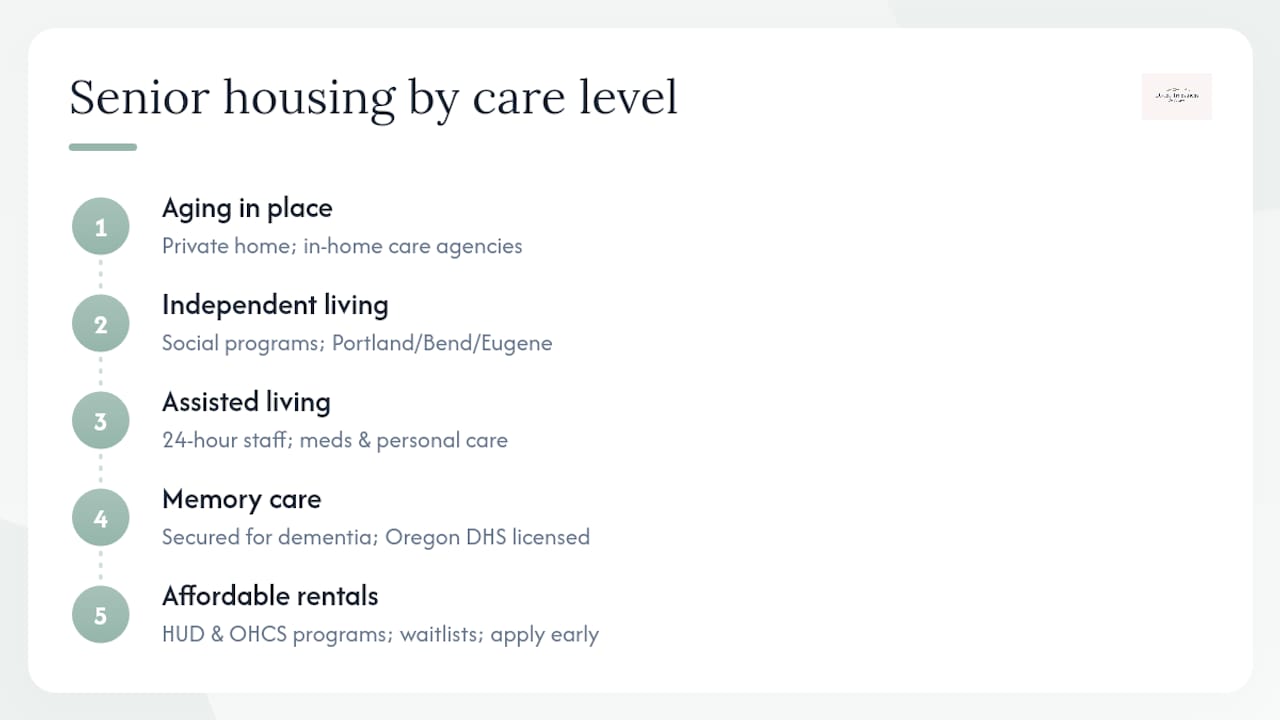
Aging in place with in-home care suits parents who are medically stable and want to stay in a private home. Oregon's Older Adult Housing Program is expanding accessible rental units statewide, though supply remains tight. In-home care agencies, including in-home senior care providers operating in the Pacific Northwest, can supplement daily needs without a facility move.
Independent living communities offer social programming and light services with no medical component. Portland, Bend, and Eugene each have strong options, and county-level service differences mean it's worth checking what's available in the specific city before committing.
Assisted living provides 24-hour staffing, medication management, and personal care. Memory care is a secured subset for parents with dementia. Both are licensed by Oregon DHS, and costs vary significantly by metro area.
Affordable rentals through HUD Section 8 and Oregon Housing and Community Services programs exist but carry waitlists. Apply early.
What does moving a parent to Oregon actually cost?
Costs stack up across three categories: the physical move, housing transition fees, and healthcare setup.
A long-distance household move typically incurs costs that vary depending on distance and volume. Oregon requires ODOT-certified movers for intrastate moves, written signed estimates, and certificate verification — skip those steps and disputes get expensive.
Assisted living in Oregon generally involves monthly fees and additional move-in costs, which vary by facility and level of care required. If your parent's home needs to sell to fund care, a traditional MLS listing can take 60–90 days; an as-is sale through a coordinated process can cut that to two to four weeks. Selling the home to fund senior care is often the fastest path when equity is the primary asset.
HECM reverse mortgages and HELOCs are alternatives worth comparing. A HECM vs. HELOC breakdown can clarify which funds care faster given your parent's equity position and timeline.
Healthcare setup costs include potential Medigap premium changes, prescription plan transfers, and specialist copays. Specialty medical appointment wait times in parts of Oregon can be several months, so scheduling ahead is advisable to minimize delays.
How do you help your parent adjust emotionally after the move?
The logistics are manageable. The emotional piece is harder, and it's where families often underinvest.
Your parent is leaving a home, a neighborhood, and a social network built over decades. Acknowledge that directly rather than rushing past it. Involve them in decisions wherever possible — which furniture comes, which community to tour — because agency reduces anxiety.

Oregon has strong senior center networks in Portland, Salem, Eugene, and Bend. Many offer daily programming, volunteer opportunities, and peer connection. The local Area Agency on Aging can point you to specific programs within days of arrival.
Video calls with old friends and family back home matter more than most families realize. Set up a tablet with a large-font interface before moving day, not after.
How do seniors get around Oregon without a car?
Oregon's transit options vary sharply by city. Portland's TriMet system is the most accessible, with bus, light rail, and the LIFT paratransit service for riders who qualify due to disability or age-related limitations. Salem, Eugene, and Bend each have local transit systems with paratransit components.
For rural counties, options thin out fast. Volunteer driver programs through local Area Agencies on Aging fill some of that gap. Ride-sharing apps like Lyft and Uber operate in most Oregon metros, and GoGoGrandparent provides a phone-based interface for seniors who don't use smartphones.
Pro Tip: Before choosing a specific city or neighborhood, check whether your parent's likely destinations — medical offices, grocery stores, senior centers — are reachable without a car. A walkability or transit audit takes 20 minutes and can prevent a serious quality-of-life problem.
What families usually get wrong about this process
Most families sequence this backward. They find a facility, sign a lease, and then scramble to fund it — which means a rushed home sale, missed Medicare windows, and no time for estate planning. The families who handle this well do the opposite: they nail the deadlines first, then make housing and funding decisions from a position of clarity.
The Medigap birthday rule is one of Oregon's most underused advantages for incoming seniors. A Salem Reporter column noted that moving to Oregon can produce meaningful annual savings for seniors who switch to a lower-cost plan like Plan G once they have access to the rule. Most families never hear about it because no one thinks to call SHIBA before the move.
Oregon's estate tax is the other blind spot. The $1 million threshold sounds high until you add a paid-off home, retirement accounts, and savings together. A pre-move conversation with an elder-law attorney costs a few hundred dollars and can prevent a five-figure tax surprise.
My prioritization framework: safety first (immediate housing and medical needs), then paperwork (DMV, Medicare, medical record transfers), then funding (home-sale options, HECM or HELOC), then legal protections (power of attorney, advance directive). That order matters. Funding decisions made before housing is secured tend to be reactive and expensive.
Book the SHIBA appointment and the DMV slot before moving day. Both take longer to schedule than families expect, and both unlock subsequent steps.
Divinetransitionsforseniors coordinates the whole move, not just one piece
When a parent needs care now and the home hasn't been touched in years, a traditional real estate process is the wrong tool. Divinetransitionsforseniors handles home-sale coordination (including fast as-is sales), belongings downsizing, and assisted-living placement coordination — all through one point of contact.

Families pay no direct fee for this coordination. Divinetransitionsforseniors earns referral fees from industry partners — real estate agents and care placement specialists — when a property sells or a placement is made. That structure means you get full-service support without an upfront cost.
The right time to call is when you're facing a simultaneous care placement and home sale, when the home needs work you don't have time to manage, or when you simply need someone to hold the timeline together. Reach out to Divinetransitionsforseniors to talk through your situation — no obligation, no pressure.
Key official resources for your Oregon move
Use these before and immediately after the move:
- Oregon Health Plan / CCOs: Oregon Medicaid is administered through county-level Coordinated Care Organizations; eligibility and waitlists vary by county.
- Oregon DOR — Estate tax: Review the $1 million threshold before the move if a home sale is involved.
- ODOT — Household goods moving: Verify your mover's ODOT certificate number and require a signed written estimate before loading.
- Visit Oregon relocation guide: Practical checklist covering no-sales-tax benefits, income tax considerations, and regional differences.
- Area Agency on Aging finder: Search by county at Oregon DHS to locate local services, transportation programs, and Medicaid waiver waitlists. Call before choosing a city.
Before calling any of these, have your parent's Medicare ID, prior insurance end date, current address, and Social Security number ready. It cuts call time in half.
This article is general information, not a substitute for advice from a qualified financial advisor. Consult a qualified financial professional about your own circumstances before acting on anything here.
Sources
- Oregon Department of Revenue: Estate tax
- Oregon Housing and Community Services: Older Adult Housing Program
- Oregon Department of Transportation: Household goods moving
- Visit Oregon: Relocate to Oregon
- OHSU: Moving to Oregon (moving guide for families)
FAQ
How soon must my parent get an Oregon driver's license?
Within 30 days of establishing Oregon residency, per Oregon DMV requirements. The visit must be in person.
What is Oregon's Medigap birthday rule?
Oregon allows Medicare Supplement policyholders to switch plans or carriers once per year without health-status underwriting, which can lower premiums tied to pre-existing conditions.
How long does moving a parent to Oregon take from start to finish?
Most families complete the core transition — housing secured, insurance transferred, DMV done — in 60–90 days when they start planning before the move date.
Can my parent move into assisted living before the house sells?
Yes. Options include bridge loans, a HELOC, or a fast as-is sale coordinated alongside the placement. See home sale contingency options for how families sequence this.
What does Oregon's estate tax mean for my family?
Oregon taxes estates above $1 million at rates from 10% to 16% on the amount over the threshold. A home sale that pushes total assets past that line can trigger the tax, so pre-move planning with an elder-law attorney is worth the time.