

Your fastest path to care funding is a coordinated as-is cash sale. For most Oregon families facing an urgent assisted living or memory care decision, that single move unlocks equity in days rather than months. A short-term bridge loan is the backup when a sale needs more time.
Two immediate options:
- As-is cash sale (coordinated): A cash buyer or investor purchases the home in its current condition. Cash buyers can close in as little as 7–14 days and typically pay 10–30% below market, trading top dollar for speed.
- Bridge loan or placement advance: If the home has equity but the sale isn't ready, a bridge loan covers deposits and first-month fees while the sale closes. Funds can arrive in days.
Read the step-by-step checklist in Section 4 for the exact actions to take in the next 72 hours.
Key Takeaways
Selling a senior's home quickly to fund care is achievable in 14–21 days with an as-is cash sale, but legal authority and Medicaid planning must come first.
| Point | Details |
|---|---|
| Confirm authority first | No sale can proceed without a valid POA, owner consent, or court guardianship order. |
| As-is cash sales close fastest | Cash buyers typically close in 7–21 days, trading 10–30% of market value for speed. |
| Medicaid look-back is five years | Gifts or below-market transfers within five years can trigger Medicaid penalties; consult an elder-law attorney before any transfer. |
| Carrying costs erode equity | An empty home accumulates mortgage, taxes, insurance, and utility costs that shrink net proceeds every month. |
| Divinetransitionsforseniors coordinates it all | Oregon and Washington families can get a free intake covering authority, timeline, and care placement alignment. |
Table of Contents
- What are your real options for accessing home equity fast?
- How do you choose the right option for your family?
- Step-by-step: how to get a parent's home sold fast
- What does a fast sale actually cost, and how long does it take?
- Legal and financial cautions you must understand before selling
- What one family's experience looked like
- How Divinetransitionsforseniors coordinates the whole transition for Oregon families
- Sources
- FAQ
What are your real options for accessing home equity fast?
When assisted living runs $4,500–$8,000 per month and memory care frequently exceeds $10,000, waiting 90 days for a traditional MLS sale isn't always realistic. Here are the practical routes:
- As-is cash sale to an investor or local cash buyer: Fastest close (7–14 days), no repairs, no cleanout required. Expect a 10–30% discount from market value. Best when the home needs work or the family can't manage showings.
- Direct investor marketplace: Platforms that connect sellers with multiple cash buyers simultaneously. Slightly more competitive offers than a single investor, but still fast.
- Auction: Can move quickly (30–45 days), but final price is unpredictable. Works better for distinctive or high-demand properties.
- Bridge loan: Short-term financing, typically structured for 6–12 months and requiring roughly 20% home equity to qualify. Covers care costs while the home sells on the open market. Carries interest and fees.
- HECM (reverse mortgage): Available only if the senior is still the primary resident and is 62 or older. Once they move to a care facility, HECM eligibility ends. Useful for in-home care transitions, not facility placement. See the HECM vs HELOC comparison for details.
- Family advance or private loan: A sibling or family member fronts the deposit while the sale proceeds. Informal but fast. Document it carefully to avoid estate disputes.
If the home has deferred maintenance and equity is thin, an as-is cash sale often nets more after carrying costs than a bridge-plus-MLS combination.
How do you choose the right option for your family?
Five questions narrow this down fast. Work through them in order.
-
How much equity does the home have? Low equity (under 20%) rules out bridge loans and makes an as-is cash sale or family advance the only realistic paths. Higher equity opens more doors.
-
How soon do you need funds? If a care facility requires a deposit within two weeks, only a cash sale or a family advance can meet that window. If you have 30–60 days, a bridge loan or even a light MLS listing becomes possible.
-
Who has legal authority to sell? Confirming legal authority is always the first step. A competent owner can sign directly. A valid durable power of attorney with real estate authority lets an adult child act. Without one of those, you'll need a court-appointed guardian or conservator before any sale can proceed.
-
Is Medicaid a realistic payor now or in the next five years? If yes, stop before transferring anything. Medicaid's five-year look-back penalizes below-market transfers and gifts. Selling at fair market value and using proceeds for care is generally acceptable, but the details matter enormously. Consult an elder-law attorney before signing anything.
-
What is the home's condition and clearout burden? A house full of 40 years of belongings, deferred repairs, and an overgrown yard is a poor candidate for a quick MLS listing. An as-is sale sidesteps all of that. If the home is well-maintained, a brief MLS exposure might recover the 10–30% discount.
Step-by-step: how to get a parent's home sold fast
Here's a realistic timeline for an as-is cash sale in Oregon. Traditional MLS sales run 45–90+ days; the Oregon sell house timeline for a coordinated as-is sale looks more like this:
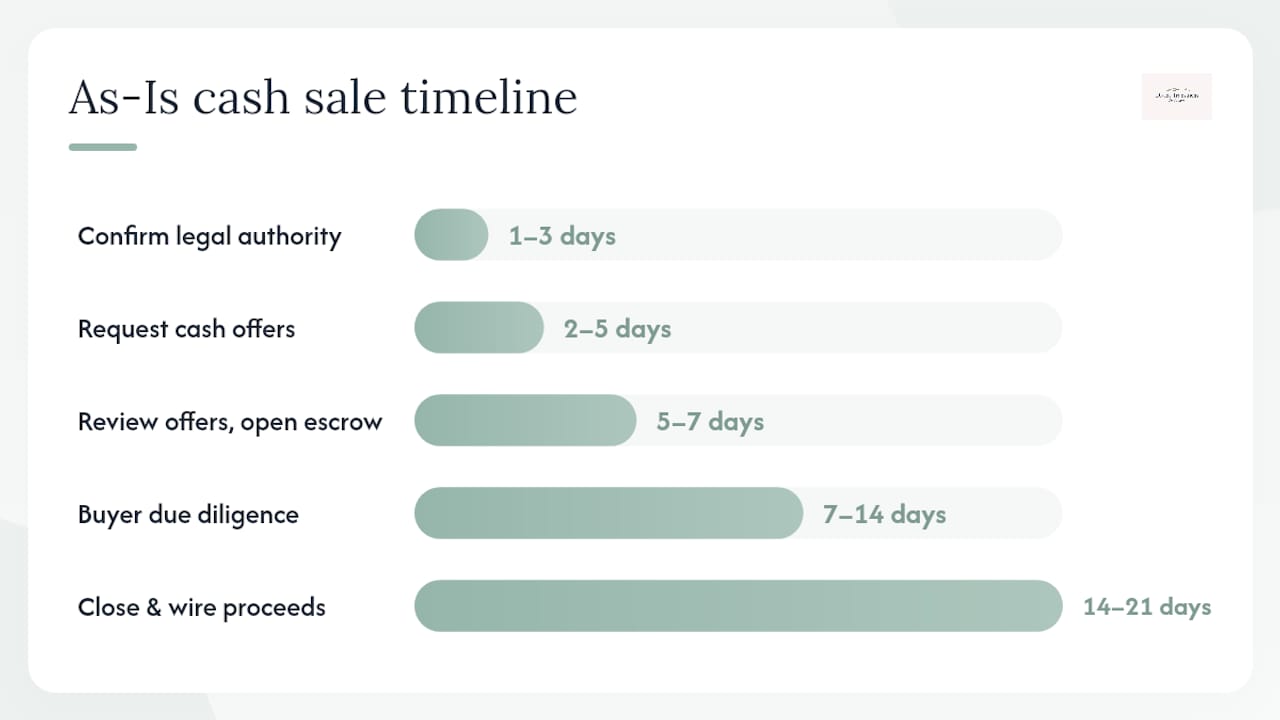
| Days | Action |
|---|---|
| 1–3 | Confirm legal authority (POA, guardianship, or owner consent); pull mortgage payoff statement |
| 2–5 | Request 2–3 cash offers; share basic property info and photos |
| 5–7 | Review offers; accept best fit; open escrow |
| 7–14 | Buyer due diligence, title search, inspection (as-is, no repairs) |
| 14–21 | Close; proceeds wire to family or care facility |
Documents you'll need (per Assistedliving):
- Proof of authority: signed POA with real estate language, or court order
- Current mortgage statement and payoff amount
- Property tax records and HOA documents (if applicable)
- Utility account info and access codes/keys
- Any known material defects disclosure
For belongings, you have three practical options: a partial family sort (keep sentimental items first), a donation pickup service, or a specialist estate clearance team that handles the full contents. Coordinate the clearout after the offer is accepted, not before, so it doesn't delay the listing.
Pro Tip: A light clean and basic yard tidy can add $5,000–$15,000 to a cash offer without requiring weeks of work. But if the home needs a new roof, HVAC, or foundation repair, skip it. Those repairs rarely return dollar-for-dollar in an as-is sale, and the time cost is worse than the price gap.
What does a fast sale actually cost, and how long does it take?
Here's the honest math. Say the home's market value (fully repaired) is $400,000.
- As-is cash sale: Buyer pays roughly $300,000–$360,000 (10–30% discount). Closing costs are typically low (cash buyers often cover fees). Net proceeds: approximately $285,000–$350,000 after a small mortgage payoff.
- Traditional MLS sale: List at $400,000, spend $20,000–$40,000 on repairs and staging, pay 5–6% agent commission, wait 45–90+ days. Net proceeds: roughly $330,000–$355,000, but three months later.
The gap narrows fast once you add carrying costs: mortgage, property taxes, insurance, and utilities on an empty home accumulate quickly and erode equity every month the house sits unsold.
Hidden closing risks to watch for:
- Title issues (liens, unpaid taxes, unclear ownership) that delay closing
- Authority gaps discovered mid-transaction when no valid POA exists
- Escrow timing mismatches between the home sale and the care facility's deposit deadline
- Probate delays if the senior has already passed and the estate hasn't been opened
A coordinated approach that aligns the sale timeline with the care placement timeline prevents most of these.
Legal and financial cautions you must understand before selling
The five-year Medicaid look-back is the single biggest legal trap families walk into. Medicaid is clear: transfers of assets below fair market value within five years of a Medicaid application can trigger a penalty period that delays eligibility. Selling the home at fair market value and spending the proceeds on care is generally fine. Gifting the home to a child, selling it for $1, or transferring it to a trust without proper planning is not.
Authority scenarios and what each allows:
- Competent owner: Can sign all sale documents directly. No additional authority needed.
- Valid durable POA with real estate authority: Adult child or agent can list, negotiate, and close on the owner's behalf. Verify the POA language explicitly covers real estate transactions.
- Court-appointed guardian or conservator: Required when the senior lacks capacity and no valid POA exists. Court approval for the sale may add 60–120 days to the process in Oregon.
What one family's experience looked like
A Portland-area family reached out after their father's dementia progressed to the point where he could no longer safely live alone. The house hadn't been updated since the 1990s, the garage held decades of tools and furniture, and there was no clear POA in place. The family had about three weeks before the memory care facility needed a deposit.

They confirmed a guardianship filing was already in process, accepted a cash offer within a week, and used a family advance to cover the deposit while escrow closed. The belongings were sorted in two sessions: one for family keepsakes, one for donation pickup. The father moved in before the house closed.
It wasn't easy, and the family took a price below what a renovated listing might have fetched. But the father was safe, the deposit was paid, and the family wasn't managing a vacant house across town. Involving him in small choices, like which chair to bring to his new room, made the transition feel less like something being done to him.
That kind of coordination is exactly what Divinetransitionsforseniors is built for.
How Divinetransitionsforseniors coordinates the whole transition for Oregon families
When you're managing a parent's care placement, a house full of belongings, and a closing deadline at the same time, having one point of contact changes everything.

Divinetransitionsforseniors coordinates the entire process for Oregon and Washington families: connecting you with vetted cash buyers and real estate professionals, managing the belongings sort and clearout timeline, aligning the home sale closing with your parent's move-in deposit deadline, and working alongside senior placement specialists rather than around them. Families pay nothing directly. The service runs on referral arrangements with real estate and placement partners.
The intake takes about 20 minutes and covers the home's condition, your timeline, authority status, and care placement needs. From there, you get a clear picture of the fastest appropriate path. Divinetransitionsforseniors and get a same-week response.
Sources
- What is a bridge loan? — Bankrate
- Medicaid
- Unsellable Home to Cash Fast: As-Is Buyers Fund Senior Care Now - The DailyMoss
- Assistedliving
- Selling a Parent's Home to Pay for Long-Term Care | Karen Langsfeld
Always consult a licensed elder-law attorney for Medicaid questions and verify current Oregon probate and guardianship procedures with a local attorney before acting.
This article is general information, not a substitute for advice from a qualified financial advisor. Consult a qualified financial professional about your own circumstances before acting on anything here.
FAQ
Can you sell a house before probate is complete?
If the senior is still living and has a valid durable power of attorney with real estate authority, the home can be sold without any probate process. Probate applies only after death; a POA or guardianship order covers sales during the senior's lifetime.
How long does selling a house in probate or guardianship take in Oregon?
An as-is cash sale with authority already confirmed typically closes in 14–21 days. If a court-appointed guardianship is needed first, add 60–120 days for the court process in Oregon before the sale can proceed.
Does selling a parent's home affect Medicaid eligibility?
Selling at fair market value and using proceeds for care is generally permitted under Medicaid rules. Gifts, below-market sales, or transfers to family members within five years of a Medicaid application can trigger a penalty period. Consult an elder-law attorney before any transfer.
Can you sell a house held in a trust?
Yes. If the home is in a revocable living trust and the senior is the trustee, they can sell directly. If a successor trustee has taken over, that trustee has authority to sell per the trust document, usually without court involvement.
What is the fastest way to sell a senior's home to pay for memory care?
An as-is cash sale coordinated alongside the care placement is the fastest path. Cash buyers can close in 7–14 days, and a senior transition coordinator can align that closing with the facility's deposit deadline so the family isn't managing both at once.