

If you must access or sell a parent's house to pay for care, confirm legal authority first: who is on the deed, is there a durable power of attorney (POA), and can your parent still sign? Once you know that, secure short-term funding to cover care while the sale moves forward, and appoint one family member to coordinate everything.
Your first 72 hours:
- Pull the deed from your county recorder's website or office and confirm who holds title.
- Locate any existing POA, trust documents, or will.
- Call an elder-law attorney if authority is unclear or your parent's capacity is in question.
- Appoint a single family point person to handle calls, decisions, and paperwork.
If authority is unclear right now:
- Contact a title company for a preliminary title search.
- Reach out to an elder-law attorney for a same-week consult.
- Explore a bridge loan or cash buyer to cover care costs while legal steps catch up.
Pro Tip: Don't wait for a crisis to check the deed. Many families discover a deceased spouse is still listed as a co-owner, which stops a sale cold until probate clears it.
Key Takeaways
Confirming legal authority to sell is the single most time-sensitive step: a missing or invalid POA can add months to the timeline and delay care funding entirely.
| Point | Details |
|---|---|
| Confirm legal authority first | Check the deed and POA before listing; a durable POA with real-property language is required to sell on a parent's behalf. |
| Match funding to your timeline | Cash buyers often close in less than a month; bridge loans fund within a few weeks; traditional sales typically take several months. |
| Address occupancy early | A family member living in the home may have tenant rights under Oregon law; resolve status before listing to avoid closing delays. |
| Watch for benefits impact | Home sale proceeds count as assets for Medicaid and VA pension; consult an elder-law attorney before selling below market value. |
| Divinetransitionsforseniors | Coordinates the full transition for Oregon and Washington families at no charge, from legal referrals to as-is home sales. |
Table of Contents
- What are the fastest ways to access home equity for care?
- How do you confirm legal authority to sell a parent's home?
- What if your parent still lives in the house?
- How do you prepare a parent's home for sale quickly?
- What are the detailed funding options and their real costs?
- How do you prevent sibling conflict during a home sale?
- What red flags can delay or derail a home sale?
- What does a realistic sale timeline look like?
- What are tenant rights when living in a parent's house?
- How does tenant status affect a property sale?
- What is the difference between a formal tenant and an informal occupant?
- What rights and responsibilities do family-member tenants have?
- How do Oregon's landlord-tenant laws affect selling a home with a tenant?
- What can a family-member occupant do during a sale or transition?
- Divinetransitionsforseniors coordinates the whole transition, not just the sale
- What families often get wrong about this process
- Sources
- FAQ
What are the fastest ways to access home equity for care?
Selling a parent's home is an emotional milestone layered with legal logistics. Before you choose a funding path, match the option to your timeline and your parent's situation.
| Option | Typical Close Time | Net Proceeds | Best Fit |
|---|---|---|---|
| Cash buyer / as-is sale | typically less than a month | Lower | Urgent move, deferred maintenance, no time to prep |
| Bridge loan | short-term funding period | Full (minus fees) | Parent moving now, sale pending |
| HELOC | several weeks | Full (minus interest) | Parent still lives there, has equity, can qualify |
| HECM reverse mortgage | several weeks | Partial draw | Parent stays in home, age 62+, no monthly payment |
| Traditional MLS sale | multiple months | Highest | Time available, home is in good condition |
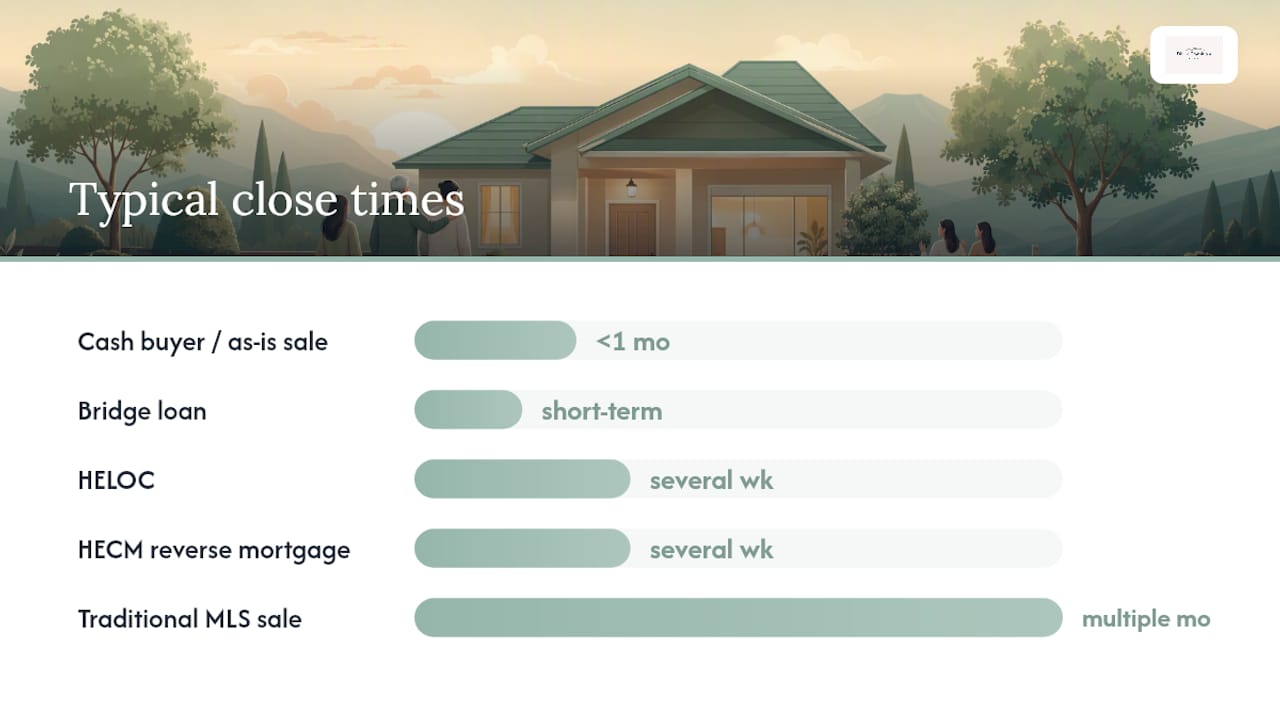
Cash buyer programs trade some net proceeds for speed and certainty, cutting out the contingency delays that derail traditional sales. For families who need a parent in memory care this week, that tradeoff is often worth it.
Key tradeoffs to weigh:
- Speed vs. net proceeds: cash buyers close fast but typically below market value.
- Benefits impact: sale proceeds count as assets for Medicaid and VA pension purposes, potentially affecting eligibility.
- Occupancy: a HECM requires the parent to remain the primary resident; moving to assisted living terminates it.
How do you confirm legal authority to sell a parent's home?
Legal authority is the single biggest source of delay. Confirm it before you list, sign anything, or accept an offer.
Step-by-step checklist:
- Check the deed. Visit your Oregon county assessor or recorder online. Look for joint tenancy with right of survivorship, tenancy in common, or trust ownership — each has different rules for who can sell.
- Review the POA. A durable power of attorney must explicitly grant real-property authority to sell. A general POA or a healthcare POA does not cover real estate.
- Confirm the POA is durable. "Durable" means it survives incapacity. A standard POA terminates the moment your parent loses capacity, which is exactly when you need it most.
- Check for a trust. If the home is held in a revocable living trust, the trustee can sell without probate.
- Gather these documents: deed, mortgage statements, homeowners insurance declarations page, POA or trust agreement, death certificate (if a co-owner has passed).
A POA for property can grant broad powers to buy, sell, rent, and manage real estate, and it can take effect immediately or upon a future trigger. Without one, no one automatically has the legal right to act on your parent's behalf.
When no valid POA or trust exists and your parent lacks capacity, a court guardianship petition is typically required, and the sale will need court approval, an independent appraisal, and post-closing reporting. That process commonly adds months to the timeline.
Pro Tip: Title companies will scrutinize your POA and may require a recorded copy before accepting a deed signed by an agent. Have an elder-law attorney review the document before you present it to a title company.
What if your parent still lives in the house?
Capacity for signing documents is task-specific: your parent may be able to consent to a home sale even if they need memory care for daily tasks. An elder-law attorney or geriatric care manager can help assess this.
Communication tactics that reduce conflict:
- Slow the pace. Give your parent time to process each decision separately.
- Offer either/or choices rather than open-ended questions ("Would you prefer to move in March or April?" not "When do you want to move?").
- Use one spokesperson for all conversations with your parent to avoid contradictory messages.
- Document every agreement in writing, even informal ones.
Bring in a geriatric care manager early if your parent resists the move or if capacity is uncertain. A real estate agent experienced with senior transitions can also pace showings and negotiations to reduce stress on your parent.
How do you prepare a parent's home for sale quickly?
Most families overinvest in repairs and underinvest in decluttering. Here is a triage approach.
- Address safety and smell first. Fix trip hazards, replace burned-out fixtures, and eliminate odors. These affect every buyer's first impression.
- Paint main living areas. A single coat of neutral paint returns more per dollar than almost any other cosmetic fix.
- Declutter before photos. Clear counters, closets, and the garage. Rent a pod or hire a senior move manager for a weekend blitz.
- Skip deep repairs. Roof replacements, HVAC upgrades, and kitchen remodels rarely return full cost in a quick sale.
- Photograph early. Good photos, taken after decluttering, can go live within days.
When to skip prep entirely and sell as-is:
- The home has deferred maintenance that would cost more to fix than it adds in value.
- Your parent needs care now and a 60-day prep timeline is not realistic.
- The home is full of decades of belongings and clearing it would take months.
Pro Tip: For Oregon families, selling a parent's home as-is to a cash buyer often closes faster than a traditional MLS sale, even accounting for the price difference.
What are the detailed funding options and their real costs?
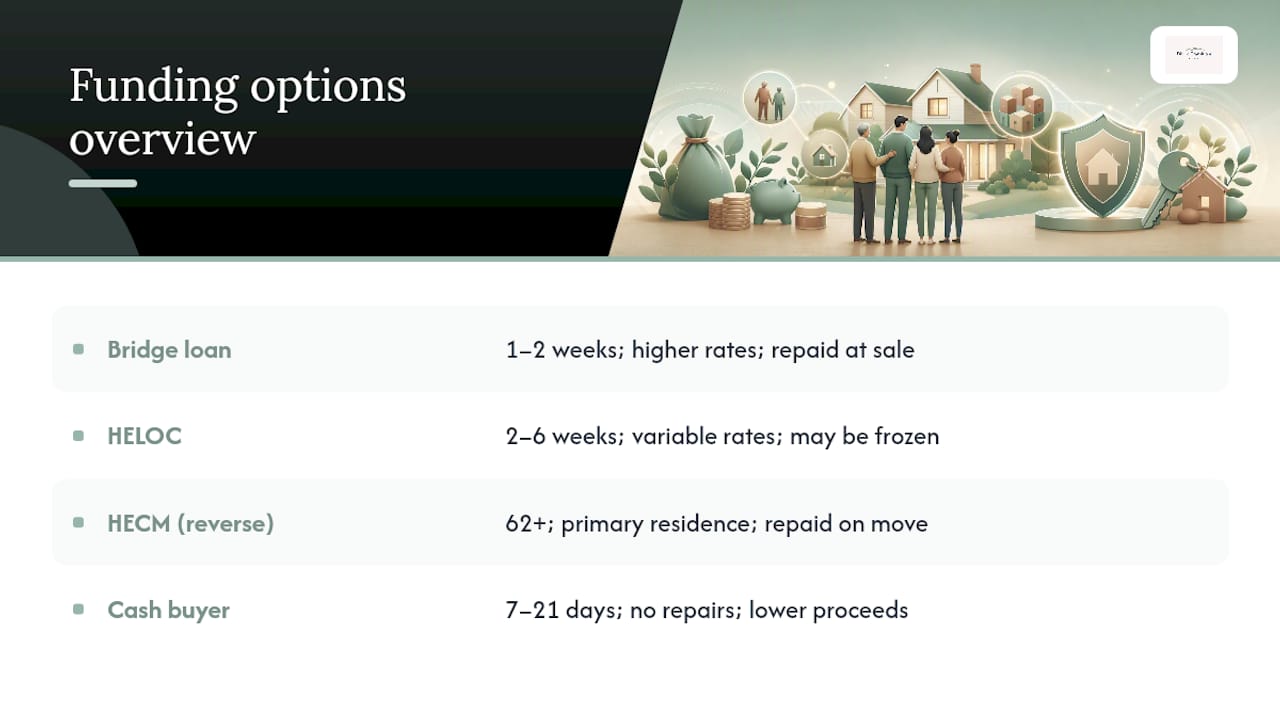
Bridge loans are short-term loans secured by the home's equity. They fund in one to two weeks and let your parent move into care immediately while the sale proceeds. Interest rates run higher than a conventional mortgage, and most lenders require a clear path to repayment (the home sale). They work best when the parent has substantial equity and the home will sell within six months.
HELOCs take two to six weeks to open and carry variable interest rates. The risk: if your parent moves to assisted living, the lender may freeze the line because the home is no longer owner-occupied. Confirm occupancy requirements with the lender before relying on this option.
HECM reverse mortgages require the borrower to be 62 or older and to occupy the home as a primary residence. Moving to assisted living triggers repayment. They work for parents who plan to stay home with in-home care for a period before transitioning.
Cash buyers close in 7–21 days with no contingencies and no repairs required. The tradeoff is lower net proceeds compared with a full market sale, but for families facing an urgent care decision, the speed and certainty often outweigh the price difference.
Before choosing any funding path, consult an elder-law attorney and a CPA. Selling a house to fund senior care can affect Medicaid and VA pension eligibility because proceeds increase countable assets. Lookback rules and spend-down requirements vary by state and benefit program.
Understanding Medicare coverage boundaries for assisted living is equally important: Medicare does not cover custodial assisted living costs, which means home equity is often the primary funding source families have.
How do you prevent sibling conflict during a home sale?
Transparency and shared goals are the most reliable safeguards. Appoint one point person before the first offer arrives.
- Name a point person in writing. This person receives all offers, communicates with agents and attorneys, and brings decisions to the family.
- Set a decision matrix upfront. Example: accept any full-price, no-contingency offer without a family vote; escalate all other offers to a group decision within 48 hours.
- Document every decision. Use a shared folder (Google Drive works fine) with dated notes on offers received, expenses paid, and distribution agreements.
- Track expenses from day one. Repairs, storage, utilities, and carrying costs all affect net proceeds and can become sources of dispute if undocumented.
Pro Tip: Set the decision matrix before emotions run high. A family that agrees on rules in week one rarely fights about offers in week six.
- Keep a running log of all family communications about the sale.
- Agree on how proceeds will be distributed before the home goes on the market.
- If conflict is already present, a mediator or elder-law attorney can facilitate a family meeting.
What red flags can delay or derail a home sale?
Catching these early saves weeks.
- Unclear title: A deceased co-owner still on the deed requires probate before the property can transfer. Run a preliminary title search immediately.
- Unpaid property taxes: Oregon counties can place a lien for delinquent taxes. Check with your county tax assessor before listing.
- Mechanic's liens or judgment liens: Contractors or creditors may have filed liens. A title company will find these; resolve them before closing.
- Lapsed homeowners insurance: Lenders and buyers require active coverage. Reinstate it immediately if it has lapsed.
- HOA violations: Unresolved fines or violations can block a transfer. Contact the HOA early.
- Occupancy disputes: If an adult child or other family member lives in the home, their occupancy status affects the sale timeline and may require formal notice.
Title and lien issues are the most common reasons a closing gets pushed back by weeks. A title company can identify most of them in a preliminary search within a few days — order one before you list.
Selling a parent's home with unresolved liens or unclear title can also affect benefits planning if the delay pushes care costs onto private funds longer than anticipated.
What does a realistic sale timeline look like?
Scenario A: Parent is competent and sells before moving
| Week | Key Actions |
|---|---|
| Week 1 | Confirm deed/title, review POA, appoint point person, contact agent |
| Week 2 | Declutter, photos, list home |
| Weeks 3–5 | Showings, offers, accepted contract |
| Weeks 6–8 | Inspection, appraisal, closing |
Scenario B: Parent moves before the sale closes
- Arrange a bridge loan or interim funding to cover care costs from day one.
- Begin decluttering and prep immediately after the move.
- List within two to three weeks of the move; close in 30–60 days.
Scenario C: No POA, guardianship required
- File guardianship petition: 4–12 weeks depending on court calendar.
- Court approval to list and sell: additional 4–8 weeks.
- Closing after court approval: 30–60 days.
- Total: 3–6 months minimum. Secure alternative funding for care during this period.
Seasonal note: Oregon's spring market (March through June) typically brings more buyers and faster sales. A winter listing may take longer but can still attract serious buyers, especially for as-is or cash-buyer transactions.
What are tenant rights when living in a parent's house?
The phrase "tenant rights in a parent's house" covers a specific situation families face during care transitions: an adult child or other family member occupies the parent's home, and the family needs to sell or access that equity. Understanding the occupant's legal status matters before you list.
In Oregon, a person living in a home without a written lease and without paying rent is typically considered a licensee or permissive occupant, not a tenant. Oregon's landlord-tenant law (ORS Chapter 90) applies when there is a rental agreement, written or oral, and when rent is exchanged. A family member living rent-free under informal permission generally does not have the same statutory protections as a paying tenant.
That said, if an adult child has been paying rent, even informally, Oregon courts may recognize a month-to-month tenancy. That status carries real notice requirements: at minimum, a 30-day written notice to vacate for a month-to-month tenancy of less than one year, and 60 days for longer occupancies under most circumstances.
How does tenant status affect a property sale?
A tenant with a valid lease has the right to remain in the home through the lease term, even after a sale. Oregon law requires the new owner to honor existing leases. For families trying to sell quickly, a sitting tenant with a 12-month lease can significantly complicate the transaction: many buyers, especially owner-occupants, will not purchase a home they cannot move into.
If the occupant is a month-to-month tenant, the seller (or the estate) can issue a notice to vacate before or during the sale process. Timing matters: the notice period must run before closing if the buyer requires vacant possession. A real estate attorney can confirm the correct notice language and delivery method under Oregon law.
For families selling a parent's home in Oregon, resolving occupancy status early, ideally before listing, prevents the kind of last-minute closing delays that push care funding back by weeks.
What is the difference between a formal tenant and an informal occupant?
A formal tenant has a written or oral rental agreement, pays rent, and holds statutory rights under Oregon's landlord-tenant law. They are entitled to proper notice, habitability standards, and protection against retaliatory eviction.
An informal occupant (sometimes called a permissive occupant or licensee) lives in the home with the owner's permission but without a rental agreement or rent payment. Their right to remain is tied to the owner's permission, which can be withdrawn. In Oregon, even informal occupants typically require a written notice to vacate, though the process is generally faster than a formal eviction.
The practical difference during a sale: a formal tenant can delay closing if their lease has not expired. An informal occupant can usually be asked to leave with proper written notice, though the family should confirm the correct process with an attorney to avoid procedural errors that restart the clock.
What rights and responsibilities do family-member tenants have?
Family members who pay rent, even below-market rent, generally hold the same statutory rights as any other tenant under Oregon law. Those rights include the right to proper notice before eviction, the right to a habitable home, and protection against self-help eviction (changing locks without a court order).
Their responsibilities mirror those of any tenant: paying rent on time, maintaining the property in reasonable condition, and complying with the terms of any agreement. If the family member has been paying utilities or making repairs in lieu of rent, an attorney should assess whether that arrangement creates a tenancy.
One practical note for families: if you need a family member to vacate so you can sell, a written agreement with a clear move-out date is almost always faster and less costly than a formal eviction. Most family members will cooperate when the situation is explained clearly and they are given reasonable time.
How do Oregon's landlord-tenant laws affect selling a home with a tenant?
Oregon has some of the stronger tenant-protection statutes in the country. Under ORS Chapter 90, landlords in most Oregon cities must provide cause for termination after the first year of tenancy. Portland has additional just-cause eviction requirements and relocation assistance obligations that apply even during a sale.
For families managing a parent's home with a sitting tenant, the key practical steps are:
- Identify whether the tenancy is month-to-month or fixed-term.
- Confirm whether the property is in Portland or another Oregon city with enhanced tenant protections.
- Issue any required notices as early as possible, since notice periods run concurrently with sale prep time.
- Consult a real estate attorney before issuing any termination notice to confirm the correct grounds and timing.
A tenant who receives proper notice and vacates on schedule does not affect the sale. A tenant who disputes the notice or refuses to vacate can delay closing by weeks or longer, which directly affects when care funding becomes available.
What can a family-member occupant do during a sale or transition?
If you are the family member living in a parent's home and a sale is being planned, you have options beyond simply waiting for a notice.
- Review your occupancy status. Do you have a written lease? Have you been paying rent? Your legal standing depends on the answer.
- Request written notice. Oregon law requires written notice for termination of any tenancy, formal or informal. You are entitled to that notice regardless of the family relationship.
- Negotiate a timeline. Most families prefer a cooperative transition. A written agreement on your move-out date, any moving assistance, and deposit return (if applicable) protects everyone.
- Consult Oregon Legal Services or a tenant's rights organization if you believe your rights are being violated. Oregon Law Help (Oregonlawhelp) provides free legal guidance for qualifying individuals.
- Understand that a sale does not automatically terminate your tenancy. If you have a valid lease, the new owner must honor it. If you are month-to-month, proper notice is required before you must vacate.
The goal for most families is a cooperative transition, not an adversarial one. Clear communication, written agreements, and reasonable timelines resolve the vast majority of family occupancy situations without legal conflict.
Divinetransitionsforseniors coordinates the whole transition, not just the sale
When your parent needs care now and the home has to sell to fund it, the logistics pile up fast: legal authority, occupancy questions, decluttering, agent coordination, and placement timing all run at once.

Divinetransitionsforseniors serves Oregon and Washington families at no charge. The first consult covers a rapid assessment of your situation, a document checklist, referrals to elder-law attorneys and experienced real estate agents, and a clear picture of your fastest path to funding care. Whether the home needs a full market sale or an as-is cash transaction, the team coordinates the moving parts so you can focus on your parent.
For Oregon families navigating senior care, having one trusted point of contact through this process makes a measurable difference in how quickly care gets funded and how much stress the family absorbs along the way.
Divinetransitionsforseniors to get a same-week assessment of your situation.
What families often get wrong about this process
Most families spend the first two weeks cleaning out closets and arguing about furniture. The legal authority question sits unaddressed until a title company flags it at closing, and suddenly a 45-day sale becomes a four-month guardianship proceeding.
The families who move fastest are the ones who treat the deed check and the POA review as the first task, not the last. Everything else, the repairs, the staging, the offers, depends on having clean legal authority to sign. A home that is ready to list but has a clouded title or a disputed occupant is not actually ready to list.
The other thing families consistently underestimate is the occupancy question. An adult child living in the home, even informally, can slow a sale if their status is not addressed early. A conversation and a written agreement in week one costs nothing. A contested eviction in week eight costs time, money, and family relationships.
Sources
When to call a professional: Contact an elder-law attorney before issuing any eviction or termination notice, before signing a POA on a parent's behalf, and before accepting any offer that could affect Medicaid eligibility. A title company can run a preliminary title search within days and identify liens, ownership gaps, and recording issues before they become closing problems.
This article is general information, not a substitute for advice from a qualified financial advisor. Consult a qualified financial professional about your own circumstances before acting on anything here.
FAQ
What rights does a family member living in a parent's home have in Oregon?
A family member paying rent, even informally, likely holds month-to-month tenant rights under Oregon's landlord-tenant law and is entitled to written notice before being asked to vacate. A rent-free permissive occupant has fewer statutory protections but still requires written notice to vacate under most circumstances.
Can you sell a parent's home if they have dementia and no POA?
Without a valid durable POA, you typically cannot sign on your parent's behalf. Families must usually petition for court guardianship or conservatorship, a process that commonly takes several months and requires court approval to list and sell the property.
How does selling a parent's home affect Medicaid eligibility?
Sale proceeds count as countable assets and can temporarily disqualify your parent from Medicaid until the funds are spent down on qualifying care expenses. Consult an elder-law attorney before selling at below market value, as Medicaid's lookback rules can treat undervalued transfers as disqualifying gifts.
How quickly can a parent's home sell if it needs repairs?
An as-is cash sale can close in 7–21 days regardless of the home's condition. A traditional MLS sale typically takes multiple months, and repair time adds to that. For families facing an urgent care placement, the speed difference often outweighs the price difference.
Does a tenant's lease survive a home sale in Oregon?
Yes. Oregon law requires a new owner to honor an existing lease through its term. If you are selling a parent's home with a sitting tenant, the buyer takes the property subject to that lease, which can affect your pool of buyers and your closing timeline.