

Assisted living costs can be tax-deductible, but only under specific conditions. The IRS allows deductions when your parent qualifies as "chronically ill" and receives care under a written plan prescribed by a licensed practitioner. Without that certification, only the documented medical and nursing portion of facility fees may qualify. Two things to do right now:
- Request an itemized statement from the facility showing the dollar split between medical/nursing services and room and board.
- Get a written physician certification or care plan dated within the last 12 months confirming your parent's chronic illness status.
These two documents are the foundation of any assisted living expenses tax write-off. IRS Publication 502 and Schedule A (Form 1040) govern the entire claim.
Table of Contents
- Who does the IRS consider "chronically ill"?
- Which assisted living expenses can you actually deduct?
- How to calculate the deductible amount and claim it on Schedule A
- What documentation should you collect from the doctor and facility?
- Common mistakes families make and audit red flags to avoid
- What if your parent doesn't qualify? Other ways families fund assisted living
- Key Takeaways
- Why documentation timing is the part most families underestimate
- How Divinetransitionsforseniors helps Washington families fund care and stay organized
- Useful sources to read next
- FAQ
Who does the IRS consider "chronically ill"?
The IRS uses a precise definition, and it matters more than the facility's license type. Your parent qualifies as chronically ill under one of two conditions:
- Severe cognitive impairment: — Requires substantial supervision to protect against threats to health and safety.
The six ADLs the IRS recognizes are eating, toileting, transferring (moving from bed to chair), bathing, dressing, and continence. The distinction between "hands-on" assistance (physically guiding or supporting the person) and "standby" assistance (supervising without touching) both count under IRS guidance.
Certification must come from a licensed practitioner — a physician, registered nurse, or licensed social worker — and must be dated within 12 months of the tax year you're claiming.
Pro Tip: Get the certification in writing with a clear date. As your parent's condition progresses, deductibility can change. A resident who didn't qualify last year may qualify this year if care needs have escalated.
Which assisted living expenses can you actually deduct?
The core distinction is medical and nursing services versus ordinary room and board. Here's how it breaks down:
- Chronically ill resident with a care plan: Room and board can become fully deductible when the stay is primarily for medical care under a licensed practitioner's plan of care. The entire facility fee may qualify.
- Resident who does not meet the chronically ill threshold: Only the portion of fees attributable to nursing and medical services is deductible. Room and board stays off the table.
Facilities often bundle everything into one monthly fee. Many will provide an estimate of the percentage attributable to nursing services, but they rarely do it proactively. You have to ask. Request a written, itemized invoice that separates care services from housing costs in dollar amounts, not just percentages.
Deductibility hinges on the services provided and the certified care plan, not the facility's licensing label. A "residential" facility and a "health facility" can produce identical deductions if the documentation supports it.

Pro Tip: Ask the facility for a signed statement tying specific medical services to the billing line items. A dated care plan plus an itemized bill is the combination that holds up in an audit.
How to calculate the deductible amount and claim it on Schedule A
Medical expenses are only deductible to the extent they exceed 7.5% of your Adjusted Gross Income (AGI), and you must itemize on Schedule A (Form 1040) rather than taking the standard deduction.
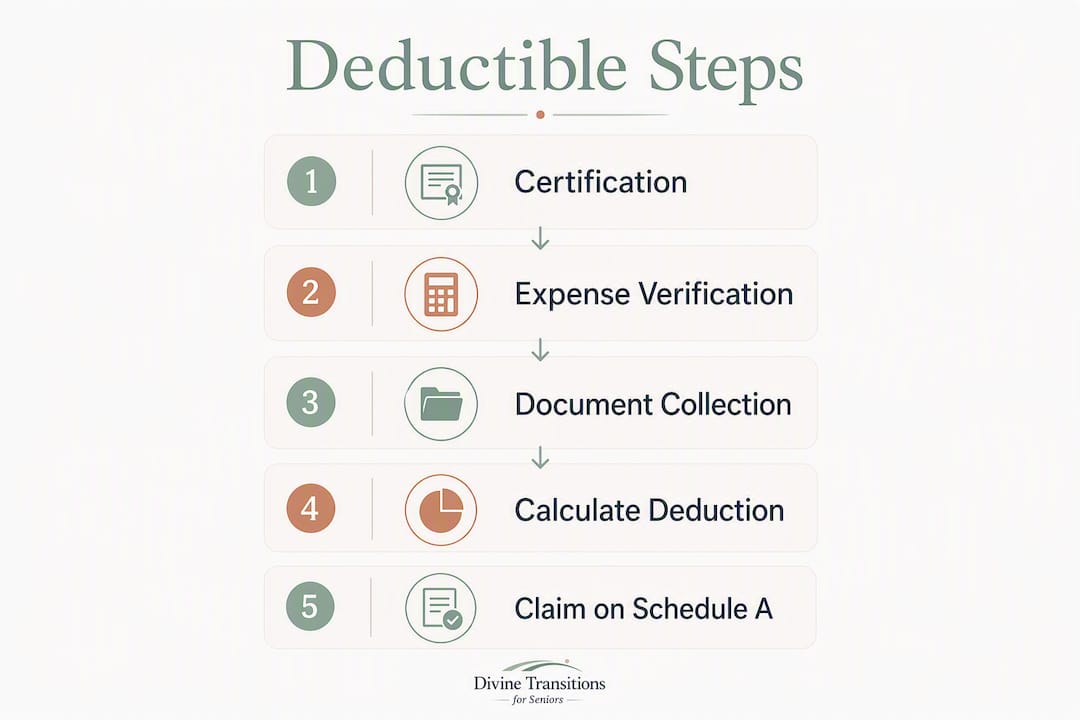
Step-by-step calculation:
- Add up all qualifying medical expenses for the year, including deductible assisted living costs.
- Multiply your AGI by 7.5% (0.075).
- Subtract that figure from your total qualifying expenses. The remainder is your deductible amount.
Worked example: To calculate your deduction, multiply your AGI by 7.5% and subtract that from your total qualifying medical expenses.
Report the total on Schedule A, Line 1 (medical and dental expenses), then apply the 7.5% floor on Line 3 and carry the net to Line 4.
One important reduction: any amount reimbursed by insurance, VA benefits, or Medicaid must be subtracted before you calculate. Qualified long-term care insurance benefits that pay facility costs directly also reduce your deductible amount dollar for dollar.
What documentation should you collect from the doctor and facility?
Gather these before you file, and keep them for at least three years after the return date:
- Written chronic illness certification from a physician, RN, or licensed social worker, dated within 12 months of the tax year.
- Written plan of care prescribing the specific services your parent receives, prepared by a licensed care practitioner.
- Itemized facility invoices showing dollar amounts for medical/nursing services versus room and board, for every month claimed.
- Payment receipts or bank/credit card statements confirming amounts and dates.
- Physician's notes documenting ADL loss or cognitive impairment, with dates of assessment.
Timing matters for which tax year you claim an expense. Under Publication 502, a credit card charge is deductible in the year charged, and a check is deductible in the year mailed, regardless of when the facility processes it.
Common mistakes families make and audit red flags to avoid
Most families get tripped up before they ever file. The single most common error is assuming all assisted living costs are automatically deductible. The critical question is always whether the stay is primarily for medical care under a prescribed care plan.
Watch for these mistakes:
- Relying on the facility's license type instead of a certified plan of care. A memory care license does not equal a chronic illness certification.
- Claiming large room-and-board amounts without a care plan or itemized billing to support them.
- Inconsistent dates between the care plan, the physician certification, and the billing period.
- Claiming reimbursed expenses. If insurance or Medicaid paid it, you cannot deduct it.
- Skipping annual re-evaluation. Eligibility can change as conditions progress, and so can the deductible amount.
The fix for all of these is the same: get everything in writing, keep dates consistent, and re-check eligibility each tax year.
What if your parent doesn't qualify? Other ways families fund assisted living
When the tax deduction isn't available or doesn't cover enough, families in Washington typically turn to one of these options:
- Long-term care insurance: — Benefits are often tax-free and can cover a substantial share of facility costs. Check whether your parent's policy qualifies under IRS rules.
- Home-sale proceeds: For many families, the parent's home is the largest available asset. Using home equity to fund assisted living is often the fastest path to meaningful funds, especially when care is needed immediately.
- HECM or HELOC: A reverse mortgage (HECM) or home equity line of credit can bridge the gap between care start date and home sale. Each carries different costs and timelines. A comparison of HECM vs. HELOC can help you decide which fits your situation.
- Multiple Support Declaration (Form 2120): When siblings share the cost of a parent's care, Form 2120 lets one sibling claim the parent as a dependent and take the medical deductions, as long as that sibling pays more than 10% and the group collectively pays more than 50%.
For families exploring companion care or non-medical supports as part of a broader care plan, companion visits for elderly parents can supplement facility-based care and help document ongoing care needs.
Key Takeaways
Assisted living costs are deductible only when your parent is certified as chronically ill and care is provided under a written plan, with all qualifying expenses exceeding 7.5% of your AGI on Schedule A.
| Point | Details |
|---|---|
| Chronically ill certification | Your parent must fail two ADLs for 90+ days or have severe cognitive impairment, certified by a licensed practitioner within 12 months. |
| 7.5% AGI threshold | Only medical expenses above 7.5% of your AGI are deductible; you must itemize on Schedule A (Form 1040). |
| Itemized facility billing | Request a written invoice splitting medical/nursing services from room and board in dollar amounts before filing. |
| Reimbursements reduce the deduction | Subtract any insurance, VA, or Medicaid payments from qualifying expenses before calculating your deductible amount. |
| Divinetransitionsforseniors | Coordinates home-sale timing and connects Washington families with placement specialists and elder-law professionals to fund and document care transitions. |
Why documentation timing is the part most families underestimate
The families I see navigate this most successfully share one trait: they started gathering paperwork before the move, not after. By the time a parent is settled into a facility, the admission notes are filed, the care plan is signed, and the billing cycle has started. That's the window. Miss it, and you're asking a facility to reconstruct records months later, which is harder for them and less convincing to the IRS.
The deduction itself is often smaller than families expect, because the 7.5% AGI floor takes a real bite. But for a family with $12,000 or $15,000 in qualifying costs, the savings are real and worth the administrative effort. The documentation steps are not complicated. They just require asking the right questions at the right time.
What I'd tell any adult child right now: call the facility this week and ask two questions. First, does my parent have a written care plan signed by a licensed practitioner? Second, can you provide an itemized statement separating nursing services from room and board? Those two calls can determine whether you have a deduction at all.
How Divinetransitionsforseniors helps Washington families fund care and stay organized
When your parent needs assisted living now and the home is the main asset, the gap between "care starts Monday" and "the house closes in 60 days" is real and stressful. Divinetransitionsforseniors was built for exactly that gap.

For Washington families, Divinetransitionsforseniors coordinates the home-sale timeline alongside the move to assisted living, including as-is sales for homes that haven't been maintained or are full of decades of belongings. The team connects families with trusted placement specialists, elder-law attorneys, and CPAs who understand the documentation a senior care tax deduction requires. One point of contact handles the moving parts so families can focus on their parent's care.
If you're trying to figure out how to fund assisted living quickly while keeping the paperwork straight, reach out to Divinetransitionsforseniors for an initial consultation.
Useful sources to read next
- IRS Publication 502, Medical and Dental Expenses: The primary IRS reference for all medical expense deductions, including the chronically ill definition, ADL criteria, and the 7.5% AGI threshold. Bring this to your CPA.
- Schedule A (Form 1040): The IRS FAQ on medical and nursing home expenses explains which line items to use and when a nursing home qualifies.
- Form 2120, Multiple Support Declaration: Use this when siblings share a parent's support costs and need to allocate the dependent claim. Bring it to a tax advisor if siblings disagree on who claims the deduction.
- IRS INFO 2009-0010: Technical IRS guidance defining hands-on versus standby assistance and when meals and lodging qualify as a necessary incident to medical care.
- Burzynski Elder Law: Assisted Living Facility Tax Deductions: A practical elder-law summary explaining how facilities allocate costs and what to request in writing. Useful before your first conversation with the facility billing department.
- ElderLawAnswers: Is Assisted Living Rent Deductible?: Explains the care-plan requirement for room and board deductibility in plain language.
For complex cases or large-dollar claims, bring Publication 502, your parent's care plan, and the facility's itemized billing to a CPA or elder-law attorney before filing.
FAQ
Is all of assisted living tax-deductible?
No. Only the medical and nursing services portion is deductible unless your parent is certified as chronically ill with a written care plan, in which case the full facility cost may qualify.
What is the 7.5% AGI rule for medical deductions?
You can only deduct medical expenses that exceed 7.5% of your Adjusted Gross Income, and you must itemize on Schedule A (Form 1040) rather than taking the standard deduction.
Who can certify that my parent is chronically ill?
A physician, registered nurse, or licensed social worker can provide the certification, which must be dated within 12 months of the tax year you are claiming.
Can siblings split the assisted living tax deduction?
Not directly, but Form 2120 allows one sibling to claim the parent as a dependent and take the medical deductions when the group collectively covers more than 50% of support costs.
Does Washington state offer additional tax benefits for assisted living?
Washington has no state income tax, so there is no state-level medical expense deduction to claim. Federal deductions on Schedule A are the primary tax benefit available to Washington families.