

Start by matching your loved one's current Activities of Daily Living (ADLs) and safety needs to the care level a community actually provides — not the level they advertise. That single step eliminates most mismatches before you ever schedule a tour.
Here are the first three actions that materially improve both decision speed and fit:
- Call your local Area Agency on Aging or visit the Oregon Department of Human Services Aging & People with Disabilities page to get a current list of licensed facilities in your county and request the DE2000 comparison tool, which gives you a structured checklist for evaluating any Oregon facility side by side.
- Request the license status and most recent inspection report for every facility on your short list before scheduling a single tour. Oregon DHS publishes these; reviewing them takes 20 minutes and can save you weeks of wasted visits.
- Call 2–3 facilities for a 10-minute phone pre-screen — ask about current availability, base vs. add-on pricing, and whether they accept Medicaid or VA benefits. Narrow to two before you visit in person.
If placement is urgent or the family home must be sold to fund care, that coordination needs to start in parallel with your facility search, not after. Divinetransitionsforseniors works alongside placement specialists to align home-sale timelines with move-in deadlines — at no cost to families.
Table of Contents
- What types of senior housing will you encounter in Oregon?
- How do you assess the right level of care before you start calling?
- What should you ask on the phone and watch for on tours?
- What does assisted living cost in Oregon, and how do families pay?
- How do you verify a facility's license and read inspection reports?
- What contract clauses matter most before you sign?
- What does the timeline look like when a home must be sold to fund care?
- Key Takeaways
- What families often wish they had known sooner
- When a home sale is part of the plan, Divinetransitionsforseniors can help
- Useful sources for Oregon families
- FAQ
What types of senior housing will you encounter in Oregon?
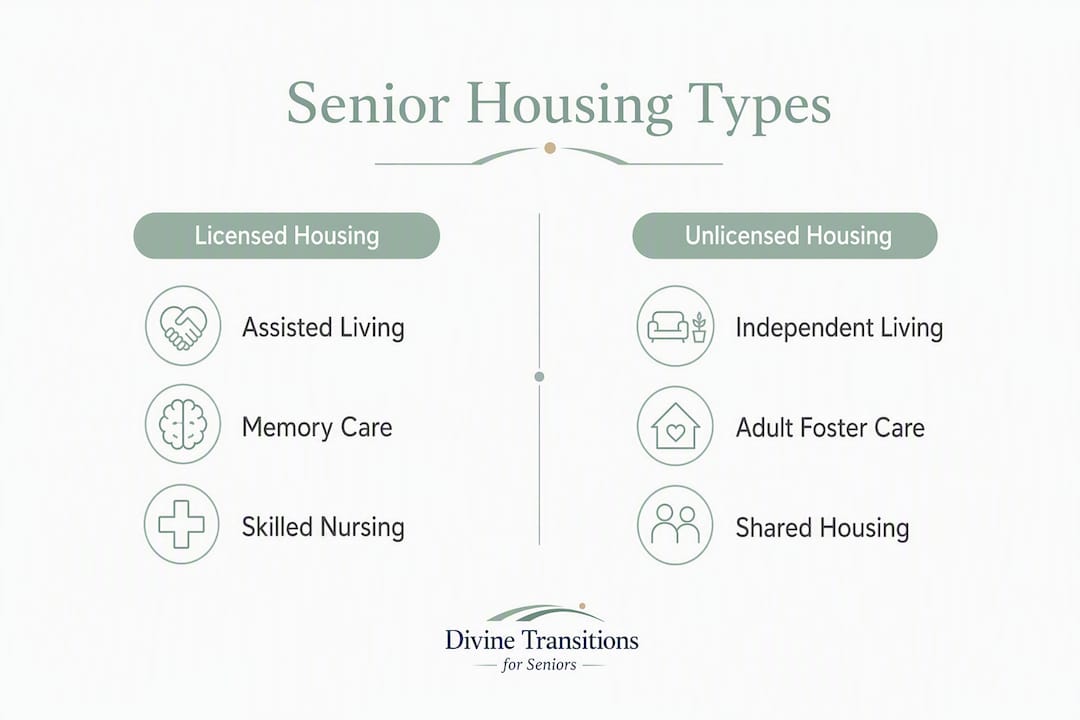
Oregon uses specific licensing categories, and the differences between them are not just administrative. They determine how much hands-on help a resident can receive, whether 24/7 care is available, and what happens when needs increase.
- Assisted living facilities (ALFs): Licensed by Oregon DHS, these communities provide help with ADLs (bathing, dressing, medication management) in a residential setting. Staff are available around the clock, but residents typically live in private or semi-private apartments. This is the most common placement for adults who need daily support but not skilled nursing.
- Memory care communities: A specialized subset of assisted living, secured and staffed for residents with Alzheimer's or other dementias. Staff receive additional dementia-specific training, and the physical environment is designed to reduce wandering risk. If your loved one has had two or more wandering incidents or significant behavioral changes, memory care is the appropriate starting point, not a step up from assisted living.
- Residential care facilities (RCFs): Smaller than ALFs, often 16 beds or fewer, and licensed for a slightly different care scope. Good for residents who want a more home-like setting and have moderate but stable needs.
- Adult foster care (AFC) homes: Oregon-licensed private homes, typically 1–5 residents, with a live-in caregiver. The most intimate option and often the most affordable, but clinical oversight is limited. Best suited for adults with moderate ADL needs who do not require complex medical management.
- Independent living communities: No licensed care services included. Residents manage their own health and ADLs; the value is amenity-rich housing and social programming. Not appropriate if your loved one currently needs help with two or more ADLs.
- Continuing care retirement communities (CCRCs): Campuses that offer independent living, assisted living, and memory care on one site. The continuum of care model reduces the need for additional moves if care needs increase — a meaningful advantage when you are planning for the long term rather than reacting to a crisis.
Oregon DHS Aging & People with Disabilities is the authoritative reference for current licensing categories, and Washington County maintains a care facilities and senior housing page that is a useful county-level starting point for families in that area.
How do you assess the right level of care before you start calling?
A quick needs assessment before your first call saves you from touring facilities that cannot actually serve your loved one. You do not need a professional to do a first pass — a structured conversation with the person and their primary physician covers most of it.
ADLs to evaluate (score 1 point for each requiring assistance):
- Bathing or showering
- Dressing and grooming
- Toileting and continence management
- Transferring (getting in and out of bed or a chair)
- Feeding (eating independently)
- Medication management
IADLs to evaluate (score 1 point for each requiring assistance):
- Meal preparation
- Shopping and errands
- Managing finances and bills
- Using the telephone or technology
- Housekeeping and laundry
- Transportation
A combined score of 1–3 typically maps to assisted living with a basic care tier. A score of 4–6 suggests a mid-tier or enhanced-care assisted living. A score of 7 or higher, or any score combined with significant behavioral symptoms (wandering, aggression, severe confusion), points toward memory care or a higher level of clinical oversight.
Safety signals carry extra weight regardless of score. A single fall with injury, two or more wandering incidents, or a pattern of missed medications that caused a medical event should push you toward a higher care level than the ADL score alone suggests. These are the situations where a facility's staffing ratio and on-site clinical presence matter most — AARP recommends asking specifically about staff-to-resident ratios and staff training during every tour.

What should you ask on the phone and watch for on tours?
Tours are often run by sales staff, not clinical staff. That gap between the person showing you around and the person who will actually manage your loved one's care is one of the most important things to close before you sign anything.
Phone-screen questions (before you visit)
- What is your current availability, and is there a wait list?
- What does the base monthly rate include, and what triggers a care-level fee increase?
- Do you accept Medicaid, VA Aid & Attendance, or long-term care insurance?
- Do you offer trial stays, and what is the minimum commitment?
- What is your policy if a resident's needs exceed what you can provide?
On the tour: what to observe
- Arrival: Is the entrance staffed and secure? Are residents visible and engaged, or are they isolated in rooms?
- Mealtime: Observe if you can. Are residents assisted appropriately? Is the food recognizable and appealing? Are staff present and attentive, or clustered away from residents?
- Staff-resident interactions: Do staff use residents' names? Do they make eye contact and speak at eye level?
- Cleanliness and odor: A faint, isolated odor in one room is different from a pervasive smell throughout common areas. The latter is a staffing and hygiene signal.
- Safety features: Grab bars, call systems, secured exits for memory care, non-slip flooring.
Documents to request on every visit
- Current state license and most recent inspection report
- Staffing chart showing ratios by shift
- Sample resident contract
- Sample monthly invoice showing base rent and itemized care fees
- Written policy on care-level reassessments and fee increases
Red flags that should stop the process
- Staff cannot tell you the current resident-to-caregiver ratio on the floor
- Leadership or Director of Nursing has turned over more than once in the past 18 months
- Medication policies are vague or staff seem uncertain about the process
- The facility discourages unannounced visits
- Promises made during the tour are not in writing anywhere
AARP notes that the initial tour is frequently managed by a community liaison or marketing representative rather than clinical staff. Ask explicitly to meet the Director of Nursing or the person who conducts care assessments. That conversation reveals the facility's actual capacity to manage complex medical or behavioral needs — something a sales tour cannot.
Pro Tip: Schedule a second, unannounced visit during a shift change (typically early morning or late afternoon). Staff behavior during transitions is one of the clearest indicators of day-to-day care culture.
What does assisted living cost in Oregon, and how do families pay?
Assisted living is primarily private pay. Medicare does not typically cover room and board, and Oregon Medicaid waiver availability varies by county and wait list. Understanding the realistic cost picture before you tour prevents painful surprises after you fall in love with a community.
Oregon cost context
| Cost reference | Monthly estimate | Notes |
|---|---|---|
| National median (2026) | $6,313 | Base care; add-ons increase total |
| Oregon metro areas (Portland, Eugene) | Higher than national median | Urban markets typically run above average |
| Oregon rural areas | Often lower | Smaller facilities, fewer amenities |
| Memory care premium | Typically 20–30% above ALF base | Secured environment, specialized staffing |
| Oregon metro areas (Portland, Eugene) | Higher than national median | Urban markets typically run above average |
| Oregon rural areas | Often lower | Smaller facilities, fewer amenities |
| Memory care premium | Typically 20–30% above ALF base | Secured environment, specialized staffing |
Oregon families should request written fee schedules from every facility they visit and ask specifically: "What has your monthly rate increased by, on average, over the past three years?" A facility that cannot answer that question clearly is one where costs may surprise you later.
How families actually pay
- Private savings and income: Social Security, pension, and personal savings cover the majority of assisted living costs for most families initially. The math often runs out within 2–3 years at current rates.
- Long-term care insurance: If a policy exists, review it immediately. Many have elimination periods (typically 30–90 days) before benefits begin, and benefit caps vary widely.
- Veterans benefits (Aid & Attendance): Veterans and surviving spouses may qualify for Aid & Attendance, which can offset a meaningful portion of monthly costs. The application process takes time, so start it early.
- Oregon Medicaid (Oregon Health Plan) and waivers: Oregon does have Medicaid-funded long-term care options, but eligibility is income and asset-based, wait lists exist, and not all facilities accept Medicaid residents. Contact Oregon DHS directly for current waiver availability.
- Oregon Project Independence (OPI): A state-funded program that supports in-home care for lower-income seniors, which can delay or reduce the need for facility placement.
- Home equity: For many Oregon families, the family home is the primary asset available to fund care. Options include selling the home (traditional listing or as-is sale), a reverse mortgage (HECM) if the senior still lives there, or a HELOC for short-term bridge funding. Each has different timelines and tradeoffs — covered in detail in the paying for assisted living with home equity guide.
When comparing facilities on cost, always separate the base rent from care-level fees, medication management charges, incontinence supply costs, and transportation fees. Ask for a sample monthly invoice from a current resident at a similar care level. The gap between the advertised base rate and the actual monthly bill is often $500–$1,500 or more.
How do you verify a facility's license and read inspection reports?
Oregon DHS licenses and inspects assisted living facilities, residential care facilities, and adult foster care homes. The inspection reports are public, and reading them is one of the highest-value 20 minutes you can spend before a tour.
Step-by-step license verification:
- Go to the Oregon DHS Aging & People with Disabilities long-term care page.
- Search for the facility by name or county to confirm active license status.
- Request or download the most recent inspection report and any corrective action plans.
- Check for open complaints or enforcement actions — these are separate from routine inspection findings.
Reading inspection reports without a clinical background:
Focus on two things: recurrence and severity. A single citation for a documentation error is different from three consecutive inspections citing the same medication management failure. Repeat citations in the same category suggest a systemic problem, not a one-time lapse. Corrective action plans that are vague or show no follow-through are a warning sign. Isolated findings with documented corrections and no recurrence are normal for most facilities.
Voluntary accreditation (CARF International):
CARF International accredits assisted living communities through a rigorous standards process that typically goes beyond state licensing requirements. CARF accreditation requires an on-site survey and commits the facility to ongoing performance reviews and public accountability. It is voluntary, so not every quality facility holds it — but when a facility is CARF-accredited, it is a meaningful third-party quality signal that supplements the state license check. You can verify CARF accreditation directly on the CARF website.
What contract clauses matter most before you sign?
The contract is where the sales tour's promises either hold up or disappear. Read it before you are emotionally committed to a community.
- Service inclusions: Get a written list of exactly what is included in the base rate. "Meals and housekeeping" can mean very different things at different facilities.
- Care-level triggers: Understand precisely what assessment criteria move a resident to a higher (more expensive) care tier, and who makes that determination.
- Deposit terms: Is the move-in deposit refundable? Under what conditions? What is the timeline for return?
- Notice requirements: How many days' notice does the facility require if you choose to leave? How many days' notice do they give you if they ask a resident to leave?
- Transfer and eviction policies: Under what circumstances can a facility require a resident to transfer to a higher level of care or leave entirely? Oregon has resident-protection rules, but the contract language still matters.
- Hospice and acute-care scenarios: Can a resident receive hospice care in place, or will they be required to transfer to a nursing facility? This is a critical question for families planning for end-of-life care.
- Rate-increase policy: Is there a cap on annual increases? Is there a written notice period before increases take effect?
Negotiation tips that actually work:
- Ask for a 30-day trial stay before committing to a long-term contract. Pre-entry assessments and trial stays let families verify promises made during sales tours.
- Request a written staffing plan showing minimum staff-to-resident ratios by shift, not just an average.
- Get the escalation path for complaints in writing: who do you call, what is the response timeline, and what happens if the issue is not resolved?
- Any verbal promise made during the tour — a specific room, a particular activity, a meal accommodation — goes in writing as an addendum or it does not exist.
What does the timeline look like when a home must be sold to fund care?
This is where most families underestimate the complexity. Clearing decades of belongings, preparing a home for sale, and coordinating a closing date that aligns with a move-in deadline requires active management. Many families discover this too late.
| Scenario | Timeline | Key parallel tasks |
|---|---|---|
| Urgent placement (24–72 hours) | Immediate | Pre-entry assessment, emergency placement call, identify interim funding (bridge loan, family contribution), begin home-sale coordination in parallel |
| Short window (2–3 weeks) | 2–3 weeks | Facility selection and deposit, medical records transfer, downsizing and belongings sort, as-is home sale initiated |
| Normal planning (8–12 weeks) | 8–12 weeks | Full facility comparison, contract review, traditional or as-is home sale, coordinated move logistics |
For families in the urgent or short-window scenarios, an as-is home sale can accelerate access to funds by skipping repairs and staging — but it typically nets less than a fully prepared traditional listing. The right choice depends on how quickly care costs must be covered and the home's condition. Many Oregon homes that have housed a senior for 20 or more years have deferred maintenance, full storage areas, and decades of belongings that make a traditional MLS listing slow and logistically difficult without professional coordination.
Who to involve and when:
- Senior placement specialist: Call one on day one. They know current availability, facility culture, and Medicaid acceptance in your county.
- Home-sale coordination: Start this in parallel with facility selection, not after placement is confirmed. The gap between move-in date and sale closing is where families run into cash-flow problems.
- Medical providers: Get updated physician orders, medication lists, and any required pre-admission assessments ready before the facility's intake process begins.
Pro Tip: Ask the facility whether they can hold a room for 2–3 weeks with a deposit while your home sale closes. Many will, and it eliminates the most stressful timing gap. Get the room-hold terms in writing.
For families navigating an urgent placement, the 24–72 hour placement guide covers the specific steps and paperwork to have ready.
Key Takeaways
Choosing the right assisted living facility in Oregon requires matching care needs to actual facility capabilities, verifying licensing and staffing, and planning the funding timeline before placement pressure forces a rushed decision.
| Point | Details |
|---|---|
| Match ADLs to care level first | Score ADLs and IADLs before calling facilities; a score of 4+ or safety incidents points to enhanced care or memory care. |
| Verify license and inspection reports | Use Oregon DHS to confirm active licensure and check for repeat citations before any tour. |
| Meet clinical staff, not just sales | Ask to meet the Director of Nursing on every tour; sales staff cannot confirm actual care capacity. |
| Get written fee breakdowns | Separate base rent from care-level fees and add-ons; ask for a sample invoice and historical rate-increase data. |
| Plan the home-sale timeline in parallel | Aligning sale closing with move-in deadlines requires coordination from day one, not after placement is confirmed. |
| Divinetransitionsforseniors | Coordinates as-is home sales, downsizing, and move timing alongside placement at no cost to Oregon families. |
What families often wish they had known sooner
There is a version of this process that goes smoothly, and it almost always involves one thing: starting the conversation about care options before a crisis forces the decision. When families have a few weeks rather than a few days, they can visit facilities without pressure, involve the senior in the choice, and line up funding without scrambling.
The financial logistics are genuinely hard, and the emotional weight of making this decision for someone you love adds another layer. Mixed feelings are normal. Guilt about not being able to provide care at home is nearly universal among adult children, and it rarely reflects the actual quality of the decision being made. A well-chosen assisted living community often provides a level of social engagement, safety, and consistent care that home caregiving cannot match.
One thing that consistently helps: bring the senior to at least one tour, even when cognitive decline makes the conversation difficult. Letting them see the dining room, meet a staff member, or comment on the garden preserves dignity and often surfaces preferences that change the final choice. The decision belongs to the family, but the person living there deserves a voice in it.
When a home sale is part of the plan, Divinetransitionsforseniors can help
For Oregon families where the family home is the primary funding source for assisted living or memory care, the coordination challenge is real: the home often has not been maintained for years, may need significant repairs, and is full of decades of belongings. A traditional MLS listing in that condition takes time most families do not have.

Divinetransitionsforseniors coordinates the entire transition, not just the home sale. That means as-is home sales that skip the repair and staging process, downsizing and belongings coordination, and aligning the sale closing timeline with the facility's move-in date. The service is free to families; the business is paid through partner arrangements with real estate professionals and placement specialists.
One point of contact. One coordinated plan. If you are facing an urgent placement tied to home equity, or you simply do not know where to start, reach out to Divinetransitionsforseniors to talk through your situation with no obligation.
Useful sources for Oregon families
- Oregon DHS Aging & People with Disabilities — Long-Term Care Options: The primary state resource for licensed facility lists, licensing lookup, inspection reports, and Medicaid waiver information. Start here for any Oregon-specific facility research.
- Washington County Care Facilities and Senior Housing: County-level facility lists and local senior housing guidance for Washington County families; a model for the kind of county-specific page available across Oregon.
- CARF International — Guide to Selecting an Assisted Living Community: CARF's own selection guide explains what accreditation means, what questions to ask, and how to evaluate a community's commitment to quality beyond state licensing.
- AARP — Assisted Living: What Caregivers Need to Know: Practical caregiver-focused overview covering ADL assessment, staffing questions, Medicare and Medicaid limits, and tour guidance.
- National Institute on Aging — Long-Term Care Facilities: Authoritative federal resource explaining the differences between assisted living, nursing homes, and other residential care settings.
- LTCFEDS Care Navigator — Understanding Senior Living Communities: Clear explanations of each senior living type, including CCRCs and the continuum-of-care model.
- SeniorLiving.org — Assisted Living Costs 2026: Current national cost benchmarks with state-level breakdowns; useful for calibrating Oregon cost expectations.
- Divinetransitionsforseniors — Paying for Assisted Living with Home Equity: Oregon-focused guide to using home equity, as-is sales, and bridge funding to cover assisted living costs.
This article provides general information, not legal, financial, or medical advice. Confirm current Oregon licensing requirements, Medicaid eligibility rules, and program availability directly with Oregon DHS or a qualified professional.
FAQ
How do you pick a good assisted living facility in Oregon?
Start by scoring the resident's ADLs and safety risks, then verify the facility's Oregon DHS license and most recent inspection report before touring. On the tour, ask to meet the Director of Nursing, not just the sales representative, and request a written fee breakdown that separates base rent from care-level add-ons.
How much does assisted living cost per month in Oregon?
The national median cost is $6,313 per month as of June 2026, and Oregon metro markets like Portland typically run higher than the national median. Memory care adds a significant premium to the base assisted living rate, typically in the range of 20 to 30 percent.
What is one of the biggest drawbacks of assisted living?
Cost is the most common concern: Medicare does not cover room and board, and most families pay privately until assets are depleted. Oregon Medicaid waivers exist but carry wait lists and eligibility requirements that many families do not meet initially.
What questions should you ask when touring an assisted living facility?
Ask about the current staff-to-resident ratio by shift, what triggers a care-level fee increase, whether the deposit is refundable, and what the facility's policy is if a resident's needs exceed their capacity. Request a sample monthly invoice from a resident at a similar care level and ask for the most recent state inspection report.
When should a family contact Divinetransitionsforseniors?
Contact Divinetransitionsforseniors when placement is urgent and the family home must be sold to fund care, or when the logistics of downsizing, home sale timing, and move coordination feel unmanageable. The service is free to families and works alongside placement specialists rather than replacing them.