

Most Washington families pay a moderate to high range for assisted living, with the statewide average varying depending on location and care level. That number is real, and it lands hard. The good news: very few families pay it from a single source. Most piece together a funding mix, and knowing which routes to pursue first saves weeks of delay when care is urgent.
The four most realistic payment routes, ranked by how quickly families can access them:
- Private funds and savings (retirement accounts, Social Security, family contributions) — fastest to deploy, no application required
- Long-term care insurance — pays quickly if a policy exists and covers assisted living; call the insurer first
- VA Aid & Attendance — meaningful monthly benefit for qualifying veterans and surviving spouses, but the application takes time
- Home equity (selling the home, bridge loan, HELOC, or HECM reverse mortgage) — often the largest available asset, with timelines ranging from two weeks to six months depending on the route
Start by pulling together a realistic monthly cost estimate for your target area, then check whether any insurance policy or VA benefit applies. Those two steps alone will shape every decision that follows.
Key Takeaways
Washington families typically pay a range of monthly amounts for assisted living, and the fastest path to funding almost always combines private assets with at least one program benefit or home-equity strategy.
| Point | Details |
|---|---|
| Washington monthly cost | Statewide average is approximately $5,500/month; Seattle metro often exceeds $6,000. |
| Medicare does not cover room and board | Medicare pays only for short-term skilled nursing after a hospital stay, not long-term assisted living. |
| Home equity is often the largest asset | As-is sales close in 2–4 weeks; bridge loans fund in 1–2 weeks; HECM takes 6–8 weeks. |
| Apply for VA and Medicaid early | VA Aid & Attendance and Apple Health HCBS waivers take months to process; start applications before the move. |
| Divinetransitionsforseniors coordinates the full transition | Home sale, belongings, and care placement are aligned as one process, at no direct cost to families. |
Table of Contents
- How much does assisted living cost in Washington?
- What does a monthly assisted living fee actually include?
- What do government programs actually cover for assisted living in Washington?
- Private funding options: insurance, annuities, life insurance, and retirement income
- Using the house to fund care: selling, bridge loans, HELOC, and reverse mortgages
- When care can't wait: urgent funding options for immediate moves
- Family checklist: estimate costs, verify benefits, and align the home sale
- Washington resources: agencies, calculators, and who to call first
- Tax deductions for assisted living expenses in Washington
- Estate planning considerations when paying for assisted living
- How to compare assisted living facilities on price and services
- Financial pitfalls and scams to watch for when funding assisted living
- What families get wrong about paying for assisted living
- Divinetransitionsforseniors: one point of contact for the whole transition
- Useful sources
- FAQ
How much does assisted living cost in Washington?
Washington consistently ranks above the national median for assisted living costs. AssistedLiving.org's Washington data places the statewide average around $5,500 per month, while WhereYouLiveMatters shows city-level variation that can push that figure significantly higher or lower depending on where you look.
| Market | Estimated Monthly Range |
|---|---|
| Seattle metro area | $5,800–$7,500+ |
| Bellevue / Eastside | $5,500 or more |
| Tacoma / Pierce County | $4,500 or more |
| Vancouver / SW Washington | $4,500 or more |
| Statewide average | ~$5,500 |
Ranges are illustrative estimates based on aggregated market data; individual facility quotes will vary.
Memory care commands a premium. Facilities typically add $800–$1,500 per month above the base assisted living rate for a secured memory care unit, reflecting the higher staffing ratios and specialized programming involved. Higher-dependency care, such as two-person transfers or skilled nursing support layered into an assisted living setting, can push costs even further.
The factors that drive price differences are straightforward: urban real estate costs, staff-to-resident ratios, unit size, and how many services are bundled into the base rate versus billed separately. A Seattle facility charging $7,000 may include more than a Spokane facility at $4,500. That is why the next section matters before you compare any two quotes.
Washington families should budget for at least 12–18 months of costs upfront when planning a move, since Medicaid waiver waitlists and VA benefit processing can take months to activate.
What does a monthly assisted living fee actually include?
Facility quotes are not standardized, which means two facilities can charge the same monthly rate and deliver very different levels of care. Getting an itemized breakdown before signing anything is non-negotiable.
Typically included in the base monthly rate:
- Room (private or semi-private)
- Three meals and snacks daily
- Housekeeping and laundry
- Basic activities of daily living (ADL) assistance: bathing, dressing, grooming
- Medication reminders or management (confirm the exact level)
- Social and recreational programming
- Emergency call system
Commonly billed as extras:
- Memory care or secured unit fees
- Physical, occupational, or speech therapy
- Skilled nursing visits
- Incontinence supplies beyond a basic allotment
- Private transportation to appointments
- Move-in or community fees (often $1,000–$3,000 one-time)
- Beauty salon, cable, or phone services
- Additional ADL assistance beyond the contracted level
Pro Tip: Ask every facility for a written "Level of Care" assessment and a complete fee schedule before signing. Specifically ask: "What happens to my monthly cost if my parent's care needs increase?" Many families are surprised by mid-year rate adjustments tied to care-level reclassification.
What do government programs actually cover for assisted living in Washington?
This is where families lose the most time to confusion. The short version: Medicare covers almost nothing for long-term assisted living. Medicaid can help, but only under specific conditions. VA benefits are real and often underused.
Medicare: what it won't pay for
Medicare does not cover room and board for long-term assisted living. It pays for short-term skilled nursing care after a qualifying hospital stay of at least three days, and it covers some outpatient therapy and physician visits. That is the full extent. Families who assume Medicare will cover assisted living costs are often blindsided at move-in.
Apple Health (Washington Medicaid) and HCBS waivers
Washington's Medicaid program, Apple Health, can help cover personal care services through Home and Community-Based Services (HCBS) waivers. The key distinction: Apple Health may pay for personal care assistance within an assisted living setting, but it generally does not cover room and board. Eligibility requires meeting both financial limits (low income and limited assets) and a functional need assessment.
Two practical complications: not all assisted living facilities accept Apple Health, and waiver programs often have waitlists. Contact Washington's Department of Social and Health Services (DSHS) early, because the application and assessment process takes time.
PACE: an alternative for some families
The Program of All-Inclusive Care for the Elderly (PACE) integrates Medicare and Medicaid services to help eligible seniors remain in the community rather than move to a nursing home. PACE participants must be 55 or older, certified as needing nursing-home-level care, and live in a PACE service area. Washington has PACE programs in select counties. It is not a fit for everyone, but for families trying to delay or avoid a facility move, it is worth checking availability in your county.
VA Aid & Attendance and VA pension benefits
Veterans and surviving spouses who qualify for VA pension benefits may also qualify for the Aid & Attendance supplement, which provides additional financial help to cover care costs. Eligibility depends on service history, income, assets, and demonstrated care needs.
The application process requires gathering discharge papers (DD-214), medical documentation, and financial records. Processing times vary and can take several months from application to first payment. Filing early is advisable.
Documents to gather for VA and Medicaid applications:
- DD-214 (veterans) or marriage certificate (surviving spouses)
- Social Security award letters
- Bank statements (last 3 months)
- Investment and retirement account statements
- Property deed and mortgage statement
- Current insurance policies
- Physician's statement of care needs
Pro Tip: Washington's Area Agencies on Aging offer free benefits counseling. A SHIBA (Statewide Health Insurance Benefits Advisors) counselor can review VA and Medicaid eligibility at no cost and help with paperwork. Call 1-800-562-6900 to find your local office.
Private funding options: insurance, annuities, life insurance, and retirement income
Private pay remains the most common funding source for assisted living nationally, and Washington families are no exception. Most use a combination of Social Security income, retirement account withdrawals, savings, and sometimes family contributions to cover monthly costs.
| Funding Source | Speed to Access | Key Considerations |
|---|---|---|
| Long-term care insurance | Fast (days to weeks once claim approved) | Confirm assisted living is a covered setting; check elimination period (often 30–90 days) and daily/monthly benefit cap |
| Annuities | Moderate (weeks) | Medicaid-compliant annuities can convert assets; tax implications vary; consult a CPA |
| Accelerated life insurance / life settlement | Moderate to slow (weeks to months) | Accelerated death benefits pay faster; life settlements take longer but may yield more |
| Retirement accounts (IRA) | Fast | Withdrawals are taxable income; early withdrawal penalties apply under age 59½ |
| Social Security + pension income | Immediate (ongoing) | Rarely covers full cost alone; typically offsets $1,500–$2,500/month of the total |
Long-term care insurance policies vary widely in what they cover, how long benefits last, and which care settings qualify. Many older policies were written primarily for home care or nursing home care, not assisted living specifically.
Checklist for reviewing an existing long-term care policy:
CareScout advises pulling policy documents immediately and contacting the insurer to confirm coverage specifics, since many families discover gaps only after a move is underway. A tax note: premiums paid on qualifying long-term care insurance may be deductible as a medical expense on federal returns, subject to age-based limits. Consult a CPA for your specific situation.
Using the house to fund care: selling, bridge loans, HELOC, and reverse mortgages
For many Washington families, the home is the largest asset available. Converting that equity into care funding is often the most practical path, but the right method depends entirely on how much time you have.
The four main home-equity routes
Selling as-is (fast sale). When the home needs repairs, is full of decades of belongings, or a traditional MLS listing would take too long, an as-is sale to a cash buyer or investor can close in two to four weeks. The tradeoff is a lower sale price, but speed often matters more than maximizing proceeds when care costs are accumulating. Divinetransitionsforseniors specializes in exactly this situation, coordinating the sale, belongings, and care placement timeline as a single process.
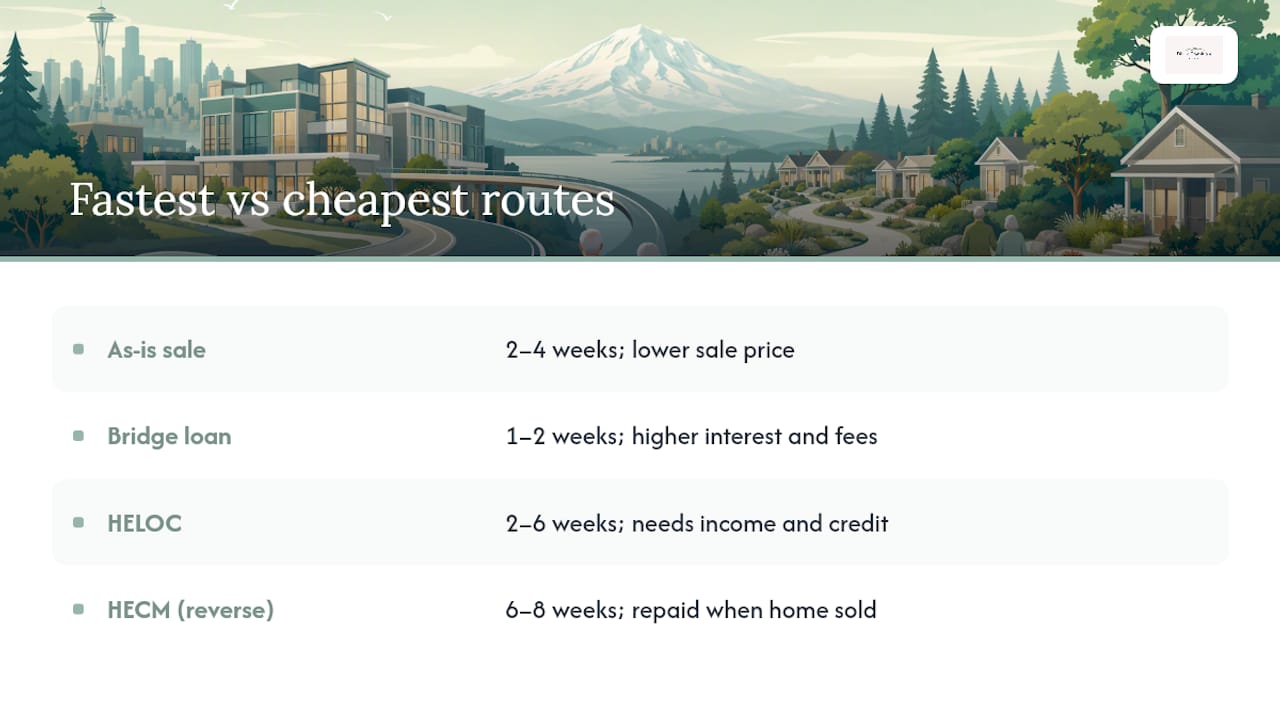
Bridge loan for assisted living. A bridge loan is a short-term loan secured by the home's equity, designed to cover move-in costs and monthly fees while the home is listed and sold. Funds can be available in one to two weeks. The cost is higher than a conventional loan, typically carrying elevated interest rates and origination fees, but it solves the timing gap between "care is needed now" and "home sale closes in 60 days."
HELOC (Home Equity Line of Credit). A HELOC gives access to a revolving credit line secured by the home. It requires the borrower to qualify based on income and credit, which can be a barrier for seniors who are no longer earning. Approval takes two to six weeks. It works well for planned transitions where the senior still qualifies and the home will be sold within a year or two.
HECM reverse mortgage. The FHA-insured Home Equity Conversion Mortgage (HECM) allows homeowners 62 and older to convert home equity into cash without monthly mortgage payments. The loan is repaid when the home is sold or the borrower permanently leaves. Closing takes six to eight weeks and requires mandatory HUD-approved counseling. A HECM works best when the senior plans to remain in the home for a period, or when a spouse remains in the home after the other moves to assisted living. For a detailed comparison of these two options, see HECM vs HELOC: Which Funds Senior Care Faster?
Matching urgency to the right solution
| Situation | Best-fit route | Estimated time to funds |
|---|---|---|
| Move needed in 2–4 weeks | As-is cash sale or bridge loan | 1–4 weeks |
| Move needed in 4–8 weeks | Bridge loan + MLS or as-is listing | 2–6 weeks |
| Planned move in 3–6 months | Traditional MLS sale or HELOC | 6–12 weeks |
| Spouse remains in home | HECM reverse mortgage | 6–8 weeks |
Practical considerations across all home-equity routes:
- Proceeds from a home sale are generally not taxable up to $250,000 (single) or $500,000 (married) under the federal capital gains exclusion, subject to IRS rules
- A home sale can affect Medicaid eligibility if proceeds are not spent down appropriately; consult an elder law attorney before listing
- Vacant homes need insurance coverage changes; a standard homeowner's policy may lapse after 30–60 days of vacancy
- Bridge loans and HELOCs require the home as collateral; if the home does not sell, the debt remains
Pro Tip: If the home has not been maintained, is full of belongings, or needs significant repairs, a traditional MLS listing may sit for months. An as-is sale coordinated alongside the care move often costs less in total than months of carrying costs, facility deposits, and family stress. Read more about paying for assisted living when home equity is your main asset.
When care can't wait: urgent funding options for immediate moves
Sometimes a hospital discharge, a fall, or a sudden cognitive decline compresses the timeline to days. These options cover the gap when there is no time for a standard application or sale process.
Urgent funding sources:
- Bridge loan for assisted living: — fastest structured option; funds in one to two weeks; requires home equity as collateral; expect higher interest rates
For a step-by-step plan when the move must happen within 24–72 hours, see When Assisted Living Can't Wait.
Pro Tip: Watch for predatory "senior bridge loan" offers with origination fees above 3%, prepayment penalties, or balloon payments due in under 90 days. A legitimate bridge loan for assisted living should have a clear repayment tied to the home sale, transparent fees, and no pressure to sign within 24 hours. If an offer arrives unsolicited, treat it as a red flag.
Warning: Scammers target families in crisis. Any unsolicited offer to "unlock" home equity quickly, especially one requiring upfront fees or wire transfers, should be reported to the Washington State Attorney General's office.
Family checklist: estimate costs, verify benefits, and align the home sale
Working through this in order prevents the most common and costly delays.
- Estimate local monthly costs. Get itemized quotes from at least three facilities in your target area. Note what is included and what is billed separately.
- Calculate a 12-month reserve. Multiply the monthly cost by 12 and add a 15% buffer for care-level increases and extras.
- Pull all insurance policies. Review any long-term care insurance for coverage, elimination period, and benefit amount. Call the insurer to open a claim.
- Check VA eligibility. If the senior is a veteran or surviving spouse, gather the DD-214 and contact a VA-accredited claims agent or your local Area Agency on Aging.
- Contact DSHS for Apple Health. Call Washington DSHS at 1-877-501-2233 to start the Medicaid eligibility screening. Ask specifically about HCBS waiver availability and waitlists.
- Assess the home. Determine its condition, approximate value, and how quickly it could sell. Decide whether an as-is sale, bridge loan, HELOC, or HECM fits the timeline.
- Consult an elder law attorney. Before selling the home or spending down assets, get a one-hour consultation on Medicaid planning and estate implications.
- Get facility contracts reviewed. Before signing, have someone review the arbitration clauses, rate-increase policies, and discharge conditions.
Questions to ask every facility:
- What triggers a care-level reclassification and a rate increase?
- What is your policy if a resident's funds are exhausted?
- Do you accept Apple Health or VA benefits?
- What is the move-out notice requirement?
Approximate timelines by funding route:
- VA Aid & Attendance application: 3–6 months from submission to first payment
- Apple Health HCBS waiver: weeks to months depending on waitlist
- HECM reverse mortgage: 6–8 weeks from application to closing
- Traditional MLS home sale: 60–120 days in most Washington markets
- As-is cash sale: 2–4 weeks
- Bridge loan: 1–2 weeks
Washington resources: agencies, calculators, and who to call first
If the move is urgent (days to weeks): Contact Divinetransitionsforseniors for home sale and transition coordination, and call the facility directly to ask about short-term private-pay options while benefits are pending.
If the senior is a veteran: Start with the VA's Aid & Attendance page at va.gov or call 1-800-827-1000. A VA-accredited claims agent can file at no cost to you.
For Medicaid / Apple Health: Contact Washington DSHS at 1-877-501-2233 or visit dshs.wa.gov. Ask for a functional needs assessment and HCBS waiver screening.
For local guidance and benefits counseling: Washington's Area Agencies on Aging cover every county. SHIBA counselors provide free Medicare and insurance help. Find your local office through DSHS or call the Aging and Disability Resource Center line.
For PACE availability: Check Medicare.gov's PACE finder to see whether a program operates in your county.
For facility-level cost comparisons: Use WhereYouLiveMatters.org and AssistedLiving.org to compare published rates by city. Always follow up with a direct call to the facility for a current itemized quote.
For Washington-specific senior care articles and local resources, see Senior Care Washington and Senior Resources Vancouver WA.
Tax deductions for assisted living expenses in Washington
Washington has no state income tax, so there are no state-level deductions to claim. The relevant tax relief comes at the federal level.
Medical expenses that exceed 7.5% of adjusted gross income (AGI) can be deducted on a federal Schedule A. Assisted living costs qualify as a medical deduction only to the extent they are attributable to medical care. If a resident requires assisted living primarily for medical reasons (documented by a licensed health care practitioner), a larger portion of the monthly fee may qualify. Room and board alone, without a medical necessity certification, generally does not qualify.
Long-term care insurance premiums are deductible up to age-based annual limits set by the IRS. For 2025, those limits ranged from $480 for individuals under 41 to $5,960 for those 71 and older. A CPA familiar with elder care situations can determine what portion of assisted living costs qualifies and whether itemizing beats the standard deduction for your family's situation.
One practical note: if you are paying for a parent's assisted living and claiming them as a dependent, their medical expenses can be included in your itemized deductions. The dependency rules are specific, so verify with a tax professional.
Estate planning considerations when paying for assisted living
The financial decisions made during a care transition can have lasting effects on an estate. A few points families consistently overlook:
Medicaid look-back period. Washington follows the federal 60-month (five-year) look-back rule for Medicaid eligibility. Gifts, transfers below fair market value, or asset spend-downs made within that window can create a period of Medicaid ineligibility. Selling the home at fair market value is generally safe; gifting it to a child is not. An elder law attorney should review any asset transfer before it happens.
Durable power of attorney. If your parent has not signed a durable financial power of attorney, you may not be able to manage their accounts, sell their home, or apply for benefits on their behalf without a court-ordered guardianship, which is slow and expensive. Get this document in place before a crisis, not during one.
Beneficiary designations. Retirement accounts and life insurance policies pass outside of a will. Confirm that beneficiary designations are current and consistent with the overall estate plan. A policy naming a deceased spouse as beneficiary creates delays and legal complications.
Spend-down planning. Families sometimes spend assets in ways that disqualify a loved one from Medicaid without realizing it. Paying for legitimate care costs, home modifications, or prepaid funeral arrangements is generally permissible. Transferring cash to family members is not. Document every expenditure.
Trust structures. Certain irrevocable trusts can protect assets from Medicaid spend-down if established well before the look-back period. These require an elder law attorney to set up correctly and are not a last-minute solution.
How to compare assisted living facilities on price and services
A facility's published rate is a starting point, not a final number. The real cost comparison happens at the contract level.
Start by requesting a complete fee schedule, not just the base rate. Ask for the facility's Level of Care assessment tool so you understand how they classify care needs and what triggers a rate increase. Then compare three things across every facility you visit: what is included in the base rate, what is billed separately, and what the rate-increase history looks like over the past three years.
Check the facility's state inspection reports. Washington's DSHS posts inspection results for licensed assisted living facilities at dshs.wa.gov. Deficiencies related to medication management, staffing, or resident rights are worth discussing directly with the administrator.
Ask about the facility's financial stability and ownership. A facility that has changed ownership recently or is under management by a large out-of-state operator may have different staffing patterns than one with long-tenured local leadership. Neither is automatically better, but it is worth understanding.
Finally, visit at a meal time and an evening. The quality of interaction between staff and residents during unscheduled moments tells you more than any tour.
Financial pitfalls and scams to watch for when funding assisted living
Families in crisis are a known target for financial exploitation. The most common pitfalls are not always obvious.
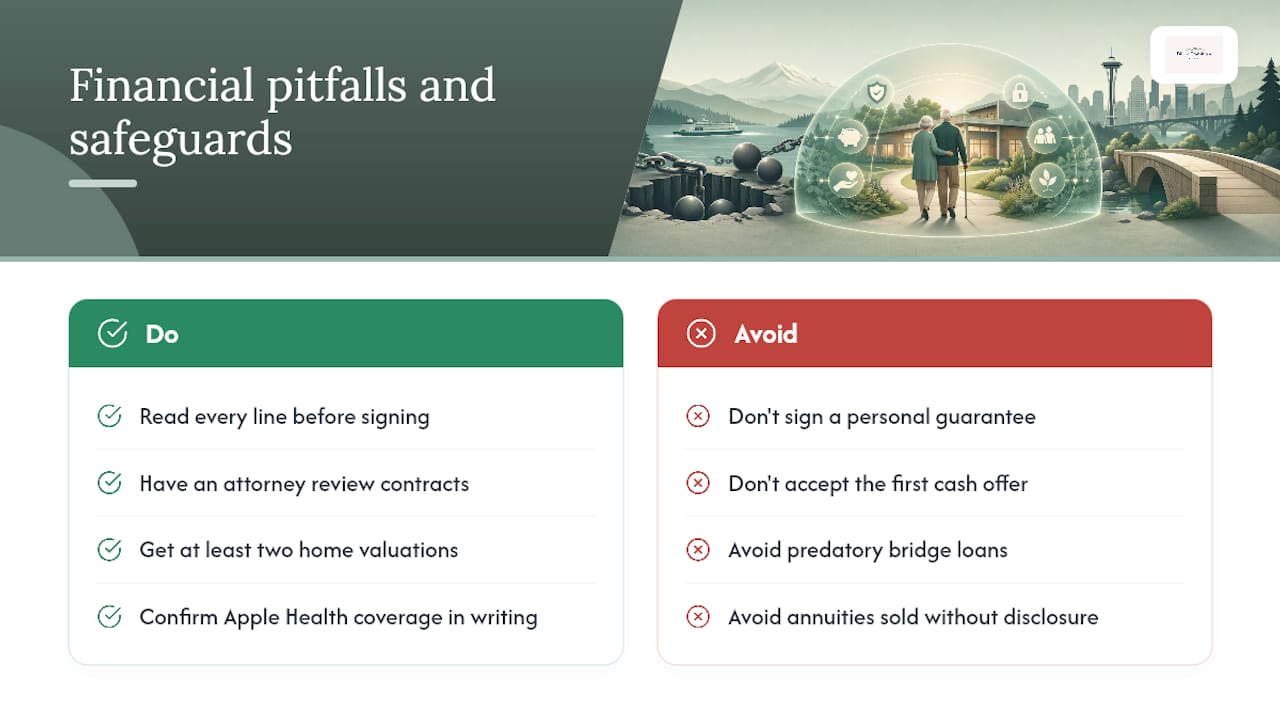
Signing a personal guarantee on a facility contract. Some facilities ask adult children to sign as a personal guarantor for a parent's monthly fees. This is legal in Washington only under specific conditions. Read every line of the admission agreement before signing, and have an attorney review it if you are unsure.
Rushing into a home sale without comparing options. An as-is sale can be the right choice, but accepting the first cash offer without understanding the home's market value can cost tens of thousands of dollars. Get at least two valuations before committing.
Predatory bridge loans. As noted earlier, unsolicited bridge loan offers with high origination fees, short repayment windows, or upfront wire transfer requirements are red flags. Legitimate lenders do not pressure families in crisis.
Annuity products sold without full disclosure. Some financial products marketed to seniors as "Medicaid planning tools" are unsuitable, expensive, or structured in ways that create Medicaid ineligibility rather than preventing it. Work only with a fee-only financial advisor or an elder law attorney for Medicaid-related financial planning.
Misrepresentation of what Medicaid covers. Some facilities imply they accept Medicaid when they accept only specific waivers, or only for residents who have already been private-pay for a set period. Confirm in writing exactly which Apple Health programs the facility accepts and under what conditions.
Companion and community services can also play a role in a senior's wellbeing during a transition. Resources like From Love With Care offer nonmedical support services that complement formal care arrangements.
What families get wrong about paying for assisted living
The families who struggle most are not the ones with the fewest resources. They are the ones who wait. Waiting to list the home until after the move, waiting to call the VA until the facility asks for payment, waiting to review the long-term care policy until the elimination period has already started burning through private funds. By the time the paperwork catches up, months of out-of-pocket costs have already accumulated.
The second mistake is treating the home sale as a separate project from the care move. In reality, the timing of those two events determines everything: whether a bridge loan is needed, whether a Medicaid spend-down creates a problem, whether the family is scrambling or calm. A home that has not been maintained for years, or that is full of a lifetime of belongings, does not sell on a standard MLS timeline. Families who discover this after the move-in deposit is due are in a genuinely difficult position.
The third mistake is assuming that the monthly rate on the facility's website is the real number. It rarely is. The real number emerges after the Level of Care assessment, after the first rate-increase letter, after the first month of extra charges for supplies and transportation. Getting the itemized fee schedule and asking about rate-increase history before signing is not paranoia. It is the only way to build a budget that holds.
Divinetransitionsforseniors: one point of contact for the whole transition
When a family is managing a care move and a home sale at the same time, the coordination gap between those two timelines is where things fall apart. Divinetransitionsforseniors was built specifically for that gap.

The service covers home sale coordination, downsizing and belongings management, and assisted living placement alignment, all under one roof. Many of the homes involved have not been maintained for years, need repairs, or are full of decades of possessions that make a traditional MLS listing impractical. Divinetransitionsforseniors works with trusted local real estate professionals and senior placement specialists to create the fastest appropriate path to funding care, whether that means an as-is sale, a coordinated listing, or connecting the family with bridge financing options.
Families pay nothing directly for placement coordination. The service operates on referral arrangements with real estate and placement partners, so the support costs the family nothing out of pocket. If you are trying to figure out how to align a home sale with a move-in date, or simply need one trusted person to help you see the full picture, reach out to Divinetransitionsforseniors to start the conversation.
Useful sources
- Does Medicare pay for assisted living? | NCOA
- Paying for long-term care | NIA
- PACE | Medicare.gov
- HECM (reverse mortgage) | HUD
- Assisted Living Facilities in Washington | WhereYouLiveMatters
Save any facility quotes, policy pages, and program correspondence as PDFs. When Divinetransitionsforseniors coordinates a home sale alongside a care move, key documents are tracked as part of the transition process, reducing the risk of lost paperwork at a critical moment.
FAQ
What is the average monthly cost of assisted living in Washington State?
Washington's statewide average is approximately $5,500 per month, with Seattle-area facilities often ranging higher and Eastern Washington markets starting lower depending on city and facility type.
Does Washington State pay for assisted living?
Washington's Apple Health (Medicaid) can cover personal care services within an assisted living setting through HCBS waivers, but it generally does not pay room and board. Not all facilities accept Apple Health, and waiver programs may have waitlists.
How do low-income families pay for assisted living?
Low-income families typically combine Social Security income with Apple Health HCBS waivers, VA benefits (if applicable), and family contributions. When savings are limited, home equity through an as-is sale or bridge loan is often the most accessible larger funding source.
What happens if an elderly person can't afford a nursing home or assisted living?
Washington DSHS can conduct a needs assessment and connect families with HCBS waiver programs, PACE (where available), or adult family homes, which are typically less expensive than larger assisted living communities. An Area Agency on Aging can help identify all available options at no cost.
Can a bridge loan cover assisted living costs while the house sells?
Yes. A bridge loan secured by the home's equity can fund move-in costs and monthly fees in one to two weeks, with repayment tied to the home sale proceeds. Interest rates are higher than conventional loans, so it works best as a short-term gap solution rather than a long-term strategy.