

Yes — if the power of attorney is durable and explicitly grants real property powers, an agent can use a POA to sell a house while the principal is still alive. The moment the principal dies, that authority ends completely, and the property must go through probate instead.
If your parent just moved into memory care and you need to sell their home fast, here are the three steps to take right now:
- Verify the POA type and language. Confirm it says "durable" and specifically authorizes selling, conveying, and signing deeds for real property. A general financial POA often lacks the explicit real estate powers title companies require.
- Contact the county recorder and a title company. Ask the title company to pre-clear the document before you list. Oregon's county recorder offices can tell you whether the POA needs to be recorded in the county land records where the property sits.
- Notify the lender if there is a mortgage. Lenders often require explicit POA approval or a transaction-specific form before they will process a payoff. Contact them early.
Table of Contents
- When does a POA legally allow an agent to sell property?
- Is this POA actually ready to close a sale?
- Why do title companies and lenders block POA sales?
- How to document that the sale protects the principal's interests
- What does the timeline and cost actually look like?
- What if there is no valid POA or it won't be accepted?
- How Divinetransitionsforseniors helps families sell quickly and safely
- Key Takeaways
- What families often get wrong about POA and real estate
- When you are ready to move forward, here is the first step
- FAQ
When does a POA legally allow an agent to sell property?
Not every power of attorney document qualifies for a real estate closing. The legal threshold is specific, and missing even one element can stall or kill a sale.
The POA must be durable. A standard POA becomes void if the principal loses mental capacity. A durable POA survives incapacity, which is exactly the situation most families face when a parent moves into memory care. Without the word "durable" (or equivalent statutory language under Oregon law), the document may be worthless at the moment you need it most.
The document must explicitly grant real property powers. This is the most common gap families discover too late. A general financial POA is often insufficient for a real estate closing. The document needs to specifically authorize the agent to:
- Sell and convey real property
- Sign deeds and closing documents
- Accept sale proceeds on the principal's behalf
- Satisfy or pay off a mortgage or encumbrance
Execution requirements matter. The POA must be signed by the principal while they have legal capacity, notarized, and in many cases recorded with the county recorder's office where the property is located. Oregon follows this general practice, and state-level guidance consistently recommends notarized, recordable forms that explicitly authorize listing, contract signing, deed acknowledgment, and closing tasks.
POA authority ends at death. Under established statutory authority, a power of attorney terminates the instant the principal dies. If your parent passes away before the closing date, the sale cannot proceed under POA. The property transfers to the estate, and a personal representative or probate court must authorize the sale instead.
Is this POA actually ready to close a sale?
Run through this checklist before you list the property or sign any contracts.
- Does the document use the word "durable" or include statutory language that survives incapacity?
- Does it explicitly name real property powers: sell, convey, sign deeds, accept proceeds?
- Was it signed by the principal while they had legal capacity?
- Is it properly notarized with a valid notary seal and signature?
- Has it been (or does it need to be) recorded with the county recorder where the property sits?
- Do you have the original or a certified copy? Many title companies will not accept a photocopy.
- Is the principal still alive? Confirm this before any agent signs anything on their behalf.
If the principal still has capacity, involving them directly is usually faster and safer than relying on POA at all. A direct signature from the principal eliminates most title company objections immediately.
Pro Tip: Before you list the property, email the POA document to the title company and ask them to review it in writing. Getting a "pre-clearance" letter from title takes one to two weeks but prevents a closing-day rejection that could cost you the buyer entirely.
Why do title companies and lenders block POA sales?
Title companies are the practical gatekeepers of any real estate closing, and they are conservative by design. Even a legally valid POA can be rejected by a title insurer if it does not meet their internal standards. Common reasons for rejection:
- The POA is old (many title companies treat documents older than a decade as suspect and may require a freshly executed version)
- Missing explicit real estate language
- Not recorded in the county land records
- Incorrect signature format on the deed or closing documents
- Concerns that the principal may have died or revoked the POA after signing
Local escrow and title practice typically requires the original notarized POA, explicit real estate authority, possible recording before closing, and the agent's representative-style signature on all documents.
Lenders add another layer. When a mortgage payoff is involved, many lenders require explicit written approval of the POA or a transaction-specific form before they will release the lien. Some will not accept a broad durable POA at all and will insist on a limited POA drafted specifically for that closing.
How to clear these hurdles before they become problems:
- Send the POA to the title company before listing. Ask for written confirmation of what they need at closing.
- Call the lender's loss mitigation or payoff department. Ask specifically whether they require a transaction-limited POA or their own approval form.
- Record the POA with the county recorder if title or the lender requests it. Recording fees in Oregon are modest.
- Confirm the agent's signature format in advance (see the next section).
Pro Tip: Get written confirmation from both the title company and the lender that the POA is acceptable. A phone call is not enough. An email or letter protects you if a new closer reviews the file on the day of signing.
How to document that the sale protects the principal's interests
The agent under a POA has a fiduciary duty to act in the principal's best interest at all times.
unless the POA document explicitly permits it. Selling the property to yourself, a family member at below-market value, or gifting the home are all potential breaches that can create personal liability or criminal exposure.Documenting why the sale is necessary protects the agent from later challenges by other family members or a court. The record should show that the proceeds are needed to fund the principal's care, not to benefit the agent personally.
Specific documents that create a defensible record:
- Written placement recommendation from a physician or senior care specialist
- Cost estimates or admission agreements from the assisted living or memory care facility
- A copy of the POA with the real estate authority section highlighted
- Written notes from any family meeting where the decision was discussed
- Correspondence with the lender, title company, and real estate agent
Signature format at closing. The agent must sign every closing document as: [Agent Name], as attorney-in-fact for [Principal Name]. Signing only the agent's own name is a common mistake that title companies and escrow officers will reject, sometimes on the day of closing. Confirm this format with the title company in advance.

What does the timeline and cost actually look like?
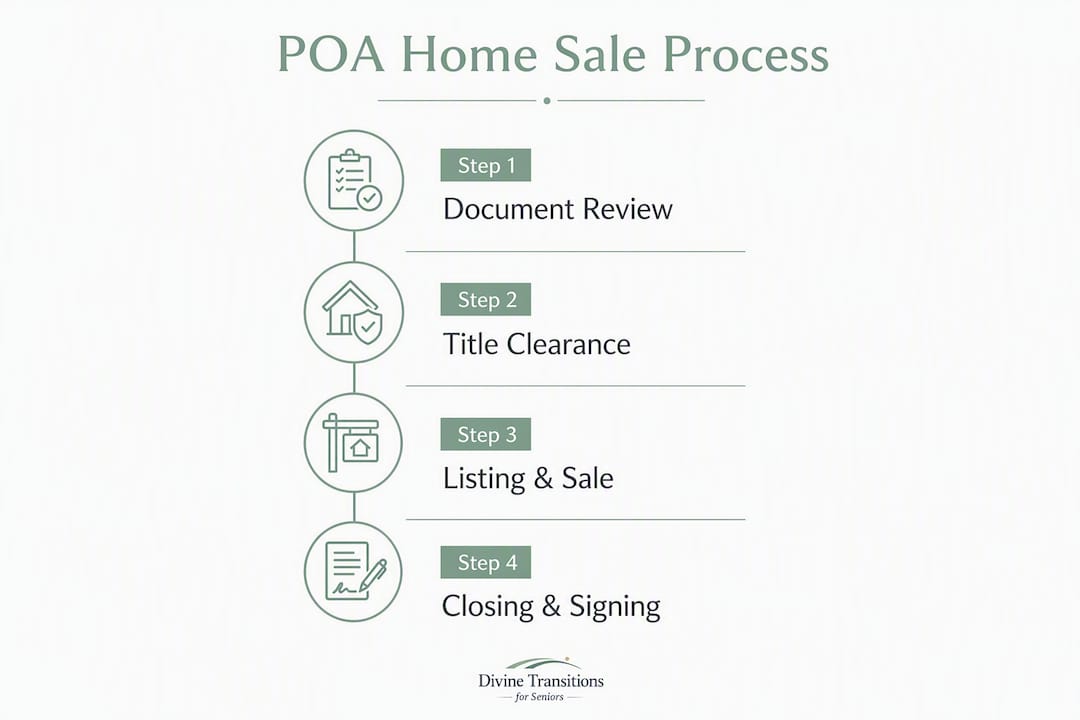
Here is a realistic picture of the POA house sale process from start to close:
- Pre-clear with title and lender (1–2 weeks). Send the POA, get written approval, record if required.
- List, show, and negotiate (2–8 weeks). Oregon market conditions vary by county. A well-priced, as-is home in a seller's market can move in days; a home needing repairs in a slower market can take months.
- Underwriting and closing (2–6 weeks). Buyer financing adds time. Cash buyers close faster.
- Recording delays. If the POA must be recorded before closing and was not done in advance, add several business days.
Typical costs to budget:
- Notary fees: modest in Oregon
- County recording fees vary by county and are generally modest per page
- Attorney fees for court orders, conservatorship, or custom limited POAs depend on complexity and can vary widely
- Title and escrow fees: standard closing costs apply regardless of POA involvement
| Route | Speed | Net Proceeds | Complexity |
|---|---|---|---|
| As-is cash sale / quick sale | 2–4 weeks total | Lower | Low; fewer POA objections |
| Traditional MLS listing | 6–8 weeks total | Higher | Higher; full title/lender review |
| Court conservatorship (no valid POA) | 3–6+ months | Varies | Very high; attorney required |
For families funding assisted living in Oregon, the speed difference between an as-is cash sale and a traditional listing can mean months of out-of-pocket care costs. Understanding Medicare's limited role in assisted living coverage makes the urgency of a fast sale even clearer for most families.
What if there is no valid POA or it won't be accepted?
This is more common than families expect, and there are still lawful options.
- Transaction-specific limited POA. If the principal still has capacity, an attorney can draft a limited POA for a single closing. It expires after the transaction, which title companies often prefer over a broad durable POA.
- Emergency or same-day POA. If the principal has capacity but cannot travel, a notary can come to the care facility. This is often the fastest fix.
- Court conservatorship or guardianship. If the principal lacks capacity and no valid POA exists, a family member must petition the court for authority to sell. In Oregon, this process typically takes several months and requires an attorney.
- Sell after death through probate. If the principal passes before a valid POA is in place, the property transfers to the estate. A personal representative appointed by the probate court can then authorize the sale.
- Bridge funding while resolving POA issues. A HECM or HELOC may provide short-term funds to pay for care while the legal authority to sell is being established.
Pro Tip: If the principal has any capacity at all, even limited, consult an elder law attorney immediately. A properly executed limited POA or direct signature from the principal today can save months of court proceedings later.
How Divinetransitionsforseniors helps families sell quickly and safely
When a parent needs care now and the home has to sell to pay for it, the legal and logistical pieces rarely line up on their own. Divinetransitionsforseniors coordinates the entire process for Oregon and Washington families at no direct charge.
- As-is home sales. Many homes in senior transitions have not been maintained for years or are full of decades of belongings. Divinetransitionsforseniors connects families with buyers who purchase as-is, skipping repairs and staging entirely.
- POA and title coordination. The team works alongside real estate agents and title companies to help families understand what the title company needs and when to record the POA.
- Placement timing alignment. The home sale timeline is coordinated with the assisted living or memory care move-in date so families are not paying for two places at once.
- Downsizing and belongings support. Sorting decades of possessions while managing a care crisis is genuinely hard. Divinetransitionsforseniors coordinates that process too.
- Trusted local connections. The team connects families with senior placement specialists, real estate agents, and elder law attorneys in Oregon.
Contact Divinetransitionsforseniors when you have title company pushback, need a fast as-is sale, or simply do not know where to start.
Key Takeaways
A durable POA with explicit real estate powers can authorize a home sale, but it must be pre-cleared with the title company and lender before listing to avoid closing delays.
| Point | Details |
|---|---|
| POA must be durable and specific | The document must survive incapacity and explicitly authorize selling, conveying, and signing deeds for real property. |
| POA ends at the principal's death | If the principal dies before closing, authority terminates and probate is required to sell. |
| Pre-clear with title and lender early | Send the POA before listing; get written confirmation from both parties to prevent closing-day rejections. |
| Document the principal's best interest | Gather placement recommendations and care cost estimates to protect the agent from self-dealing challenges. |
| Divinetransitionsforseniors coordinates the full process | Oregon families can get as-is sale coordination, POA/title guidance, and placement alignment at no direct charge. |
What families often get wrong about POA and real estate
The assumption that trips up most families is this: they believe that having any power of attorney document means they can sell the house. They find the POA their parent signed years ago, hand it to a real estate agent, and assume the closing will proceed normally. It usually does not.
A general financial POA, signed a decade ago, with no specific real estate language, is almost certain to be rejected by a title company. The title insurer is not being difficult. They are protecting themselves from a future claim that the agent lacked authority, the principal had already revoked the document, or the sale was not in the principal's interest. Their caution is legitimate.
The families who move fastest are the ones who treat the POA review as step one, not an afterthought. They send the document to the title company before the home is even listed. They call the lender the same week. They get a real estate attorney to review the language if anything looks unclear. That preparation, done in the first two weeks, is what separates a smooth 30-day closing from a three-month stall.
If you are in Oregon and facing an urgent placement decision, the timeline from listing to funded care is shorter than most families expect when the legal groundwork is done right.
When you are ready to move forward, here is the first step
Divinetransitionsforseniors is the resource Oregon families call when they need to sell a parent's home fast, without the delays of a traditional listing, and without managing every piece of the process alone. Many of the homes families bring to the team have not been touched in years, are full of belongings, or need repairs no one has time to manage. That is exactly the situation the service is built for.

The first call is a straightforward conversation: what is the situation, what does the POA say, and what needs to happen in what order. Families pay nothing directly for coordination and referral services. The team works with trusted Oregon real estate agents, title companies, and senior placement specialists to move the process forward as quickly as the legal requirements allow.
Reach out to Divinetransitionsforseniors today to get a clear picture of your next steps.
FAQ
Can a power of attorney sell a house without the owner present?
Yes, provided the POA is durable, explicitly grants real property powers, and the principal is still alive. The agent signs all closing documents as attorney-in-fact for the principal.
What happens to the POA if my parent dies before closing?
POA authority ends immediately at death. The sale cannot proceed under POA, and the property must be handled through probate or by a court-appointed personal representative.
Why would a title company reject a valid POA?
Title companies commonly reject POAs that are old, lack explicit real estate language, are not recorded, or use an incorrect agent signature format. Pre-clearing the document with the title company before listing prevents most rejections.
What if my parent no longer has capacity and there is no POA?
A family member must petition an Oregon court for conservatorship or guardianship to gain authority to sell. This process typically takes several months. A bridge funding option may help cover care costs in the meantime.
How does Divinetransitionsforseniors help with a POA home sale?
Divinetransitionsforseniors coordinates as-is home sales, works with title companies and placement specialists, and aligns the sale timeline with the care move-in date, all at no direct charge to Oregon families.